
Wills Do Not Always Guarantee Dispute-Free Inheritance: This is the Mechanism of Inheritance in Indonesia
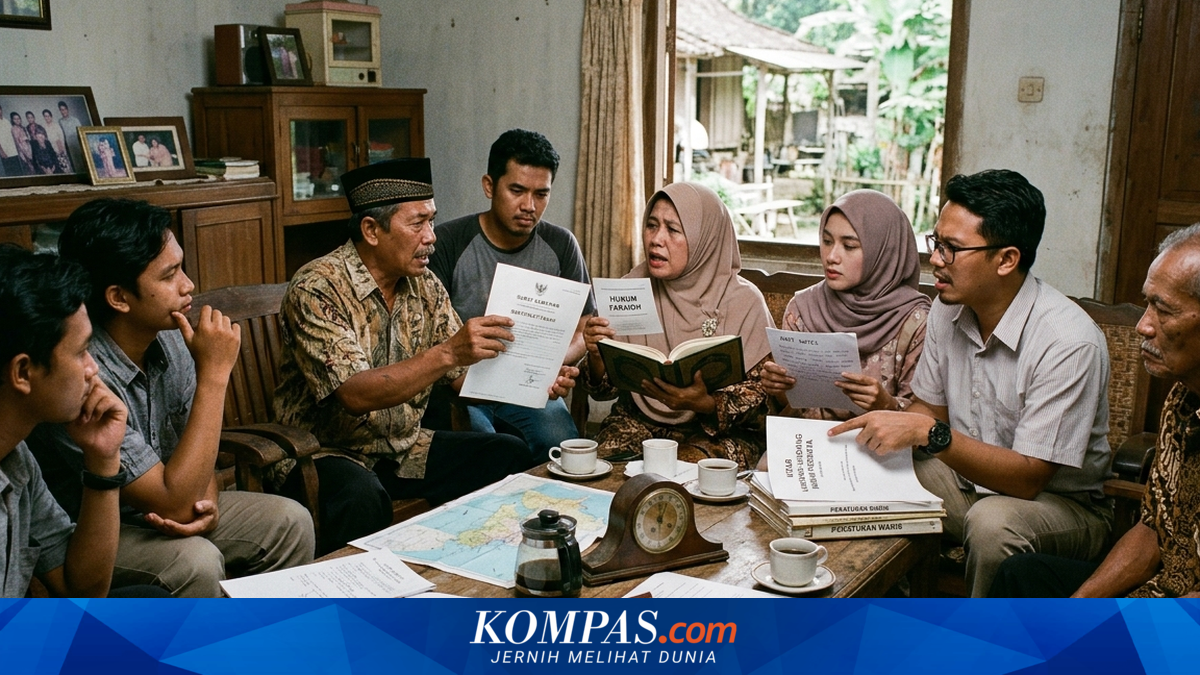
JAKARTA, KOMPAS.com - The preparation of a will is often considered a solution to prevent conflicts among heirs. However, in practice, the existence of a will does not necessarily guarantee that disputes can be avoided.
Legal practitioner Yosi Mulyadi emphasises that inheritance issues are fundamentally not about agreements among heirs, but are strictly regulated by applicable legal norms.
According to Yosi, many people mistakenly believe that inheritance distribution can be negotiated like a contract.
“A will agreement is essentially a consensus, so whether it avoids disputes depends on the people involved (human nature),” said Yosi in an interview with Kompas.com some time ago.
“But in principle, distribution must be carried out fairly (legitimate portion) as stipulated by the law. In principle, heirs ‘receive’ as the law determines,” he stated.
“So, inheritance distribution is not an ‘agreement’ among heirs, but a legal determination or norm that must be accepted by the heirs,” he added.
Furthermore, Yosi explained that in principle, heirs have no room to “disagree” with the inheritance distribution.
“In principle, heirs cannot ‘disagree’ because inheritance is not an agreement, but a norm or law that has already been regulated. Heirs simply have to accept it,” he said.
In this context, the state does not act as a party that directly determines the inheritance distribution, but only provides the legal framework that must be followed.
“The state does not decide the portions. Inheritance distribution is regulated in civil law for non-Muslims,” he clarified.
Meanwhile, for Muslims, inheritance distribution refers to religious provisions that have been codified in the national legal system.
“For Muslims, inheritance is regulated in the Quran, which is then translated through the Compilation of Islamic Law (KHI),” said Yosi.
“Islamic law is binding for Muslims. Heirs cannot arbitrarily determine inheritance law,” he stressed.
According to him, the position of heirs is fundamentally passive, namely receiving their portion according to the provisions, not determining or dividing it themselves.
“In principle, the rights of heirs are only to receive, not to divide and determine,” he said.
Nevertheless, Yosi stated that there remains the possibility of inheritance distribution based on agreement. However, this can only be done if all heirs share the same view.
“Inheritance can be divided and determined by the heirs themselves with one condition: that they all agree,” he concluded.
On the other hand, managing inheritance in Indonesia is often considered complicated and exhausting. Many families delay it because they feel the process is lengthy, expensive, or fear it will trigger conflicts among relatives.
Results from a Kompas.com survey of 979 readers from late 2025 to early 2026 show that inheritance issues are not a marginal concern.
As many as 73 percent of respondents have been involved in inheritance distribution in their immediate family. The majority describe inheritance disputes as a serious problem in Indonesia.
As many as 71 percent of respondents consider inheritance disputes, both from a legal and family conflict perspective, to be a major issue.
This figure comes not only from those who have been involved, but also from those who have not experienced it. Even the 18–24 age group is the most sensitive to this issue.
The survey also shows that the culture of taboo remains very strong.
In the family environment, 62 percent of respondents consider discussing inheritance before parents pass away as taboo. However, when asked privately, that figure drops to 51 percent.
This indicates that many people actually feel that inheritance discussions are necessary, but fear being seen as impolite, greedy, or sparking quarrels.