
Will the JCI and Rupiah Be Jolted by Prabowo's State Address and Fiscal Note?
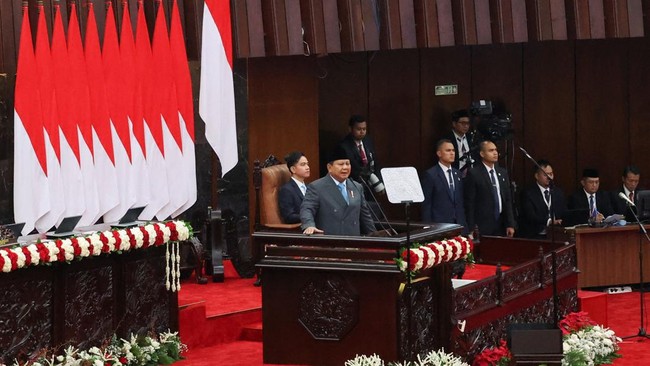
Indonesia’s financial markets are expected to be highly dependent on the policy direction to be delivered at the annual MPR session and the financial note at the DPR RI building today.
The JCI’s reversal yesterday was also felt by the majority of stocks. In the morning, the number of stocks in the green zone was still higher than those that were corrected.
At the end of trading, 186 stocks had strengthened, 474 stocks had weakened, and 303 other stocks were stagnant. Market capitalisation was recorded at Rp11,050 trillion.
As a result, when data is drawn on a year-to-date basis, the stock exchange experienced a net foreign outflow of Rp71.84 trillion in the all market and Rp96.56 trillion in the regular market.
From the American stock market, Wall Street closed higher in trading on Thursday, or early Friday morning Indonesian time.
The S&P 500 index set a new intraday record high on Thursday, as oil prices fell and investors digested the latest inflation data.
The S&P index rose 0.65% and for the first time broke through the 7,800 level. The S&P 500 also recorded a record close at 7,798.99.
Meanwhile, the Nasdaq Composite strengthened 0.81% to 26,803.03, driven by gains in Meta Platforms, Micron Technology, and Netflix shares. The Dow Jones Industrial Average rose slightly by 0.13%, or 69.72 points, to 53,839.99.
Oil prices fell more than 2%
Brent crude oil futures fell more than 2% and closed at US$87.07 per barrel. Meanwhile, West Texas Intermediate (WTI) oil also slumped more than 2% to US$81.25 per barrel.
The decline in oil prices occurred as investors weighed weakening oil demand, amid the ongoing US-Iran war.
US inflation is more benign
The US Producer Price Index (PPI) for July was unchanged, or 0% month-on-month.
This figure was lower than the expectations of economists surveyed by Dow Jones, who had forecast a 0.2% rise in the PPI.
Excluding volatile food and energy prices, core PPI rose 0.2%, slightly below economists’ expectations of 0.3%.
The lower-than-expected PPI data came a day after the release of the Consumer Price Index (CPI).
The US CPI in July rose 0.1% month-on-month, in line with market expectations. The relatively benign inflation data helped push the S&P 500 higher after it had fallen for two consecutive sessions.
The data also led investors to reduce expectations of a Fed rate hike in September.
“The current inflation picture is not enough to derail a market that is fundamentally still driven by corporate earnings performance,” said Bill Merz, head of capital markets research at U.S. Bank Asset Management, as quoted from CNBC International.
According to him, the market is still waiting to see how the Fed under new Chairman Kevin Warsh will interpret the inflation data and determine its next policy.
However, he assessed that the gradual moderation in the current CPI and PPI figures is a positive development for the market.
Cisco shares were under pressure. Cisco Systems shares were one of the main drags on the market on Thursday. The company’s shares plunged more than 8% after its latest quarterly financial report failed to meet investor expectations.
Cerebras shares also slumped nearly 12%, while Coherent fell about 8% after both released their latest performance reports.
Today is an important day for Indonesia’s financial markets due to a crucial event, namely the State Address and the delivery of the Financial Note at the Annual Session of the MPR RI at the DPR RI Building, which will begin at 08.30 WIB.
The Joint Session of the DPR, MPR, and DPD RI is important because President Prabowo Subianto will deliver the State Address as well as outline the government’s fiscal policy direction for the 2027 fiscal year.
Unlike previous years, which were held on 16 August, this year’s Joint Session was brought forward by two days because 16 August 2026 falls on a Sunday.
Prabowo is scheduled to deliver the State Address in the morning. In the afternoon, the President will deliver the Government’s Introductory Statement on the Draft Law on the 2027 State Budget as well as the Financial Note.
The two speeches will be an important signal for the market.
Through the State Address, Prabowo will convey the achievements of 2026 and the government’s priorities going forward. The public is waiting to see which priority programmes will form the backbone of 2027.
Priority programmes such as the Free Nutritious Meals (MBG) are also among those eagerly awaited. This is because the programme not only concerns state spending, but also relates to people’s purchasing power, absorption of domestic products, and economic activity in the regions.
However, the biggest attention of market participants will be focused on the 2027 Draft State Budget.
Through the Financial Note, the government will show how much the state will spend, where revenue will be obtained, and how the government will finance its various priority programmes.
A number of macro indicators will also be in the spotlight, ranging from economic growth targets, inflation, the rupiah exchange rate, oil and gas lifting, to the assumption of the Indonesian Crude Oil Price (ICP).
These figures are not merely targets on paper. For investors, these figures provide a picture of the government’s fiscal policy direction. For the business world, these figures provide clues about demand prospects, investment, business costs, and business opportunities in 2027.
Previously, in the 23rd Plenary Meeting of the DPR RI for the Fifth Session Period of the 2025-2026 Session Year, the DPR stated in the meeting to discuss the 2027 Macroeconomic Framework and Fiscal Policy Principles (KEM-PPKF) that the DPR Budget Committee (Banggar) and the government had agreed on the 2027 Draft State Budget, in which they are targeting economic growth in 2027 to reach around 5.8% to 6.5%.
“With the development targets and indicators for 2027, it has been agreed that the development target for economic growth in 2027 will reach 5.8% to 6.5%,” said Wihadi in the Plenary Meeting, as quoted on Friday (3/7/2026).
After this agreement, the government will use the range of the initial draft of the 2027 State Budget as material for setting the initial proposed figures for the Draft Law on the State Budget along with its Financial Note on 16 August 2026.
The 2027 State Budget Bill will later be discussed in more detail with Commission XI of the DPR before finally being enacted as a law at the end of October 2026.
In the initial agreement, the government and the DPR’s Banggar agreed on a number of initial references in the preparation of the 2027 State Budget, ranging from macroeconomic assumptions, development targets, to the macro fiscal posture.
The State Address and Financial Note are also an important test for the Indonesian stock market. Investors want to see whether the government’s fiscal direction is able to improve confidence and attract back foreign funds after large net selling throughout 2026.
Yesterday, MSCI announced the August 2026 Index Review. However, the review was not a re-determination of Indonesia’s treatment because the policy had been set since 6 July. The more decisive evaluation will only be directed towards November 2026.
In trading yesterday, the JCI closed down 1.13% at 6,301.77 after touching 6,390.33. In line with the index correction, foreigners recorded a net sell of Rp1.41 trillion in the entire market and Rp1.39 trillion in the regular market, after recording a net buy of Rp725.4 billion on the previous Wednesday.
In the three trading days after 10 August, foreign outflow reached around Rp1.37 trillion. The reversal erased the initial signal from the net buying of the previous two days, while foreign net selling throughout 2026 reached Rp71.84 trillion in the entire market.
Foreign Outflow Remains a Burden
Of the 144 trading days up to 13 August, foreigners only recorded a net buy on 50 days and a net sell on 94 days. This means that almost two out of every three trading days this year were marked by foreign net selling.
July proved that the JCI can rise without broad-based foreign buying. The index jumped 10.51%, even though foreigners recorded a net sell on 16 of 23 trading days.
However, the foreign surplus in July was highly dependent on a net buy of Rp8.97 trillion on 29 July. Without that large transaction, July would actually still have recorded a net sell of around Rp7.35 trillion.
This means that domestic liquidity can produce a short-term rally. But to form a longer and more broad-based trend, the JCI still needs consistent foreign inflow.
August MSCI Is Final, November Becomes a Big Test
MSCI officially announced the August 2026 Index Review on 12 August local time, or 13 August early morning Indonesian time, which will be implemented on 1 September. As a result, no Indonesian stocks were added to the MSCI Global Standard Indexes.
MSCI has determined that the increase in the Foreign Inclusion Factor and Number of Shares for Indonesian stocks remains frozen. There were no additions of Indonesian stocks to the Investable Market Indexes nor any upward movement from Small Cap to Standard Index.
The August risk has been seen technically, namely GOTO being removed from the MSCI Indonesia Investable Market Index, CPIN being downgraded from Global Standard to Global Small Cap, and nine stocks being removed from the MSCI Global Small Cap Indexes. These changes will take effect after the close of trading on 31 August, or effective on 1 September.
The more decisive test lies in November. MSCI will assess whether ownership transparency reforms, supervision of shareholder concentration, and free float improvements have been implemented consistently.
If Indonesia’s progress is deemed insufficient, MSCI may consider further steps, including opening consultations on the possibility of changing Indonesia’s status from Emerging Market to Frontier Market. However, Indonesia will not automatically be downgraded in November.
Thus, the Financial Note is an opportunity for the government to strengthen investor confidence during the three months leading up to that evaluation.
Domestic Investors Hold the Market, Foreigners Needed for a Rally
The Indonesian stock market is not entirely supported by retail investors. Trading and ownership data show the significant role of domestic institutions.
Domestic investors are able to hold back declines and trigger rebounds. However, foreign inflow is still needed because foreign ownership in large-capitalisation stocks is still significant and highly determines the direction of the JCI.
Issuer fundamentals are actually quite supportive. Of the 763 companies in the first-half data, around 65.4% recorded revenue growth and 60% recorded profit improvement or turned a profit. The market’s obstacle is not solely company performance, but the lack of sufficiently large fund flows to carry out repricing.
JCI Flew to 8,000 During the 2025 State Address, What About This Year?
The 2025 experience shows that the Financial Note speech can generate optimism, but does not guarantee a sustained increase. On 15 August 2025, exactly when Prabowo was about to deliver the State Address, the JCI briefly touched 8,017 intraday, but ultimately closed down 0.41% at 7,898.38.
From the position of 6,301.77, the JCI needs an increase of around 2.4% to reach 6,450 today. That level is most likely to be achieved if the technical pressure after the MSCI review subsides, the rupiah remains stable, and the Financial Note shows a highly credible programme, a controlled deficit, and measured debt financing.
However, the main key remains foreign inflow. A net buy of Rp1.56 trillion during 1-12 August was a solid start, but a net sell of Rp1.41 trillion in the entire market on 13 August shows that the flow is not yet consistent.
The JCI needs large and strong foreign inflow today in order to close above 6,450 and form a very positive weekly candle.
A weekly close above that level is important to strengthen the upward momentum and open up opportunities for a continued rally in the JCI, given the sweet memory of the same moment last year when the JCI briefly touched the 8,000 level for the first time in history.
Indonesia’s financial markets on Friday (14/8/2026) will digest the decline in United States producer inflation, the rise in unemployment claims, and the results of the MSCI index review for Indonesian stocks.
The next attention will be focused on US retail sales and Eurozone GDP data.
Japanese Producer Inflation Eases
Japanese producer inflation for the July period, announced on Thursday, grew 7.2% year-on-year, slowing from 7.3% in June and lower than the consensus of 7.4%.
On a monthly basis, the Producer Price Index (PPI) rose only 0.1%, far below the forecast of 0.6% and slowing from the 0.5% increase in the previous month.
The data shows that the cost pressure received by Japanese companies is beginning to ease. This condition could reduce the risk of more aggressive price increases at the consumer level while slightly reducing pressure on the Bank of Japan to immediately tighten monetary policy.
However, annual growth of 7.2% is still relatively high. This means that companies still face pressure from raw material and import costs, especially if the yen weakens again. For the market, the lower-than-expected result tends to hold back the rise in Japanese bond yields and limit the strengthening of the yen.
US Producer Inflation Lower Than Expected
The US PPI for the July period, announced yesterday, showed no month-on-month growth, or 0%, lower than the consensus of a 0.2% increase. The June figure was revised to a contraction of 0.1%.
On an annual basis, producer inflation slowed sharply to 4.7% from 5.5% and was lower than the forecast of 4.9%. Core PPI also fell to 4.2% year-on-year from 4.7%, in line with market expectations. On a monthly basis, core PPI rose 0.2%, slightly below the forecast of 0.3%.
Producer goods prices fell 0.7%, including a 3.1% decline in energy prices. Meanwhile, services prices still increased by 0.2%. This data shows that price pressure from the producer level is beginning to ease, although core inflation is still at a high level.
These results tend to be positive for risky assets because they can reduce concerns that cost pressures will be passed on to consumers again.
US Unemployment Claims Rise
At the same time, initial claims for US unemployment benefits rose to 209,000 in the week ending 8 August. This figure was higher than the consensus of 202,000 and the previous week’s realisation, which was revised to 200,000.
The increase in initial claims shows an increase in the number of workers losing their jobs. However, continuing claims actually fell to 1.777 million from 1.799 million and were lower than the forecast of 1.8 million.
The combination of the two data points provides a relatively balanced picture. Layoffs are starting to increase, but the number of continuing benefit recipients is decreasing, so it does not yet show a serious weakening in the labour market.
For the market, the rise in initial claims along with the easing PPI could strengthen hopes that the Federal Reserve does not need to maintain a policy that is too tight. This condition has the potential to pressure the dollar and US bond yields while providing room for the rupiah and emerging market assets to strengthen.
US Retail Sales Become the Next Determinant
The most important agenda on Friday is US retail sales for the July period, which will be announced at 19.30 WIB. Sales growth is expected to slow to 0.1% month-on-month from 0.2% in June.
However, sales excluding vehicles are expected to turn around and grow 0.2% after falling 0.2%. Meanwhile, the retail sales control group, which is one of the components in calculating consumption in gross domestic product, is projected to rise 0.3% after growing 0.5%.
Data that is too strong could push bond yields and the US dollar back up because it shows consumption is still resilient to high interest rates. Conversely, a moderate realisation could be a more positive scenario for the JCI: producer inflation eases without being accompanied by a weakening of consumption.