
Will the End of War Immediately Lower Fuel Prices? It's Not That Simple
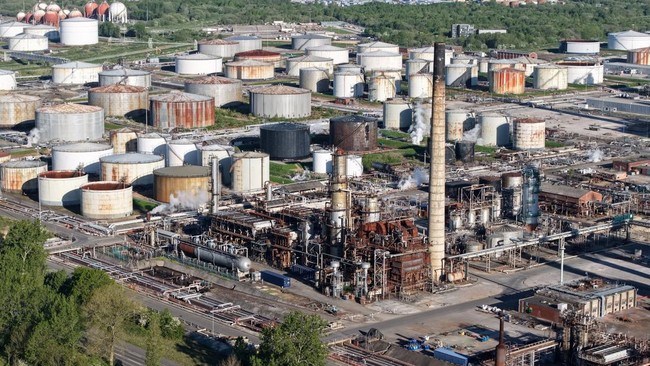
Ukrainian drone strikes on Russia and repeated attacks in the Persian Gulf have triggered destructive disruption to global oil refining capacity. The intensifying military conflict between the United States, Israel, and Iran has left the world fuel market facing severe supply pressure.
Citing CNBC International on Friday (6/8/2026), the refining crisis caused by the war means petrol prices are predicted to remain sharply elevated into the coming autumn. This sky-high price trend is expected to continue unabated even as global crude oil prices begin to show signs of stabilising.
Patrick De Haan, head of petroleum analysis at GasBuddy, said US drivers could face a record petrol price on Labour Day. That record could be broken if Washington and Tehran do not soon reach a definite and stable agreement over the Strait of Hormuz waterway.
“Prices previously set a Labour Day record of US$3.83 (Rp68,645) per gallon in 2012,” Patrick explained.
Motorists are currently paying around US$4.06 (Rp72,767) per gallon for their daily fuel. That figure has fallen from the 2026 high of US$4.56 (Rp81,728), but is still 36% more expensive than before the US and Israel began striking Iran.
Patrick projects that fuel prices should ease slightly in the autumn as demand weakens due to seasonal factors. However, the crisis and shortage of global refining capacity could result in petrol becoming extremely and abnormally expensive for that time of year.
Valero Chief Operating Officer Gary Simmons also highlighted the damage inflicted by the Iran and Ukraine wars on energy infrastructure. He said the deadly armed conflicts had knocked out various refinery facilities with a total capacity of around five million barrels per day.
Phillips 66 Executive Vice President of Marketing Brian Mandell likewise acknowledged the extraordinary tightening of fundamentals in the oil refining sector.
“Refining fundamentals are very tight and getting tighter with the problems in Russia and the Middle East,” Brian said.
ExxonMobil CEO Darren Woods explained that this refining crisis is what keeps fuel expensive even though crude oil prices have actually slumped. He said current refining constraints have created a real disconnect between global crude oil prices and the prices citizens pay at the pump.
“That is one of the reasons we are not seeing product prices fall when crude oil prices fall, because there is this disconnect in the market,” Darren said.
US oil prices were recorded to have slumped around 10% this week to trade in the range of US$76 (Rp1.3 million) per barrel after President Donald Trump raised the possibility of a deal with Iran. Although world oil prices have risen only 14% since the war broke out, retail petrol prices have actually surged 36% above their starting level.
Amid this punishing supply crisis, refining companies are reaping multiplied profits because they are operating at full capacity to meet remaining demand. The profit margin between the cost of crude oil and the selling price of products, often known as the crack spread, is reported to have surged past US$70 (Rp1.2 million).
“If you have a refinery, you are going to run it as hard as you can,” Patrick said.
Valero’s second-quarter revenue was reported to have soared more than 400% to reach US$3.7 billion (Rp66.31 trillion). Meanwhile, net profits at Marathon Petroleum and Phillips 66 each also skyrocketed more than 300% to US$5.1 billion (Rp91.4 trillion) and US$3.8 billion (Rp68.1 trillion) respectively.
Refinery facilities along the US Gulf Coast were reported to have benefited greatly from smooth imports of Venezuelan crude oil and the waiver of shipping rules under the Jones Act. Patrick said that bureaucratic easing essentially allows Gulf Coast refiners to export petrol and diesel anywhere freely.
“The refineries on the Louisiana and Texas coast have the most options, and there is no better place in the world to be a refinery,” Patrick said.
Darren explained that around three million barrels per day of refining capacity in the Middle East is currently unavailable due to the chaos of disruptions in the Hormuz region. The barrage of Ukrainian drone strikes on a number of Russian refineries is also considered to have successfully knocked out around one million barrels per day of additional capacity.
“Ukraine has been very effective in crippling Russian oil refineries,” Patrick stressed.
Marathon Petroleum CEO Maryann Mannen highlighted the severe challenges and slow recovery process for oil refineries across the Middle East region.
“Any further disruption in the region could cause supply constraints to evolve further,” Maryann said.
Darren also noted the fact that China has now stopped exporting, which directly removes several million barrels per day of supply from the global market. Meanwhile, Brian from Phillips 66 estimates that a total of around seven million barrels per day of refinery capacity has been forced offline in Asia and the Middle East.
Brian projects that there will be more idle crude oil than finished product supply if the Strait of Hormuz is ever reopened.
“Those refineries, depending on the damage and the ability to obtain spare parts, will take quite a long time to come back online,” Brian concluded.
Source: jawawa.id (https://jawawa.id/newsitem/will-the-end-of-war-immediately-lower-fuel-prices-its-not-that-simple-1786092680)
Originally published by CNBC Indonesia (https://www.cnbcindonesia.com/news/20260807080528-4-757296/perang-kelar-langsung-bikin-harga-bbm-turun-tak-semudah-itu), translated from Indonesian