
Will Platforms Violating PP TUNAS Face Fines? Meutya Hafid Responds
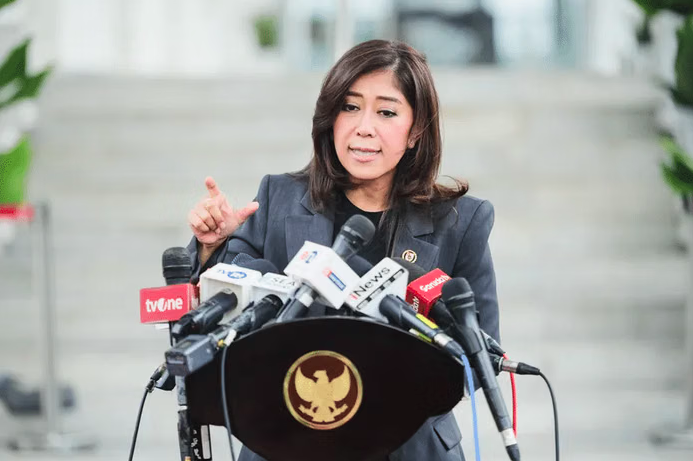
The Ministry of Communication and Digital (Kemkomdigi) has formulated the amount of fines for digital platforms that violate the provisions in Government Regulation Number 17 of 2025 concerning the Governance of Electronic System Implementation in Child Protection, also known as PP TUNAS.
The Minister of Communication and Digital, Meutya Hafid, stated that a sanctions mechanism is necessary to ensure that child protection obligations have clear consequences for platforms that fail to implement the regulations.
“The government has finalised the formulation of fines as part of the compliance enforcement instrument,” Meutya said during a press conference at the Kemkomdigi Office, Jakarta, on Monday (14/9).
She explained that for large-scale or global digital platforms, the established fine could reach 6 per cent of their global revenue. Meanwhile, for domestic private Electronic System Providers (PSE), the maximum fine will be adjusted according to the scale of the business: IDR 1 billion for micro-enterprises, IDR 5 billion for small enterprises, and IDR 10 billion for medium enterprises. “The determination of business scale refers to Government Regulation Number 7 of 2021,” she added.
This fine formulation has undergone a public consultation process and has been officially communicated to Electronic System Providers (PSE), particularly eight high-risk platforms.
The eight platforms identified from the outset as high-risk services are YouTube, TikTok, Facebook, Instagram, Threads, X, Bigo Live, and Roblox.
The fine formulation will subsequently be submitted to the Ministry of Finance to be discussed with relevant ministries and established within the Government Regulation on Non-Tax State Revenue (PNBP).
Meutya emphasised that the government will impose administrative sanctions on digital platforms deemed non-compliant with the rules in PP TUNAS. Digital platforms also face the threat of blocking sanctions if they violate PP TUNAS, ranging from the disconnection of specific features to the complete disconnection of the platform.
“Of course, we do not hope to do this and hope that these platforms make noticeable and significant changes within the framework of fulfilling existing regulations in Indonesia,” said Meutya.