
Will Digital Transactions and QRIS Be Taxed? Airlangga Responds
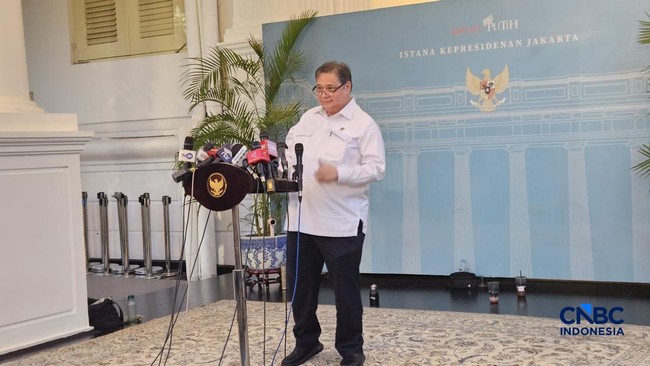
Jakarta, CNBC Indonesia — Co-ordinating Economic Affairs Minister Airlangga Hartarto has responded to plans to introduce a digital tax this month, which were previously announced by Presidential Special Envoy for Energy and the Environment Hashim Djojohadikusumo.
Airlangga said the policy would be discussed with the Finance Ministry.
“We’ll discuss it with the Finance Ministry,” Airlangga said when asked about the proposed digital tax at the Presidential Palace complex on Monday (2 November 2026).
Asked whether the digital tax might affect people’s purchasing power, Airlangga gave no definite answer. He said the government would examine the implementation mechanism further.
“We’ll see, because it relates to payments,” he said.
Airlangga also did not confirm whether payments made using the Quick Response Code Indonesian Standard (QRIS) would be subject to the digital tax.
“We’ll see,” he said.
Finance Minister Suahasil Nazara separately declined to comment when questioned by reporters. “The Coordinating Minister for Economic Affairs will explain the outcome of the meeting,” he said after a limited cabinet meeting at the Presidential Palace complex on Monday (2 November 2026).
Hashim Djojohadikusumo had earlier said that President Prabowo Subianto’s administration was committed to expanding the coverage of tax collection in Indonesia. One measure would be to broaden the digital tax collection scheme.
He made the remarks at the opening of the 2026 Kadin National Leadership Meeting in Jakarta on Thursday (29 October 2026). Hashim said that from 9 November 2026, banks, fintech firms and e-commerce companies would effectively begin collecting digital taxes.
“Digital taxation will soon be implemented. From 9 November, all state-owned and private banks, and all fintech companies, including Shopee, Lazada, GOTO and others, will have to collect and remit taxes that have not been collected so far,” Hashim said.
According to Hashim, this is an initial step by the Prabowo administration to strengthen the country’s fiscal capacity. He said that nearly Rp 10,000 trillion of Indonesia’s wealth currently circulates in the informal or black market and is beyond the reach of the tax authorities.
He said this contributed to Indonesia having the lowest government revenue-to-GDP ratio among ASEAN countries, at around 12% of GDP.
“Recorded government revenue is 12% of GDP. Compare us with our neighbours and countries further afield: Cambodia is at 18%, India at 20%, and a country in Africa at 16%. All of these countries have government revenue well above ours,” said Hashim, the younger brother of President Prabowo.
Inge Diana Rismawanti, Director of Public Education, Services and Public Relations at the Directorate General of Taxes, said the collection system in question is the Foreign Digital Transaction Tax Collection System (SPP-TDLN). She said it is not a new tax, does not change the value added tax (VAT) rate, and is not intended to tax all overseas transactions.
“SPP-TDLN is a government measure to organise VAT collection on overseas digital transactions in a fairer, more orderly and technology-based manner,” Inge told the media on Monday (2 October 2026).
However, Inge did not confirm Hashim’s statement that all state-owned and private banks, as well as fintech companies including Shopee, Lazada and GOTO, would become tax collectors or issuers.
“Other prospective issuers are currently in a stabilisation period. We will share information on the appointment of new issuers through the Directorate General of Taxes’ official channels once all preparatory stages have been completed,” she said.
Source: jawawa.id (https://jawawa.id/newsitem/will-digital-transactions-and-qris-be-taxed-airlangga-responds-1793677897)
Originally published by CNBC Indonesia (https://www.cnbcindonesia.com/news/20261103084902-4-781770/transaksi-digital-qris-bakal-dipajaki-ini-respons-airlangga), translated from Indonesian