
Wild Animal Revealed as Livestock Predator in Gunungkidul
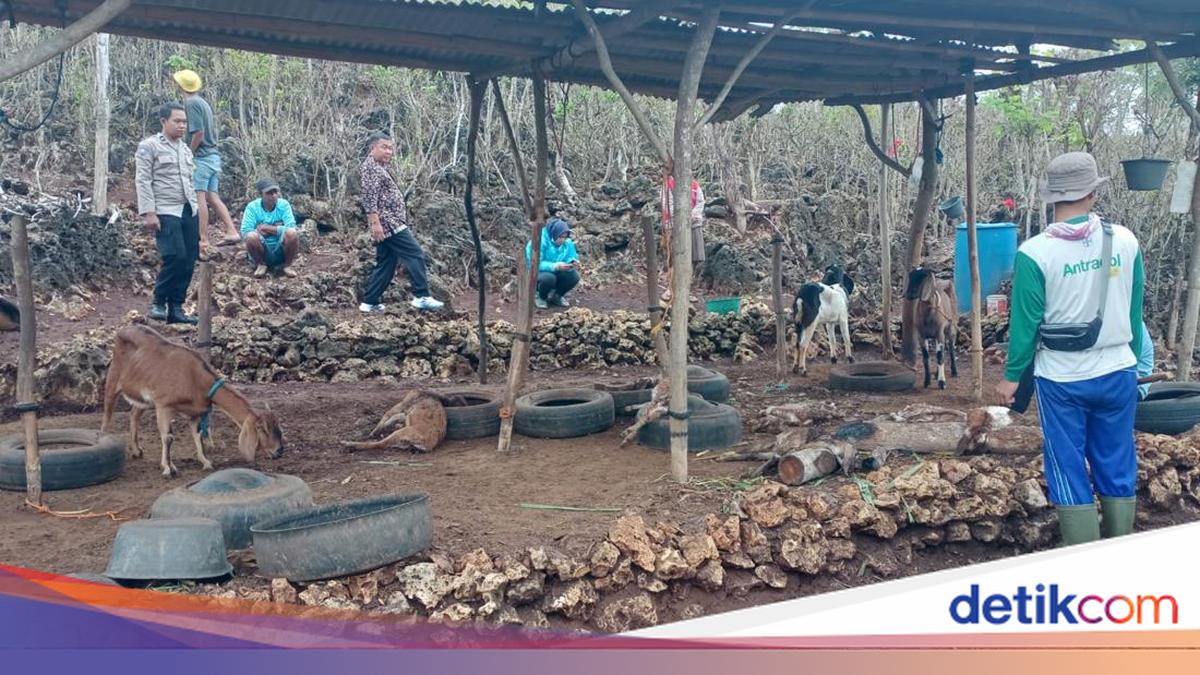
Wild animal attacks on livestock have happened again in Gunungkidul. Most recently, nine goats belonging to a resident and kept at Bulak Belang, Bamban hamlet, Bohol village, Rongkop subdistrict, were found dead in a horrific condition. Police said the goats had been killed by stray dogs.
“The nine goats in Rongkop died because of an attack by stray dogs,” said Gunungkidul Police public information officer First Inspector Tukiran, speaking to detikJogja on Wednesday (28 October 2026).
“At the time of the incident, a witness (Hardi Suwito) saw two adult dogs. When he threw something at them, the dogs ran west, away from the pen,” he added.
Tukiran said the owner, 82-year-old Hardi Suwito, discovered the deaths at 5.30am on Wednesday (28 October). The goat pen is about 500 metres from Hardi’s home.
“When he reached the pen, the witness was shocked to see that eight of his goats had died in a horrific state, torn apart and bearing bite wounds on their necks, stomachs and hind legs,” he said.
The eight dead goats comprised six kids about four months old and two breeding goats. Four other breeding goats in the same pen were still alive.
“As the witness walked around the pen, he found another of his goats dead in a similarly horrific condition. That brings the total number of dead goats to nine,” Tukiran said.
After receiving a report from a Bohol village official, officers from Rongkop Police Station went to the scene.
Tukiran added that the pen’s distance from the house, limited lighting and lack of supervision were believed to have allowed the wild animals to attack the goats freely.
“Officers have coordinated with the Rongkop Animal Health Centre, village officials and community leaders to prevent a recurrence. The livestock owner has been advised to bring goats or cattle kept in the fields back home,” he said.
Recurring attacks since 2017
Wild animal attacks on livestock have repeatedly terrorised parts of Gunungkidul since 2017. The Gunungkidul Agriculture and Food Agency (DPP) said they usually occur when water sources, such as ponds, dry up.
“Wild animal attacks on livestock in Gunungkidul have occurred since 2017 and have recurred every year,” DPP head Rismiyadi told detikJogja on Monday (26 October 2026).
Rismiyadi made the statement in response to the deaths of two goats found torn apart in Saptosari, Gunungkidul, the previous week.
The DPP has recorded attacks in Wonosari, Purwosari, Saptosari, Tepus, Girisubo and Karangmojo subdistricts, and said they could also occur in other parts of Gunungkidul.
“These wild animal attacks usually happen when water levels in springs, especially ponds, fall,” he said.
Rismiyadi said livestock, particularly goats, needed to be protected to ensure their safety and survival, and that residents should take preventative measures.
The agency has issued a letter to subdistrict heads and village chiefs across Gunungkidul outlining precautions. These include moving livestock from distant fields to areas near homes and organising night patrols.
“Attacks have generally taken place in mountainous areas and fields far from residents’ homes,” Rismiyadi said.
If those measures cannot be taken, he said, residents should maintain close surveillance of livestock kept in hilly areas.
“People can also carry out regular checks or night watches, raise pen fences, reinforce the walls so wild animals cannot break in, and install lighting around the pens,” he said.
Prevention should also include improving community communication, education and information (KIE) about the patterns and cycles of these attacks, so residents can prepare in advance.
Residents should promptly report attacks on livestock to the nearest officials, either through local technical units or animal health centres, or via the LaporDok app hotline, he said.
Assistance promised for farmers
The Gunungkidul Agriculture and Food Agency also said that assistance would be available to farmers whose livestock had been attacked.
“Yes. For livestock bitten by animals, the scheme is through Baznas. We will submit the proposal, and the assistance will take the form of a goodwill payment,” Rismiyadi said.
The payment scheme is being arranged through Baznas because there is no regulation providing compensation to residents whose livestock die in wild animal attacks. The existing Gunungkidul Regent’s Regulation No. 10 of 2025 covers compensation and/or assistance for controlling infectious animal diseases, as well as compensation for healthy animals culled as part of disease-control measures. That compensation is funded from the regional budget’s unforeseen expenditure allocation (BTT).
“The current regulation only covers livestock that die from infectious animal diseases. So, although there is no regulation for this, we are trying to use another funding route, in this case Baznas,” he said.
The subdistrict administration will collect information on livestock killed by wild animal attacks and report it to the regent. The regency administration will then coordinate with Baznas.
“We have proposed to Baznas that goodwill payments be provided for livestock killed in wild animal attacks,” he said.
The amount will be determined after Baznas verifies each case. The agency also applies an income-decile criterion to ensure assistance goes to those who need it.
“Baznas will decide the amount. But it is likely to be lower than the goodwill payment for livestock that die from infectious animal diseases,” he said.
Two goats found torn apart
Livestock deaths believed to have been caused by wild animals have recently been reported again in Gunungkidul. Two goats belonging to residents of Saptosari were found dead and torn apart.
“Yes, that’s correct. Two goats were found dead in Kanigoro, torn apart,” Saptosari Police chief Superintendent Sigit Teja Sukmana told detikJogja on Wednesday (21 October).
The goats belonged to two different owners. The first belonged to Pardi, a resident of Klepu, Planjan, Saptosari. The second belonged to Bejo, from Kanigoro. Both were found dead, apparently after being attacked by wild animals.
“The owners went to check their pens and found their goats dead, as if they had been eaten,” he said.
Similar incidents had been reported earlier. Between August and September, cases occurred in Playen, Tepus and Panggang. Seven goats died in Tepus, while two cattle were reported killed in Panggang, allegedly by wild animals.
BKSDA to inspect the site
The Yogyakarta Natural Resources Conservation Agency (BKSDA) said it would inspect the site to establish what killed the two goats in Saptosari.
“Information about the reported deaths of the two goats still needs to be clarified and verified,” BKSDA Yogyakarta public relations officer Desy Rachmawati told detikJogja on Monday (26 October 2026).
“We will inspect the site and coordinate with the relevant agencies to verify the information and conditions on the ground,” she added.
As of the previous day, BKSDA Yogyakarta had not reached a conclusion about the cause of the goats’ deaths. Desy said any determination must be based on an examination by the competent authorities or experts.
“We therefore urge people not to link the circulating information to wildlife or any particular cause before the examination results are available,” she said.
BKSDA will make the findings public once the examination is complete.
Source: jawawa.id (https://jawawa.id/newsitem/wild-animal-revealed-as-livestock-predator-in-gunungkidul-1793238669)
Originally published by detikJogja (https://www.detik.com/jogja/berita/d-8728659/terungkapnya-hewan-liar-pemangsa-ternak-di-gunungkidul), translated from Indonesian