
WIKA Gedung Business Transformation Through BIM Implementation and Net-Zero Construction Practices
Jakarta (ANTARA) – PT Wijaya Karya Banglar Gedung Tbk (WEGE) continues to strengthen its commitment to accelerating digital transformation and Net-Zero Construction practices to realise a sustainable infrastructure ecosystem in Indonesia. By integrating Building Information Modelling (BIM) as an advanced information management platform, the company’s strategy focuses on project efficiency, decarbonisation, and the implementation of ESG principles in alignment with national emission reduction targets. This commitment to technological innovation is balanced with efforts to enhance the readiness of future construction human resources through educational synergies to produce work-ready specialist BIM architects.
Reaffirming this vision of sustainability, the President Director of WEGE, Mahendra Vijaya, stated, “Digital transformation and the achievement of Net-Zero Construction are no longer merely options, but a strategic necessity and our responsibility towards the future. WEGE is committed to remaining at the forefront, pioneering the integration of technologies such as BIM to deliver construction works that are not only efficient and of high quality, but also environmentally friendly and sustainable for Indonesia.”
The global construction industry is currently entering the largest era of transformation in its history. Reports from the United Nations Environment Programme (UNEP) and the Global Alliance for Buildings and Construction (GlobalABC) show that the building sector still contributes approximately 37% of global carbon dioxide emissions. Meanwhile, the McKinsey Global Institute notes that productivity growth in the construction industry has remained stagnant compared to the manufacturing sector. To address these challenges of efficiency and climate change, digital transformation has become an indispensable strategic necessity.
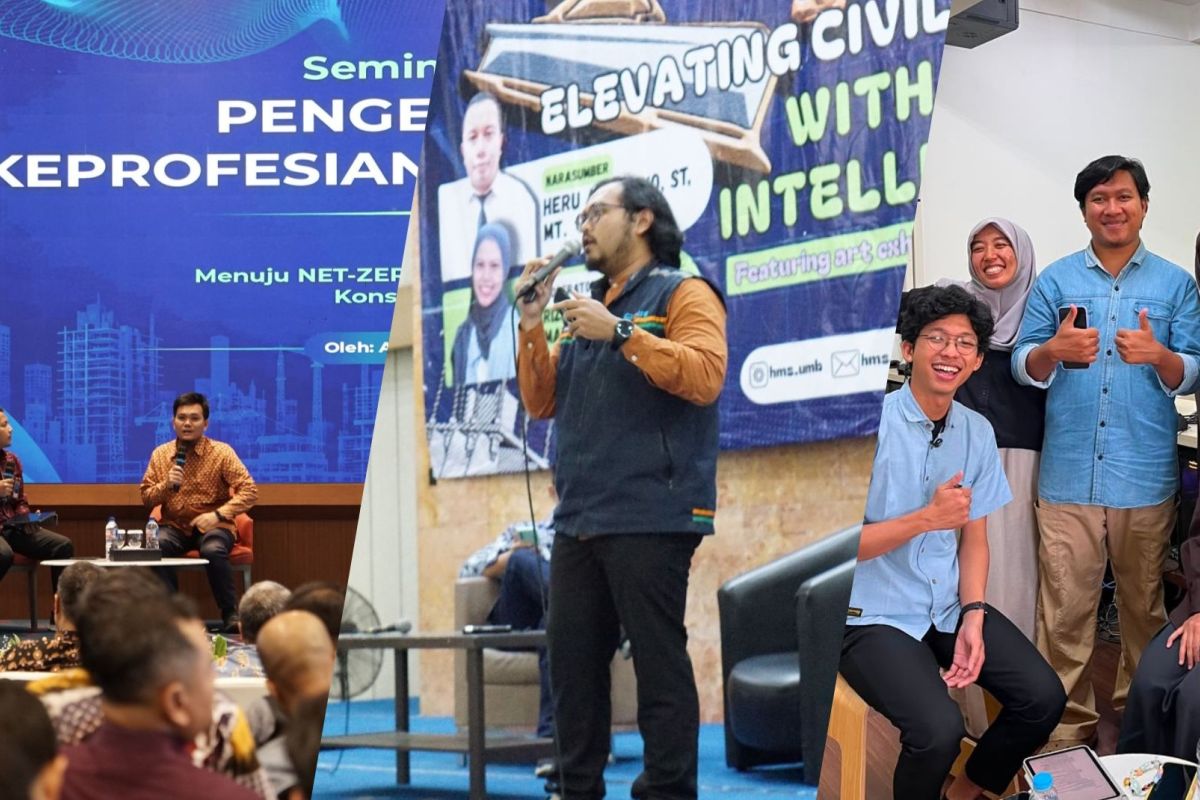
In various strategic forums, WEGE continues to emphasise the importance of digitalisation. “BIM is no longer just a 3D drawing tool, but the ‘brain’ of construction information management,” said Ir. Imam Agung Baskar, WEGE’s BIM Coordinator, during a presentation at Mercu Buana University. “By integrating Artificial Intelligence (AI) and Digital Twins based on the international ISO 19650 Kitemark standard, we can make more precise, transparent, and efficient decisions throughout the building lifecycle.”
This new paradigm is also key to reducing carbon footprints. Ar. Yudi Purmigo, another WEGE BIM Coordinator, emphasised during a National Seminar at the Waskita Building, “To achieve Net-Zero Construction, we must change how we build starting from the design phase. BIM is a strategic platform that allows us to perform energy simulations and manage embodied carbon—the emissions generated from the production processes of construction materials. Thus, sustainability principles are no longer just theory, but are measurable and precisely executed.”
To support this technological ecosystem and the demand for green infrastructure, the availability of adaptive human resources is crucial. Addressing this need, an interactive educational session titled “Sharing Career as a BIM Architect” was held on Tuesday, 21 July 2026. Featuring the topic “BIM Expert for Architects,” the event featured Ar. Retno Wulan Ndari, a BIM Architect at WEGE. Retno shared her career transition from an architecture graduate to a BIM Expert, highlighting how architectural knowledge is applied in real-world practice. “BIM is the backbone of future construction and will be mandatory for efficiency,” Retno stated. “In the industry, WEGE proves this through superior technical project planning thanks to advanced BIM implementation, where our R&D stage is currently exploring up to the 8D level. For aspiring architects, master the fundamentals of architectural science and combine them with BIM expertise to remain competitive in the digital era.”
WEGE believes that the future of the construction industry is determined by the ability to fully integrate information technology and sustainability principles. Through a robust BIM transformation pillar and proactive collaboration with academic institutions, WEGE is solidifying its position as a pioneer in accelerating sustainable infrastructure, fully supporting the government’s targets to achieve Net Zero Emissions (NZE).