
Widow's Socio-Economic Decile Suddenly Increases Despite Living in Bamboo House and Lacking Stable Income
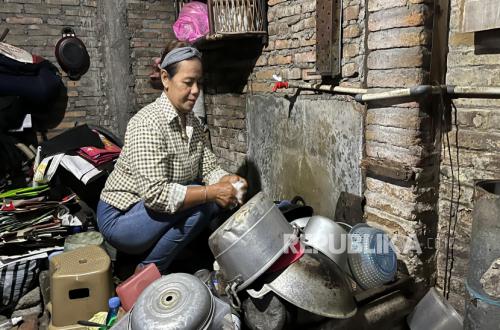
Changes in the decile rankings within the National Socio-Economic Single Data (DTSEN) have led several residents of Yogyakarta City to question the accuracy of the data used by the government. One such resident is Rika Wulandari, a 50-year-old woman from Gowongan, who claims she was suddenly recorded in decile 10 despite her economic condition being far from prosperous.
Rika is a widow who separated from her husband approximately three years ago. She currently lives in a simple house owned by her parents, a small structure with bamboo walls. The house lacks a television or a refrigerator. Rika has no stable employment and relies on daily income from providing small services to others.
“I do not know how the decile works. But on my phone, it suddenly showed 6 to 10,” she said during an interview at her home on Saturday night. “You can see for yourself that I live in a ‘gedek’ (bamboo) house; there are no luxury items. The only vehicle I have is a motorcycle I received from a relative.”
Rika admitted she initially did not understand the meaning of deciles or how the categories were determined. She only became aware of her status after discussions regarding changes in deciles became widespread among residents, prompting her to check the data through the local sub-district office.
From the information she obtained, several parameters are used to determine an individual’s socio-economic condition, including vehicle ownership, housing facilities, and electricity capacity. Rika noted that some data points were clearly incorrect. For instance, her electricity capacity was recorded as 1,300 watts, whereas she only uses 450 watts.
In addition to electricity, the data regarding her home’s sanitation facilities was also inaccurate. While she uses a squat toilet, the data recorded it as a sitting toilet. “The criteria within the decile include electricity, vehicles, and even toilets. Mine is a squat toilet, but it is written as a sitting toilet,” she said in disbelief.
Rika also emphasised that she has never been visited by officials for a direct economic survey. Consequently, she questions how data regarding her home conditions and possessions could be recorded differently from the actual reality.
According to Rika, the change in decile status is not merely a matter of numbers; she is feeling the direct impact. She stated that since April 2025, she has no longer received the Family Hope Program (PKH) benefits. Furthermore, her participation in the Healthy Indonesia Card (KIS) was also reportedly suspended or blocked over the past year.
“The impact? We no longer receive any social assistance, whether it be rice or money. Secondly, regarding health, our KIS from the government was suddenly stopped or blocked,” she added.
Rika’s family situation does not reflect economic prosperity. Of her four children, one is married and lives separately, while the other three live with her, one of whom is hearing impaired. Rika’s former husband works as a daily construction labourer, while Rika herself lacks a steady income, earning money by assisting others with errands for small tips.
Rika believes that socio-economic status should not be determined solely by the presence of certain items. She argued that owning a vehicle or household goods does not necessarily indicate wealth, noting that a large television in her house was not purchased with her own money. She hopes the government will conduct field verifications when discrepancies are found, ensuring that data collection considers the full context of family circumstances rather than just system parameters.
Source: jawawa.id (https://jawawa.id/newsitem/widows-socio-economic-decile-suddenly-increases-despite-living-in-bamboo-house-and-lacking-stable-income-1788422419)
Originally published by Republika (https://news.republika.co.id/berita/tks1j0291/desil-janda-di-yogya-tibatiba-naik-padahaltinggal-di-rumah-gedek-dan-tak-punya-pekerjaan-tetap), translated from Indonesian