
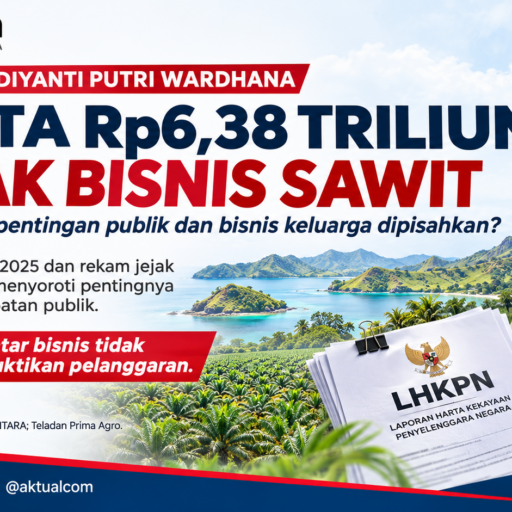
Widiyanti Putri’s Rp6.3 Trillion Wealth and Her Family’s Palm Oil Business
Appointing someone to oversee the tourism sector is not simply a matter of their ability to manage the travel industry and attract visitors.
When the role concerns natural resources, forests, coastlines and conservation areas, the official’s record and potential conflicts of interest also warrant scrutiny.
These questions have arisen in relation to Tourism Minister Widiyanti Putri Wardhana. On the one hand, she leads a sector that markets Indonesia’s natural beauty and is being urged to develop sustainable tourism.
On the other, her family’s wealth is connected to the palm oil plantation business through PT Teladan Resources and PT Teladan Prima Agro Tbk.
The central question is not whether a businessperson may become a minister. It is how to ensure that the state’s interest in protecting nature does not clash with the economic interests of an official’s family.
Trillions of Rupiah in Wealth and a Palm Oil Business Background
According to the periodic 2025 LHKPN (State Officials’ Wealth Report), submitted to the Corruption Eradication Commission (KPK) on 27 March 2026, Widiyanti’s wealth stood at Rp6.385 trillion.
That was an increase of about Rp949.5 billion from her 2024 periodic report, which recorded wealth of Rp5.435 trillion. The largest component was securities worth more than Rp5.07 trillion.
Widiyanti also has a professional history within Teladan Group. Before entering government, she served as a director and commissioner of PT Teladan Prima Agro and as chief operating officer (COO) of PT Teladan Resources.
The connection between her family’s business background and her public office is not an issue raised without grounds.
One company in this business ecosystem is PT Teladan Prima Agro Tbk (TLDN), an agribusiness company engaged in palm oil cultivation and processing.
The company began plantation operations in 2004 and expanded across several regencies in East Kalimantan, including Berau, East Kutai, Paser and Kutai Kartanegara.
In its annual report, TLDN says it manages a total plantation area of about 64,430 hectares, comprising 51,960 hectares of nucleus estates and 12,470 hectares of smallholder estates.
This figure indicates the scale of the company’s land holdings and management, and helps explain why its operations are relevant to discussions of environmental governance.
Tourism Sells Nature; Palm Oil Business Uses Land
This is where the policy paradox emerges. Nature-based tourism depends on healthy ecosystems.
Forests, rivers, coastlines, mountains and wildlife habitats are not merely backdrops for tourists’ photographs. They are the essential assets that determine whether a destination can endure in the long term.
Meanwhile, the palm oil plantation industry requires extensive areas for production. Monoculture plantations have different ecological characteristics from natural forests, particularly in terms of biodiversity and ecosystem functions.
The two sectors do not necessarily have to conflict. Plantations can apply environmental standards, preserve areas of high conservation value and build partnerships with communities. However, differences between economic and environmental interests must still be acknowledged and managed transparently.
The public is therefore entitled to ask how a minister will ensure that tourism policies do not indirectly benefit business interests connected to her or her family.
Tourism development often involves infrastructure, accommodation, commercial areas and new access routes into places that were previously relatively undisturbed.
If oversight is weak, the label of sustainable tourism risks becoming a veneer for land-based business expansion.
Company Conservation Claims Need to Be Tested
TLDN says it has allocated about 9,718.82 hectares, or 15.08 per cent of its reported total area, as high-conservation-value and high-carbon-stock areas.
The company says these areas include secondary forest, river buffers, mangroves and sites of cultural value to local communities.
This information should be noted as part of the company’s environmental commitments. However, the existence of conservation areas does not, by itself, erase all the ecological impact of plantation operations.
The next questions are how these areas are protected, whether their boundaries are effectively safeguarded, what condition their biodiversity is in, and whether their ecological functions are being maintained.
Company claims should be tested through independent monitoring, data transparency and government oversight.
The same applies to certifications and sustainability reports. Certification is an important tool, but it is not a reason to stop evaluating performance.
The public still needs to know whether practices on the ground meet the standards set out in company documents.
Conflicts of Interest Are Not Just a Matter of Legal Violations
Widiyanti’s case should not be reduced to an accusation that she will necessarily prioritise her family’s company. Her business background and wealth alone provide no basis for such a conclusion.
In public governance, however, a conflict of interest need not wait until a legal violation has occurred. Potential conflicts must also be identified and managed before they influence decisions by public officials.
The public therefore needs answers to several fundamental questions: have all relevant holdings and business relationships been adequately disclosed; how is the separation between private interests and public office being implemented; and are there procedures to prevent the minister from taking part in decisions that could benefit her family’s business interests?
Where a policy concerns destination development, tourism investment, land use or areas that overlap with related business interests, oversight and conflict-avoidance mechanisms must be open to public scrutiny.
This is a more important test than simply stating that an official has stepped down from an operational role in a company.
Leaving an executive position does not automatically answer every question about ownership, economic ties or the potential influence of family interests.
Green Tourism Must Not Become Just a Slogan
The idea of a land ethic, introduced by Aldo Leopold, reminds us that humans are part of the natural community, not its masters, free to treat land solely as a commodity.
Nature should be seen as an ecosystem that sustains life, not merely as a source of economic gain. That principle is relevant to a ministry responsible for developing tourism in Indonesia.
Tourism success should not be measured only by visitor numbers, investment value, hotel construction or foreign-exchange earnings.
Protection of natural areas, environmental sustainability and economic benefits for local communities must also be key measures.
Destination development must not displace communities from their living spaces, damage areas that sustain their livelihoods or turn nature into a commodity accessible only to groups with substantial capital.
Ultimately, the Tourism Minister’s office is not a platform for securing a family’s economic interests. It is a public trust to ensure that Indonesia’s natural wealth is protected and can be enjoyed by future generations.
Widiyanti has the opportunity to demonstrate that her business background does not prevent her from fulfilling her duties as a public official. But that demonstration cannot rest solely on green-tourism slogans or corporate sustainability reports.
She must ensure transparency, make certain that no decisions benefit her or her family’s private interests, and make environmental protection a genuine principle in every policy.
The fundamental issue is not whether a businessperson can become Tourism Minister.
It is whether the state has sufficiently robust mechanisms to ensure that the public interest always comes before business interests.
And when forests, land and communities’ living spaces are at stake, the public should not simply be asked to take things on trust.
The government must prove it through open policies, independent oversight and tangible results on the ground.
Source: jawawa.id (https://jawawa.id/newsitem/widiyanti-putris-rp6-3-trillion-wealth-and-her-familys-palm-oil-business-1793850625)
Originally published by aktual.com (https://aktual.com/kekayaan-rp63-triliun-dan-bisnis-sawit-keluarga-sang-menteri-pariwisata-widiyanti-putri-wardhana/), translated from Indonesian