
Widening Price Gap Raises Fears of Pertamax Users Switching to Subsidised Pertalite
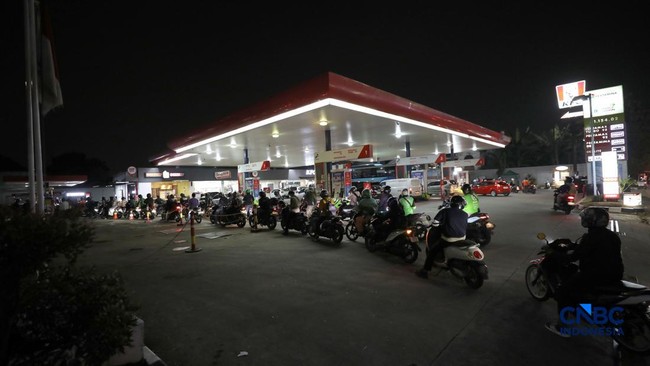
An economist from the Center of Reform on Economics (CORE) Indonesia, Yusuf Rendy Manilet, has assessed that the increase in Pertamax prices, which has created a gap of around Rp6,250 per litre with Pertalite, has the potential to accelerate a shift in consumption, particularly from non-subsidised fuel to subsidised fuel. According to him, consumers economically tend to switch to cheaper products when the price difference between two goods with relatively similar functions widens. Assuming consumption of 100 litres per month, a vehicle owner can save around Rp625,000 per month by switching from Pertamax to Pertalite.
“Therefore, it is not surprising that longer queues for Pertalite are beginning to appear and demand for Pertamax is relatively slowing down,” Yusuf told CNBC Indonesia on Thursday.
He further assessed that this migration trend is likely to continue if the price gap remains wide in the coming months. Based on simulations conducted by his team, in a moderate scenario, Pertalite consumption could increase by about 7 percent, while in a more severe scenario, the increase could approach 12 percent. “However, it should be noted that the Pertalite quota only has the potential to be exceeded when the consumption migration rate approaches 11.3 percent. This means that in a mild to moderate scenario, consumption is still relatively manageable within the available quota,” he added.
The risk starts to increase if the consumer shift occurs more aggressively than forecast. Furthermore, the full impact of the widening price gap that occurred in June is likely to only be visible in the consumption data for the second half of this year.
From a fiscal perspective, the increase in Pertalite consumption will certainly add to the government’s energy compensation burden because every additional litre consumed must be supported by greater compensation. Assuming compensation of around Rp5,400 per litre, the additional fiscal burden is estimated to be in the range of Rp4 trillion to Rp17 trillion, depending on the magnitude of the consumption shift. In a moderate scenario, the additional compensation could approach Rp10 trillion.
Nevertheless, he views that the main risk currently is not the government’s fiscal sustainability, but rather the management of consumption and distribution in the field. The additional burden is still within the capacity of the state budget to absorb, although the fiscal space has become narrower. Yusuf mentioned that what needs to be anticipated is the possibility of increased queues and supply pressure in several regions if consumer migration occurs faster than expected. Therefore, monitoring consumption and supervising distribution is important to ensure the available quota remains sufficient until the end of the year.
“So, this policy indeed has the potential to encourage a faster shift in consumption to Pertalite. Its impact on energy compensation will increase, but it is still relatively manageable under current conditions. Factors that need to be continuously observed are the magnitude of consumer migration in the second half, the development of world oil prices, and the movement of the rupiah exchange rate because these three factors will greatly determine the extent of pressure on the state budget going forward,” he said.
Previously, Pertamina Patra Niaga Corporate Secretary Roberth MV Dumatubun urged the public to use energy wisely and not to take the rights of groups entitled to receive subsidies. This was in response to concerns about consumers switching to subsidised fuels like Pertalite. “The appeal to use energy wisely and the awareness not to take the rights of subsidy recipients continues to be echoed,” he told CNBC Indonesia on Thursday.
Roberth stated that the price adjustment for the non-subsidised Pertamax fuel was made while still considering purchasing power and the national economy. On the other hand, the price of subsidised fuel has not been adjusted and continues to be sold according to applicable regulations. According to him, market price factors and economic prices are among the reasons for the price adjustment, which was finally carried out after coordination with regulators.