
Why Were Ice Age Animals Giant-Sized? An Evolutionary Explanation
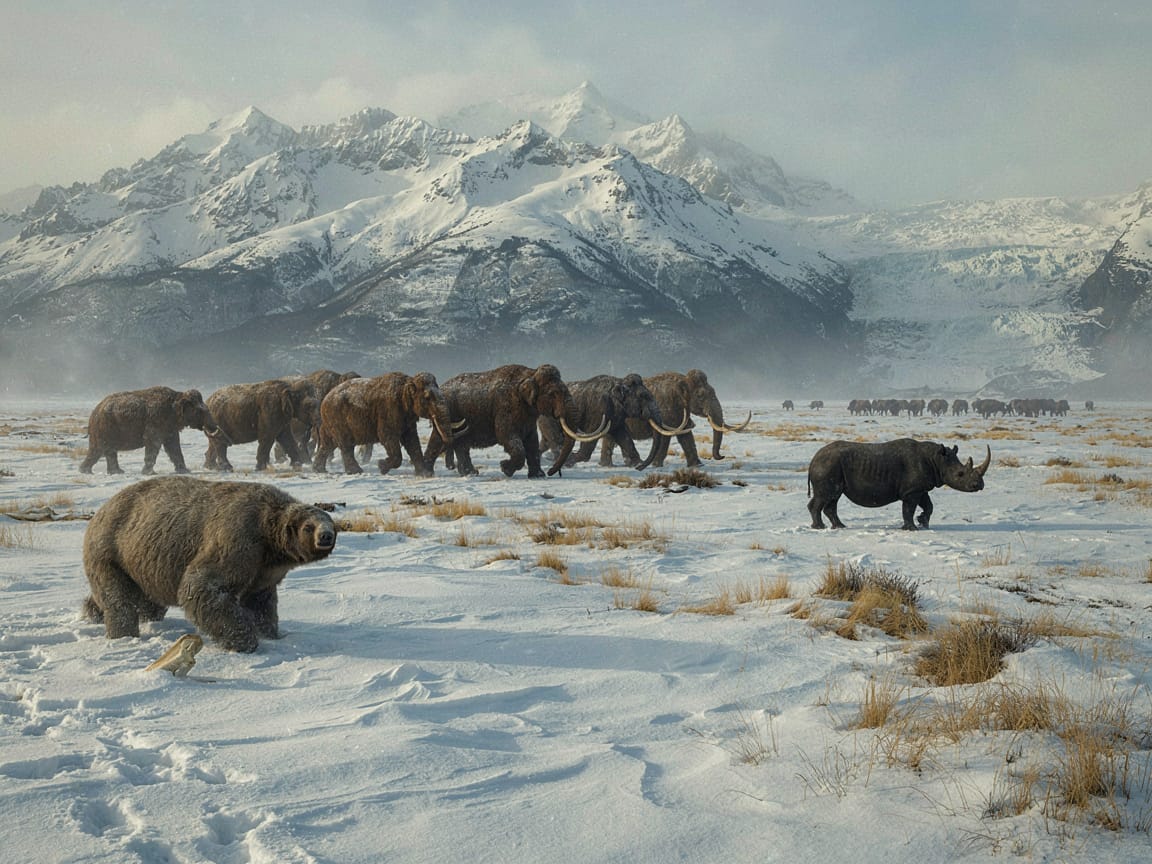
The Ice Age, or Pleistocene epoch, is known in Earth’s history as the era when giant mammals (megafauna) dominated ecosystems. Animals such as the woolly mammoth, woolly rhinoceros and steppe bison became icons of the harsh, cold environment. This phenomenon of extraordinarily large body size raises fundamental questions about the evolutionary factors that drove their emergence.
Palaeontological research reveals that gigantic body size did not appear instantaneously. This evolution was a long process that began after the extinction of the dinosaurs around 66 million years ago. Without the dominance of large reptiles, mammals began to diversify to fill the empty ecological niches. Studies show that the maximum body size of land mammals increased gradually over millions of years, reaching its peak in the late Pliocene and Pleistocene periods.
The environmental conditions of the Ice Age — which tended to be cold, dry and fluctuating — imposed certain evolutionary pressures. A large body offered several crucial biological advantages for survival:
Although the climate at the time was extreme, Ice Age ecosystems were able to support a very high biomass of herbivores. Research on the Last Glacial Maximum period shows that large herbivores were able to utilise dry grasses as a food source efficiently. This created a cycle in which the environment could sustain significant populations of large animals.
However, gigantic body size was also a double-edged sword. Large animals required a very high energy intake to survive. Research on food webs in the Americas shows that the largest species often lived at the threshold of their energy requirements.
This dependence on vast amounts of energy made them highly vulnerable to environmental change. Towards the end of the Pleistocene, a combination of drastic climate change, habitat shifts and pressure from human activity caused population declines that ended in the mass extinction of megafauna. The evolution of gigantism proves that large size was an advantage during periods of environmental stability, but became a fatal weakness when natural conditions changed radically. (Source: Nature Ecology)