
Why the Sound of Anak Krakatau's Eruption Could Be Heard as Far as Bandung: The Scientific Explanation
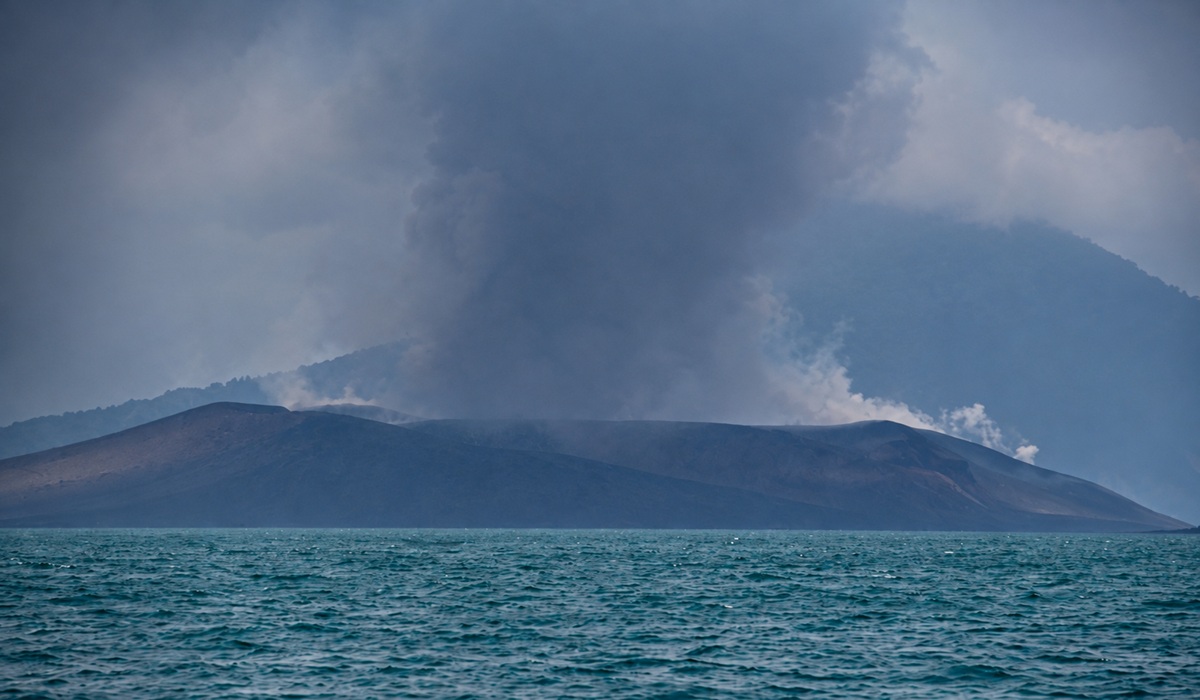
The loud booming sounds produced by the eruption of Mount Anak Krakatau have been reported to be heard in various distant regions, including Bandung, West Java. This phenomenon has raised questions among the public regarding how sounds from the Sunda Strait can reach land areas hundreds of kilometres away.
Sonni Setiawan, a lecturer from the Department of Geophysics and Meteorology at IPB University, explained that this phenomenon is heavily influenced by atmospheric conditions, specifically the presence of a temperature inversion layer. According to him, this layer acts as a medium that facilitates sound waves to travel further and be heard more loudly at the earth’s surface.
In normal atmospheric conditions, air temperature usually decreases with increasing altitude. However, in a temperature inversion condition, an anomaly occurs where the air temperature actually increases with altitude.
“The inversion layer forms when air near the surface cools more rapidly than the air above it. This cooling can occur due to radiative cooling at the surface, the influx of cold and dry air advection, or other meteorological processes,” explained Sonni.
This condition directly affects the propagation of acoustic waves. Because sound travels through the air, its propagation speed is highly dependent on temperature. These temperature differences between atmospheric layers cause sound waves to undergo reflection or refraction.
In addition to atmospheric factors, the region’s topography also plays an important supporting role. Cold air tends to accumulate in basins or lowlands, which subsequently accelerates the formation of an inversion layer.
Sonni highlighted the Bandung region as a clear example. “The Bandung Basin is one of the areas that is topographically prone to the accumulation of cold air. When atmospheric conditions support the formation of an inversion, this area can become a pathway that allows sound energy to travel further,” he stated.
Simply put, the inversion layer creates a sort of “space” or channel that maintains sound energy so that it does not directly disperse into the upper atmosphere, but is instead reflected back to the ground surface.
The public often assumes that a loud booming sound indicates that the source of the explosion is nearby. However, this Anak Krakatau eruption phenomenon proves otherwise. The wave energy reaching the receiving area is not only heard as sound but is also capable of vibrating physical objects.
In conclusion, the audible booming sound is the result of a collaboration of three main factors: the eruption activity as the energy source, atmospheric conditions (temperature inversion) as the propagation medium, and the regional topography as a factor enhancing the sound’s range.
Source: jawawa.id (https://jawawa.id/newsitem/why-the-sound-of-anak-krakataus-eruption-could-be-heard-as-far-as-bandung-the-scientific-explanation-1789311096)
Originally published by Media Indonesia (https://mediaindonesia.com/humaniora/932979/mengapa-suara-dentuman-erupsi-anak-krakatau-terdengar-hingga-bandung-ini-penjelasan-ilmiahnya), translated from Indonesian