
Why the Sound of Anak Krakatau was Loud in West Java but Silent in Banten?
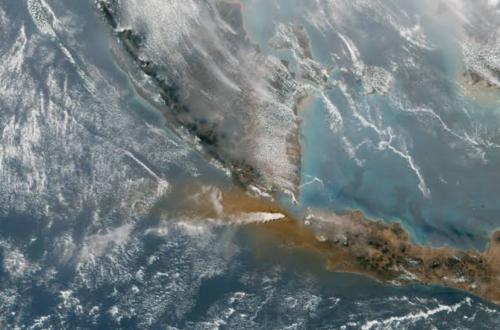
The Geological Agency of the Ministry of Energy and Mineral Resources (ESDM) stated that the booms and vibrations reported in several areas of West Java are related to the eruptive activity of Mount Anak Krakatau. This phenomenon occurred between 4 and 5 September 2026, during a period of increased eruptive activity at Anak Krakatau.
The Head of the Ministry of ESDM’s Geological Agency, Lana Saria, noted the temporal alignment between the reports of booms and the eruption of Anak Krakatau. This is further supported by signals recorded at several monitoring stations in West Java.
“The timing alignment between the eruption of Mount Krakatau and the signals at monitoring stations in West Java strongly supports the conclusion that this phenomenon originated from acoustic waves from the Mount Krakatau eruption,” Lana said during a press conference on the progress of the Mount Anak Krakatau eruption on Sunday (6/9/2026).
She explained that low-frequency acoustic waves from eruptions can propagate over long distances. Certain atmospheric conditions can cause these waves to be heard as booming sounds and felt as vibrations.
“These low-frequency acoustic waves can travel far under specific atmospheric conditions and be perceived as booms or vibrations,” said Lana.
Similar phenomena, she continued, have occurred with several other erupting volcanoes. The eruption booms of Mount Kelud were once heard as far as Central Java, while the sounds of the Mount Lewotobi Laki-laki eruption were heard as far as Maumere and Alor Island.
Activity at Mount Anak Krakatau itself has been increasing since July 2026. The volcano’s activity status was raised from Level II (Alert) to Level III (Standby) on 2 July 2026.
On 4 September 2026, at 23:00 WIB, Anak Krakatau experienced continuous eruptions accompanied by lava fountains, rumbling sounds, and booms. The highest level of activity was recorded on 5 September 2026.
The Ministry of ESDM’s Geological Agency continues to monitor the development of Anak Krakatau’s activity using various parameters. Monitoring includes seismic networks, visual observations, deformation, gas emissions, satellite imagery, and field information.
The government has requested that residents in affected areas follow official information. Citizens are also urged not to be swayed by information regarding Anak Krakatau’s activity from unreliable sources.
Source: jawawa.id (https://jawawa.id/newsitem/why-the-sound-of-anak-krakatau-was-loud-in-west-java-but-silent-in-banten-1788677691)
Originally published by Republika (https://news.republika.co.id/berita/tkxhzf393/mengapa-dentuman-anak-krakatau-kencang-di-jabar-tapi-sunyi-di-banten), translated from Indonesian