
Why the IDX Composite Fell to 4,900, Its Lowest Level Since the Pandemic
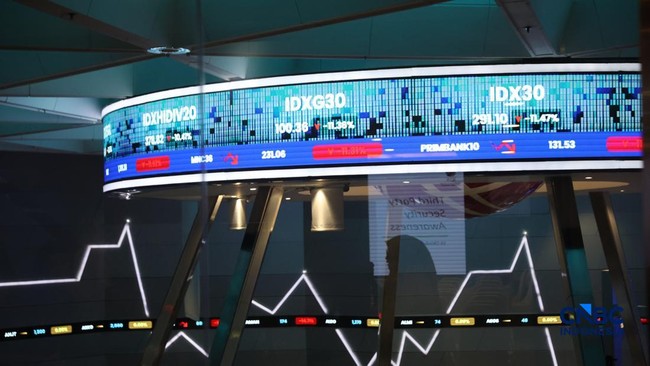
Jakarta, CNBC Indonesia – Indonesia’s stock market remained volatile on Monday (19 October 2026), after the IDX Composite recorded its steepest daily fall in nearly three decades at the end of last week.
At the market open, the index plunged 4.31% to 4,961.87, down 223 points from the previous close of 5,863.78.
This was the first time the index had returned to the 4,900 level since the Covid-19 pandemic shook financial markets. Monday’s level was the lowest since October 2020.
Large-cap blue-chip stocks continued to weigh on the index. BBCA, BBRI, BYAN and TLKM were among the day’s laggards.
On Friday (16 October 2026), the IDX Composite had slumped 11.6%. Including Monday’s decline, the benchmark of the Indonesia Stock Exchange (IDX) has fallen 43% year to date, making it the worst-performing major index in the world.
The sharp decline was triggered by an announcement from MSCI that it was considering moving Indonesia from the emerging-markets category to standalone market status.
If implemented, standalone status could cut off Indonesia, South-east Asia’s largest economy, from international capital flows. It would also place Indonesia alongside other standalone markets such as Lebanon and Zimbabwe.
In January, MSCI had threatened to downgrade Indonesia to frontier-market status, citing limited transparency over share ownership and trading practices. In its latest statement, however, MSCI said the lack of progress in addressing these issues meant that even a downgrade to frontier status would no longer reflect the seriousness of the problems.
“The burden of proof has now shifted. To avoid reclassification, there needs to be concrete evidence that the announced reforms have been consistently implemented and have materially improved market functioning,” Goldman Sachs strategists wrote in a research note, as quoted by Reuters.
IDX cuts lower auto-rejection limit
In response to the volatility, the IDX cut its lower auto-rejection limit to 7% on Monday (19 October 2026), from 15% previously.
The IDX said the move would give investors time to assess and digest available information, allowing them to make investment decisions based on Indonesia’s economic fundamentals.
The step followed a weekend meeting between financial-services regulators and capital-market participants, including analysts and economists. On Friday, the regulator also announced sanctions against parties suspected of involvement in share-trading manipulation at three companies.
Potential outflows of Rp100 trillion
Goldman Sachs estimates that if Indonesia is removed from MSCI indices, passive-fund outflows could reach US$5.6 billion, or about Rp100.8 trillion. Active funds that use the index as a benchmark hold more than US$8 billion (Rp144 trillion) in assets, although any selling by these funds would be discretionary rather than an automatic response to index changes.
Foreign investors have so far recorded net sales of Indonesian shares worth US$4.88 billion, equivalent to Rp87.84 trillion, in 2026. This could become the largest annual outflow in at least 16 years.
Aninda Mitra, BNY Investments’ head of Asia macro and investment strategy, said foreign exposure to Indonesian shares had already shrunk substantially, limiting the scope for further declines. However, she warned that attracting significant capital would become increasingly difficult under current conditions, despite some companies and banks having solid fundamentals.
Rupiah and bonds also under pressure
The MSCI warning adds to a series of pressures facing President Prabowo Subianto’s administration. Earlier this year, Moody’s and Fitch downgraded Indonesia’s debt-rating outlook to negative.
Investor concerns have spread beyond the stock market, valued at about US$500 billion (Rp9,000 trillion). The rupiah weakened to Rp18,000 per US dollar, not far from its record low of Rp18,190 per US dollar reached in June.
Gary Tan, a portfolio manager at Allspring Global Investments in Singapore, said his main concern was not index-related selling, but the risk of short-term spillovers into the rupiah and domestic bond yields.
“Market dislocation could lead to tighter financial conditions and a more significant impact on the real economy,” he said.
Source: jawawa.id (https://jawawa.id/newsitem/why-the-idx-composite-fell-to-4-900-its-lowest-level-since-the-pandemic-1792378236)
Originally published by CNBC Indonesia (https://www.cnbcindonesia.com/market/20261019090824-17-777329/penyebab-ihsg-anjlok-ke-4900-sentuh-level-terendah-sejak-pandemi), translated from Indonesian