
Why the Fed Boss's "Good Afternoon" Becomes the World's Most Expensive Greeting?
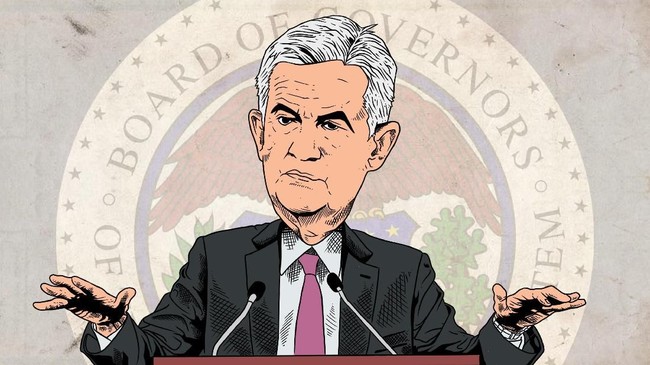
A simple “good afternoon” greeting usually sounds quite ordinary. However, in the global financial markets, that straightforward salutation can feel extremely costly if it comes from the mouth of the United States Federal Reserve (Fed) Chairman, Jerome Powell.
On social media, Powell’s greeting has even been dubbed the “Most Expensive Good Afternoon” or the world’s most expensive afternoon greeting.
This nickname arises because Powell often opens Fed press conferences with the simple phrase, “Good afternoon.” For ordinary people, it’s just an opening salutation. But for investors and traders, that sentence can signal that the markets are about to enter a phase of intense turbulence.
This is because, after that greeting, Powell typically begins explaining the direction of US interest rates. If his tone sounds firm or signals that high interest rates will persist longer, the markets can react immediately. Stocks come under pressure, bond yields fluctuate wildly, the US dollar strengthens, and even risky assets like cryptocurrencies decline.
This phenomenon has then spread to social media. Many short videos feature Powell’s voice saying “Good afternoon,” paired with charts of stocks or cryptocurrencies that suddenly plummet. From there, Powell’s greeting has transformed into a financial market meme: it sounds simple, but it can cause asset values to evaporate in minutes.
It All Began with Powell’s Role at the Fed
Jerome Powell has been Fed Chairman since February 2018. Since then, every statement he makes has captured global market attention, especially after Federal Open Market Committee (FOMC) meetings.
The FOMC is the Fed’s key meeting to determine the direction of the US benchmark interest rate. This decision has a massive influence because the US dollar is the world’s primary currency and serves as a benchmark for many financial assets.
When Powell sounds hawkish or tends to support high interest rates, markets usually react negatively. Investors worry that high interest rates will pressure the economy, make borrowing more expensive, and reduce interest in risky assets.
Conversely, if Powell sounds dovish or signals a more accommodative policy, markets can turn optimistic.
This is what makes every word from Powell weighed carefully by the markets. Not just the content of his policies, but also his tone of voice, word choices, and even the opening sentence he uses.
Google Searches Explode Since 2024
The “Most Expensive Good Afternoon” phenomenon is also evident from Google Trends. Global search data shows that this term practically did not appear from 2004 until mid-2024.
Search interest only emerged in July 2024, when the index rose to level 51. It peaked in December 2024, when the search index hit 100, the highest level in 20 years.
This means the term only truly emerged and became popular in the last two years. Not because Powell has only recently influenced markets, but because moments when markets fell after his statements began to be turned into content, and the results went viral.
Throughout 2025 to early 2026, searches for this term spiked several times. One of them was in December 2025 with an index of 91, then in March 2026 at level 79.
This shows that “Most Expensive Good Afternoon” is not just a one-off joke. The term persists because the public sees Powell as a figure whose words can move global markets. Powell is not just a central bank figure awaited by investors. He has also become part of internet culture among traders.
An 8-Minute Speech That Cost the World Billions of Dollars
One of the most famous examples of how expensive Powell’s words can be occurred at the Jackson Hole symposium on Friday (26/8/2022).
At that time, Powell only spoke for about eight minutes. However, the impact was enormous. Global markets were immediately shaken severely because Powell affirmed that the Fed would remain aggressive in raising interest rates to bring down the inflation target.
Powell then warned that tight monetary policy would bring “pain” to households and businesses. However, according to him, that pain must be endured so that inflation can return to the Fed’s 2% target.
That message dashed market hopes that the Fed would start softening. Investors immediately interpreted Powell’s speech as a signal that high interest rates would last longer.
The impact was felt immediately. Wall Street plunged on Friday’s trading. The Dow Jones, S&P 500, and Nasdaq indices all fell more than 3%, one of the worst daily drops since mid-June 2022.
In a short time, the wealth of US billionaires also evaporated. Powell’s eight-minute speech was said to have slashed the wealth of America’s richest people by around US78billion, equivalenttoRp1.326trillion(assuminganexchangerateofRp17, 000/US).
Asia Feels the Ripple Effects
The effect of Powell’s Jackson Hole speech did not stop at Wall Street. Asian markets also became volatile on Monday’s trading (29/8/2022).
The US dollar index surged to a 20-year high at that time. Citing Refinitiv data, at 13:34 WIB, the US dollar index strengthened 0.46% to 109.478, the highest since September 2002.
The strengthening US dollar pressured Asian currencies. The rupiah weakened 0.49% to Rp14,888/US$. The Japanese yen was one of the most affected, weakening 0.87%, followed by the Chinese yuan down 0.68% and the Thai baht weakening 0.66%.
Asian stock markets also turned red. The JCI fell more than 1.5% and nearly broke below the 7,000 level, before the decline eased in the second trading session.
Japan’s Nikkei index plunged 2.66%, South Korea’s Kospi fell 2.13%, Singapore’s Straits Times weakened nearly 1%, and Hong Kong’s Hang Seng corrected 0.8%.
Why Can Powell’s Words Be So Expensive?
The great influence of Powell is inseparable from the Fed’s position as the world’s most important central bank.
When the Fed raises interest rates, the US dollar usually becomes more attractive. Yields on dollar-based assets also rise.