
Why the air feels humid even though rain has not become regular: Here is the reason
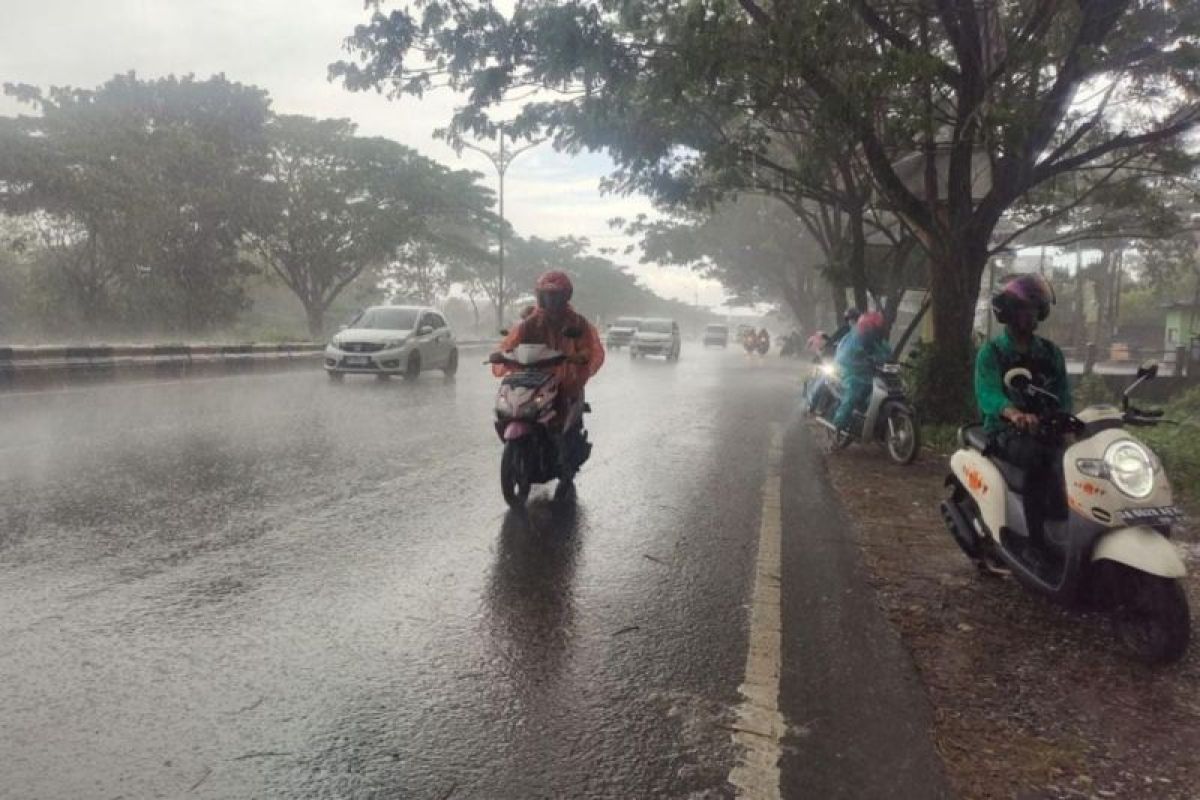
Jakarta (ANTARA) - Over the last few days, some members of the public may have begun to notice a change in the atmosphere. Although rain has not yet fallen regularly and evenly every day, the air feels increasingly humid, stuffy, and even causes the body to sweat more quickly.
This condition frequently occurs when the weather is undergoing a transition. Furthermore, rain and air humidity are two related phenomena, but they do not always arrive simultaneously.
So, why can the air feel humid even though rain has not become regular?
Simply put, air humidity indicates the amount of water vapour present in the atmosphere. The higher the water vapour content in the air, the higher the humidity.
This means that humid air does not necessarily have to be marked by rain. Water vapour may already be present in significant amounts in the atmosphere, while other atmospheric conditions do not yet support the formation of large rain clouds.
When high humidity meets sufficiently hot air temperatures, the body can also experience a more sweltering sensation.
This is because the sweat produced by the body requires an evaporation process to help cool the body down. When the air already contains a lot of water vapour, the evaporation process of sweat becomes slower. As a result, the body feels stickier and hotter even though the recorded air temperature is not actually extreme.
BMKG previously explained that, meteorologically, a sweltering atmosphere can occur when hot air temperatures are accompanied by high humidity.
One cause is the change in atmospheric dynamics when a region begins to approach a seasonal transition period.
Under certain conditions, the water vapour content in the atmosphere may increase first. However, to produce rain, other processes are still required, such as the lifting of air masses, cloud growth, and supporting wind conditions.
Therefore, there is a possibility that the air feels increasingly humid before rain truly becomes more frequent.
This phenomenon can also occur when clouds begin to grow from midday to late afternoon. The earth’s surface, which receives solar heating, causes the air near the surface to become warmer and rise. If atmospheric conditions are favourable, this process can assist in cloud formation, which subsequently develops into rain.
That is why, during certain periods, the public may feel the air becoming more stuffy during the day or afternoon, even before rain falls.
Weather conditions in Indonesia currently cannot be generalised. Based on BMKM analysis on 23 September 2026, approximately 80.7 per cent of Indonesia’s territory, or 564 Seasonal Zones, are still experiencing the dry season.
BMKG also predicts that rainfall for the period from the second ten-day period of September to the first ten-day period of October 2026 will generally fall within the low to medium category, specifically 0-150 millimetres per ten-day period.
Given these conditions, rain is not necessarily expected to fall evenly or regularly across all regions. Some areas may still experience relatively dry days, while others may already be receiving localised rain.
BMKG also noted that several atmospheric dynamics remain active. Atmospheric waves, convergence zones, or wind slowing, along with local atmospheric conditions, can cause the growth of rain clouds in specific areas even though dry conditions generally still dominate.
Source: jawawa.id (https://jawawa.id/newsitem/why-the-air-feels-humid-even-though-rain-has-not-become-regular-here-is-the-reason-1790913476)
Originally published by Antara (Indonesian) (https://www.antaranews.com/berita/5767887/kenapa-udara-terasa-lembap-meski-hujan-belum-rutin-ini-sebabnya), translated from Indonesian