
Why North Korea Is Relentlessly Building Nuclear Weapons Despite No Imminent War
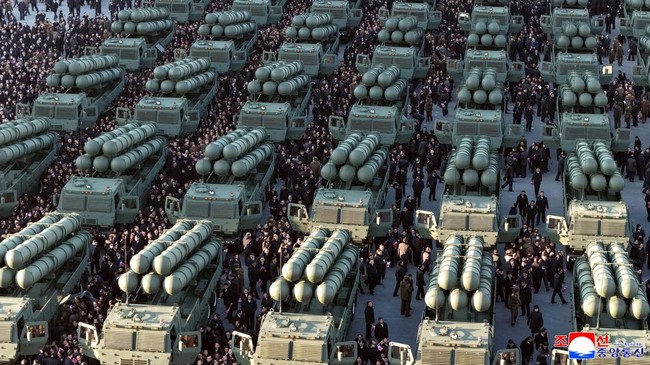
North Korea is increasingly clarifying its defence policy by placing nuclear weapons as the main pillar of national security. At the ruling Workers’ Party meeting that concluded this week, leader Kim Jong Un stressed that the continuous expansion of his country’s nuclear force is the best way to confront a world he deems increasingly unstable and dangerous.
The statement is part of a series of hardline messages Pyongyang has been delivering recently. In recent months, Kim has pledged to equip warships with nuclear missiles, double the production of strategic weapons material, and expand North Korea’s nuclear arsenal at a pace he describes as “exponential” growth.
Although North Korea is often accused of exaggerating its military capabilities, analysts say the main focus is no longer whether the country possesses nuclear weapons, but why Pyongyang feels it needs a far larger quantity than before. According to observers, the strategy indicates that North Korea is building a nuclear force sufficiently large and widely dispersed so that it cannot be easily destroyed through military attack or diplomatic negotiation.
“It is a force so large and so dispersed that no single strike can eliminate it, and it seems increasingly difficult to dismantle through diplomacy,” said Peter Ward, a researcher at the Seoul-based Sejong Institute, as reported by The Guardian on Wednesday (24/6/2026). Ward assessed that North Korea is leveraging the dispersal of its nuclear arsenal to protect itself from the possibility of foreign intervention, such as that which occurred against Iran. “We don’t know where everything is. We don’t know what they might do. And their threat is deliberately kept vague,” he said.
Lessons from Iran
The recent US-led strikes against Iran are said to have further reinforced a long-held belief in Pyongyang: that a country which stops merely at the threshold of nuclear weapons ownership actually invites attack, rather than creating a deterrent effect. “A country that remains at the threshold level is placing a large target on its own back,” Ward said. This view is believed to be one of the reasons Kim Jong Un continues to push for the development of larger and more complex nuclear capabilities.
Designed to survive an enemy’s first strike, North Korea’s arsenal now includes mobile launchers based on rail and road, reinforced underground facilities, and a growing fleet of submarines. This year, North Korea began testing nuclear-capable cruise missiles from a new 5,000-ton destroyer. On Wednesday, Kim also pledged that his country would build two additional warships each year for the next five years.
Analysts say Pyongyang believes it needs a much larger arsenal to match the military forces it perceives as surrounding North Korea. “It faces the US nuclear umbrella, combined US-South Korean forces, and trilateral cooperation with Japan,” said Hong Min, a senior researcher at the Korea Institute for National Unification. “That has already gone beyond minimum deterrence.”
Nuclear Weapons Enter the Constitution
The role of nuclear weapons in North Korea has now even been enshrined in the country’s constitution. A constitutional revision carried out earlier this year grants Kim Jong Un constitutional command over nuclear forces and the authority to delegate launch authority to other commands. Analysts view this move as an effort to anticipate possible strikes targeting the country’s supreme leadership.
According to Lee Ho Ryung, a senior researcher at the Korea Institute for Defense Analyses, Pyongyang is trying to cement the idea that denuclearisation is no longer a viable option for North Korea. “Their intent is that this is not something that can be reduced through negotiation at this point,” he said. Meanwhile, North Korea’s position is also seen as increasingly strong due to its closer military ties with Russia and improved strategic relations with China. Both relationships provide Pyongyang with additional diplomatic protection from international pressure, which was previously a significant factor in driving negotiations.
Despite their respective interests, Russia, China, and North Korea share a common interest in limiting US influence. In the current situation, analysts expect Washington and Seoul to maintain denuclearisation as an official goal. However, in practice, the policy focus is likely to shift towards arms control—limiting and gradually reducing the number of North Korea’s nuclear weapons, rather than eliminating them entirely. Lee Ho Ryung assessed that this approach may be the only realistic option remaining. “In the end, there may be no other way,” he said.