
Why Is China Eyeing the Philippine Islands Near Taiwan?
Jakarta, CNBC Indonesia – China is reportedly expanding its claims of influence in the Pacific by setting its sights on the Batanes Islands, a small Philippine island group considered strategically important to Taiwan’s defence in the event of a conflict with Beijing.
The Batanes Islands lie just south of Taiwan, facing the Bashi Channel, which China would likely need to control if it wanted to attack, encircle or blockade Taiwan. Beijing has pledged to take control of self-governing Taiwan, by force if necessary.
The Batanes Islands have been part of the Philippines since the colonial era. Earlier this year, however, a group of Chinese academics with links to the state put forward the idea that the territory was actually part of China. Chinese state media subsequently amplified the claim.
The Philippines responded swiftly. Its defence secretary called the claim absurd, while the National Historical Commission of the Philippines issued a detailed rebuttal.
The claim’s emergence has nevertheless been seen as part of China’s grey-zone strategy: an effort to expand influence and project power without military occupation or triggering open conflict.
Hunter Marston, director of the Southeast Asia programme at Australia-based think-tank the Lowy Institute, said the pattern was not new. Chinese academics, he said, were increasingly voicing views aligned with the government’s position.
“The idea that this is just a group of academics expressing their own opinions is not entirely accurate,” Marston told The Wall Street Journal, as quoted on Saturday (10 October 2026).
At a seminar in Guangzhou, southern China, in June, the academics concluded that the Batanes Islands were a geographical extension of Taiwan and could therefore be considered part of China. The conclusion appeared in a statement published by a school at Jinan University.
The academics also argued that the treaty granting the United States control over the Philippines after the Spanish-American War did not include the Batanes Islands. They also pointed to cultural ties between local Batanes residents and Taiwan’s Indigenous population.
About 19,000 people live in the Batanes Islands. Its landscape is often compared with the Scottish Highlands, despite its tropical climate. The Ivatan people who live there speak a language resembling that of the Tao Indigenous community on Orchid Island, one of Taiwan’s outer islands.
“We know very well that Batanes is ours. Batanes is not part of China,” said Joseph Cultura, mayor of Itbayat, the northernmost area in the island group.
The National Historical Commission of the Philippines said Batanes forms part of the continental shelf contiguous with northern Luzon, the Philippines’ main island. It also said there was no evidence of Chinese governance in the area when a British explorer arrived in the 17th century.
Spain, which previously colonised the Philippines, formally claimed Batanes in 1783. Since the late 19th century, the territory has also had representation in every national legislative body of the Philippines.
China has long sought to expand its influence in the surrounding region, including through measures that stop short of direct territorial occupation or open conflict.
In the South China Sea, the Chinese coastguard restricts access to several disputed areas. Chinese military aircraft also frequently manoeuvre around Taiwan’s airspace, while Beijing has built settlements in disputed areas of the Himalayas.
Batanes’ strategic position is not in dispute. The island group lies about 100 miles (161 kilometres) south-east of Taiwan and faces the Bashi Channel, a key waterway if China were to encircle Taiwan in a conflict or impose a blockade.
The US is also leading military exercises to prepare for the possibility of conflict with China in the area. Recently, the US military deployed a mobile missile system to Batanes, enabling US forces to strike Chinese vessels in the Bashi Channel.
The US and Philippine militaries held joint exercises in the islands in May.
Over the past 18 months, the Philippines has also detected several Chinese coastguard and research vessels operating around Batanes. The area is also home to important undersea cable infrastructure.
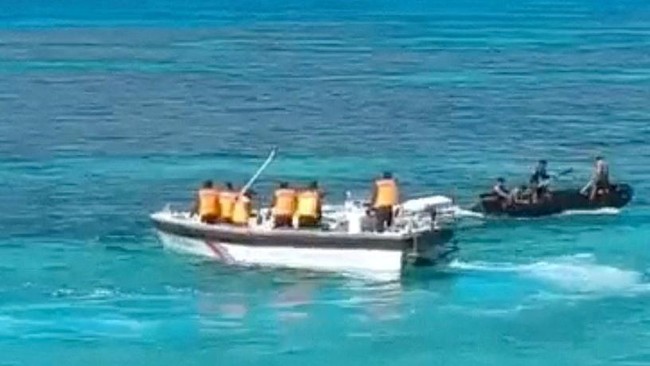
In recent days, the Philippine coastguard sent one of its largest vessels and an aircraft to Batanes to drive away a Chinese ocean-survey ship. The vessel was subsequently supported by the Chinese coastguard.
The Philippines said the Chinese vessel was operating in its exclusive economic zone (EEZ) without permission. China’s embassy in the Philippines, by contrast, said the vessel was operating in waters under Chinese jurisdiction.
China also called on the Philippines to stop interfering with and exaggerating what it described as normal Chinese shipping and scientific research activities.
For Beijing, seemingly harmless academic discussion can serve as a means of gauging international reactions to new territorial arguments.
Chinese academics have previously questioned Japan’s sovereignty over the Ryukyu Islands, including Okinawa, as well as over the uninhabited Senkaku Islands north-east of Taiwan.
Publishing academics’ views can also be another way for Beijing to pressure rival countries. Although no Chinese official has formally endorsed a claim to Batanes, the academic discussion emerged after the Philippines and Japan began talks on maritime boundaries in waters east of Taiwan, an area Beijing also regards as its territory.
Some analysts say a claim to Batanes could provide additional justification for Chinese vessels to operate beyond the group of islands known as the First Island Chain.
The chain stretches from Japan to the Philippines and is regarded as one of the US’s key lines of defence in a Pacific conflict. Earlier this year, the Chinese coastguard also stepped up patrols east of Taiwan.
Ray Powell, executive director of the SeaLight Foundation, which monitors Chinese activity around the South China Sea, said Beijing remained interested in building a legal argument for its claims.
“Law – sometimes we think it doesn’t matter to China, but it actually does,” Powell said.
“They want to have a basis to justify themselves, even if no one outside China really believes it.”
The Philippines has strengthened its military presence in Batanes, including by opening a new forward operating base last year.
Rommel Jude Ong, a former Philippine Navy rear admiral who is now with the Manila-based Stratbase Institute, said the Philippine government should take further steps to strengthen the territory’s defences.
“Perhaps that would complicate China’s calculations regarding Taiwan,” he said.
“If it cannot prevent it, at least it could delay any crazy idea China might have of invading Taiwan.”
Some local residents, meanwhile, are concerned about Batanes’ fate if a conflict with China were to break out. It is the least populous of the Philippines’ 82 provinces.
“We hope they respect the boundaries we have,” said Mark Anthony Castillo, a 34-year-old tour guide in Basco, the capital of Batanes.
“We just want to live a simple, normal life here.”
Source: jawawa.id (https://jawawa.id/newsitem/why-is-china-eyeing-the-philippine-islands-near-taiwan-1791622237)
Originally published by CNBC Indonesia (https://www.cnbcindonesia.com/news/20261010112821-4-774927/china-incar-kepulauan-filipina-dekat-taiwan-ada-apa), translated from Indonesian