
Why has pig farming in Malaysia’s Selangor state become a hot political issue?
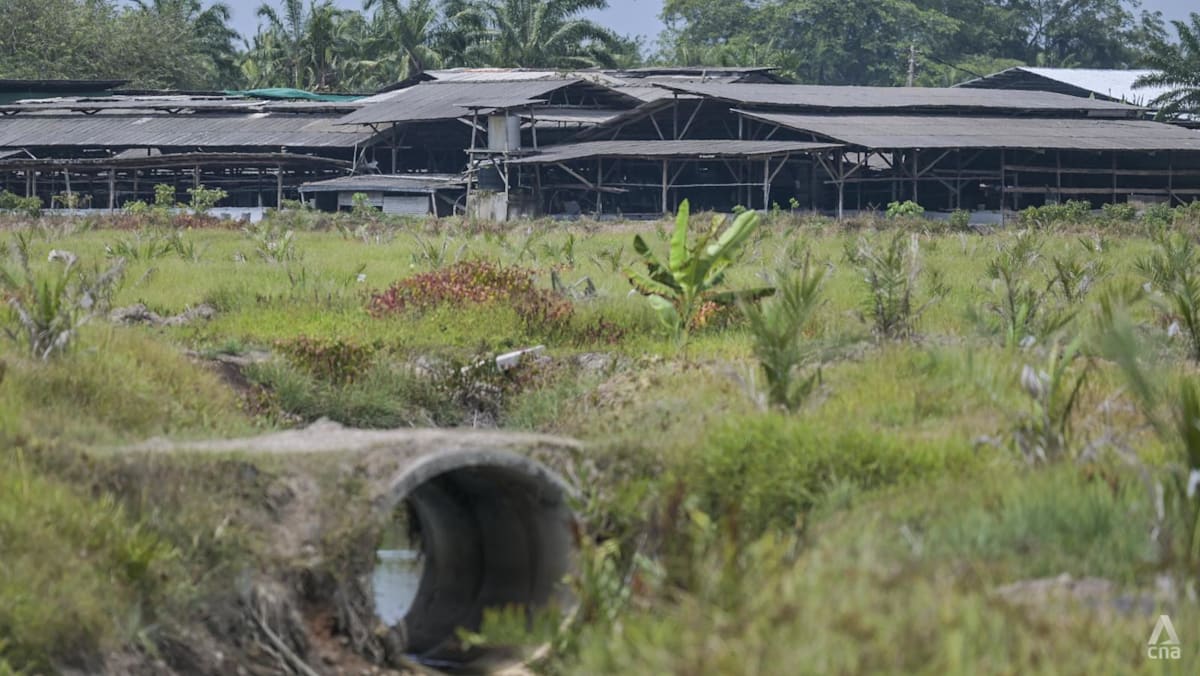
Why has pig farming in Malaysia’s Selangor state become a hot political issue?
The Selangor Sultan decreed in February that pig farming should not be allowed in the Malaysian state, but a politician’s recent suggestion that a modern farming system be allowed instead has sparked a political storm.
KUALA LUMPUR: For decades, Selangor’s pig farmers have operated on a quiet stretch of the coast south of Kuala Lumpur.
Tanjung Sepat and its surrounding areas in the district of Kuala Langat, about a 50km drive from Kuala Lumpur International Airport, once had more than 110 farms. Today, only about 30 remain.
The industry finds itself fighting for survival in the state, caught in the crosshairs of a political battle following a decree in February by Selangor’s Sultan Sharafuddin Idris Shah to shut down.
Chen (not his real name), a second-generation farmer whose family has occupied its current site for 15 years, told CNA many of his peers are ready to move on. Facing a dead end with pig farming, they are exploring alternatives like poultry or aquaculture.
“Many just want to give up and are negotiating with the state government for transition support,” said Chen, who spoke on the condition of anonymity.
“The Sultan has already made his stance against pig farming clear; I don’t see a way forward. We have been fighting for so long and the mental anguish just isn’t worth it. We are just like a ball kicked from one department to the next,” he said.
Although the state government has ordered the farmers to clear out by June, Chen is hoping for a reprieve until December. An extension would ensure his 200 pigs reach their optimal weight, preventing significant financial losses.
But the status of the farms remains unclear.
A government minister was widely quoted by local media on Wednesday (May 6) afternoon as saying that pig farms in Selangor will be allowed to operate in areas located far from residential zones and critical water sources, and must use the latest technology to manage waste and pollution.
But the news reports were taken down later, with no reasons given.
The issue had become heavily politicised in recent weeks after a Democratic Action Party (DAP)’s state assemblyperson proposed a modern, closed system for farmers in spite of the sultan’s decree.
Opposition politicians seized upon it, accusing her of disrespecting royalty.
Analysts say the DAP – part of the ruling Pakatan Harapan coalition – now finds itself in a “catch-22” situation, caught between its duty to defend constituents’ livelihoods, and appearing to defy the monarchy.
HOW PIG FARMING TURNED POLITICAL
Pork production and consumption are traditionally sensitive topics in Malaysia, given that 63.5 per cent of the population is Muslim and pork is prohibited in Islam.
The latest issue surfaced in January, when the Selangor state government announced plans to move the traditional, scattered farms around Tanjung Sepat to a centralised and modern facility in Bukit Tagar, Hulu Selangor, by 2030.
The 202-hectare zero-emission closed farming system in Bukit Tagar would allow the industry to be managed systematically, improving hygiene and waste management, said State Infrastructure and Agriculture Committee Chairman Izham Hashim.
Most pig farms in Selangor – which has the third-largest pig farming industry in the country after Perak and Sarawak – currently operate open-air systems.
The future site would have a buffer zone, and Izham said the state government wanted to “ensure this industry is well-managed to guarantee food supply, hygiene, community harmony and disease risk control”.
But Bukit Tagar was identified as a Malay-majority area and residents opposed the project.
Sultan Sharafuddin then decreed on Feb 10 that pig farming should not be allowed anywhere in the state. He said it could cause air pollution through foul odours and contaminate river water sources due to the discharge of waste and sewage.
There was a risk of polluting water catchment areas and rivers supplying treated water to Selangor, Kuala Lumpur and Putrajaya, the ruler said.
He also pointed to the state’s limited land availability and high property values, saying land should be prioritised for more economically beneficial uses that could better serve the community.
The government could grant licences for the import of pork to meet the demand and needs of non-Muslims in the state, he suggested.
Selangor currently produces 30 per cent of its pork needs and imports the rest from other states.
Following the decree, the Selangor state government announced it would stop issuing new pig farming licences and accelerate the phased closure of existing farms, moving towards 100 per cent imports.
Despite the royal decree, DAP’s Seri Kembangan assemblyperson Wong Siew Ki on Apr 22 proposed a modern, closed farming system.
She said pig farming should not be treated differently from other livestock industries, noting that modern technology could address concerns like pollution, hygiene and odour.
She cited Article 8 of the Federal Constitution, which touches on equality, to argue against singling out pig farming for a total ban.
“Pig farming should not be treated differently from other types of livestock farming. The risks of pollution, as well as hygiene and health aspects in pig farming, are identical to those faced by other livestock industries,” she said.
Wong said her proposal was based on feedback from constituents and aimed to find a sustainable way for the industry to exist within the state.
A massive backlash ensued in the state assembly and public arena, culminating in multiple police reports lodged against her for allegedly touching on sensitive issues.
Members of the opposition coalition Perikatan Nasional (PN) attempted to table a motion to refer Wong to the Rights and Privileges Committee while the Selangor youth chapter of Parti Islam Se-Malaysia (PAS) - a party in PN - demanded her immediate suspension.
“Since the Ruler’s decree is clear that pig farming is no lon