
Why Has ‘Bismillah’ Become a Slogan at Protests in France?
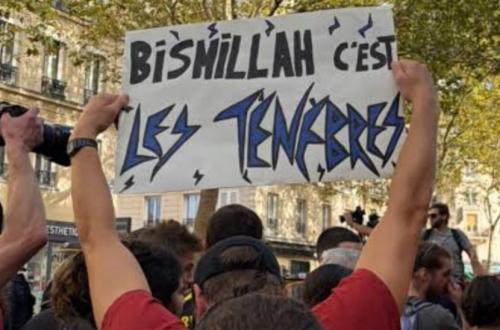
PARIS — A strange French-Arabic phrase, “Bismillah, c’est les ténèbres”, has gone viral on social media and become a slogan at student demonstrations in France. Roughly meaning “In the name of God, it is darkness”, it has been used to mock alleged police infiltration of student chat groups.
The phenomenon began with screenshots of a Snapchat conversation that circulated in early October 2026. Some students suspected that an account posing as a pupil had joined chat groups used to organise school blockades.
Middle East Eye reported that, in one widely shared message, a user named Mamadou wrote: “Salut! Bismillah c’est les ténèbres. C’est quand le blocus wallah mon frangin. On va tous casser. Met moi dans le groupe blocus Aichek.”
The message roughly translates as: “Hello! Bismillah, it is darkness. When’s the blockade, my brother? We’re going to smash everything. Put me in the blockade group.”
The choice of words and awkward phrasing quickly aroused suspicion. The user was seen as trying to imitate the way young people speak in French suburban areas, many of which are home to people of North African descent and Muslim communities.
However, the account holder’s identity and the allegation of police involvement in the conversation have not been independently verified. France’s National Police, Le Monde reported on 15 October, said it had no details about the case that had become a talking point.
The phrase quickly spread from digital conversations to TikTok, Instagram and X. Hundreds of parodies appeared, and the wording began showing up on student protest posters and banners.
The phrase’s absurdity has been part of its appeal. The combination of “bismillah”, Arabic for “in the name of God”, and the French phrase “c’est les ténèbres”, or “it is darkness”, was considered nonsensical in the context of the message.
But its popularity has not been driven by humour alone. Students have also used the slogan to satirise alleged surveillance of their movement and ridicule what they see as a botched attempt to imitate young people’s speech.
According to French media reports, the New Anticapitalist Party (NPA) has also adopted the slogan. The party used it in material reminding students of their rights if detained by police, including the right to legal representation.
The phrase has also spilled into public spaces. Demonstrators have carried it at rallies, while videos and parodies circulating on social media have prolonged the phenomenon.
Behind the humour, the controversy has prompted criticism of racial stereotyping of young people of immigrant descent in France.
In the circulating messages, names associated with the Maghrebi community, repeated references to Algeria, and a mix of Arabic and French were used in an exaggerated way. Critics say this portrays young people from minority groups as if they were inherently associated with rioting and vandalism at demonstrations.
Suspicion about the accounts has since broadened into wider criticism. Students have not only mocked the contrived language, but have also questioned how authorities view young people from working-class neighbourhoods and minority communities.
The meme has therefore become a way to turn stigma back on its source. Elements apparently used to imitate a particular group’s identity have instead become material for mocking those suspected of being behind the account.
Nevertheless, it is important to distinguish criticism of the stereotyping in the messages from conclusions about who created them. The circulating screenshots do not, in themselves, prove that the account holder was a police officer.
The case comes as social media has become a major arena in the battle over narratives between student protesters and French security forces.
Le Monde reported on 15 October that France’s National Police acknowledged adapting its communications strategy to the nature of student mobilisation and the major role social media plays in coverage of demonstrations.
The police have used digital platforms since 2012. Their official accounts on TikTok, Facebook, Instagram and X now have a combined following of around 3.5 million, according to the report.
Amid the wave of demonstrations, accounts supporting students have shared videos mocking police or highlighting alleged excessive force. In turn, official police and prefectural accounts have published footage intended to explain officers’ actions on the ground.
Le Monde also reported that France’s General Inspectorate of the National Police is handling 36 cases involving alleged police violence. Four concern injuries resulting in disability, while six involve serious injuries.
In this context, the “Bismillah, c’est les ténèbres” meme has become part of a broader communications dynamic. The slogan shows how a message that first circulated in a private chat can develop into a symbol of resistance when combined with humour, suspicion of the authorities and young people’s distrust.
The phenomenon also demonstrates that Generation Z protests do not take place only in the streets. Social media, slang, parody and meme culture serve as tools for building solidarity, attracting public attention and expressing political criticism in ways that can spread rapidly.
Source: jawawa.id (https://jawawa.id/newsitem/why-has-bismillah-become-a-slogan-at-protests-in-france-1792335035)
Originally published by Republika (https://news.republika.co.id/berita/tn3x49393/mengapa-bismillah-jadi-slogan-unjuk-rasa-di-prancis), translated from Indonesian