
Why Has Australia Delayed Buying 28 F-35s?
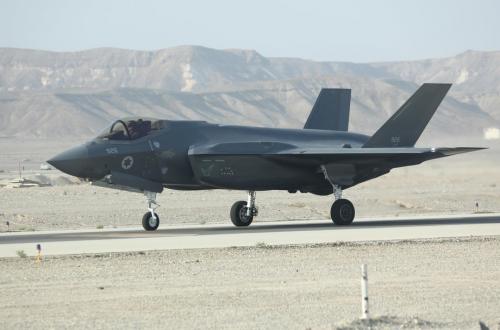
JAKARTA — Australia has not proceeded with its plan to buy an additional 28 F-35A Lightning II stealth fighters from the United States. The decision, which delays the formation of a fourth squadron of fifth-generation aircraft, reflects a major shift in Canberra’s defence priorities. Rather than expanding its fighter fleet, the Australian government has chosen to strengthen its long-range weapons, extend the service life of its F/A-18F Super Hornets and develop future air-warfare technologies.
The decision has gained renewed significance after the Australian government announced on 6 August 2026 an investment of nearly A$736 million to buy AIM-260 Joint Advanced Tactical Missiles (JATMs) from the United States. The new-generation missiles are to be integrated first with the Super Hornet, followed by the F-35A Lightning II and EA-18G Growler electronic-warfare aircraft.
The latest development involving the Super Hornet’s capabilities emerged on Wednesday (21 October 2026). US defence publication The War Zone reported that a US Navy F/A-18F Super Hornet had been seen carrying two types of long-range air-to-air missiles at once: the AIM-260 Joint Advanced Tactical Missile (JATM) and the AIM-174B. The sighting points to efforts by the US military to expand the Super Hornet’s weapons capabilities against modern air threats, including in long-range combat scenarios.
Although the aircraft in the report belonged to the US Navy, not Australia, the development is relevant to Canberra’s decision to retain its Super Hornet fleet. Australia has announced the acquisition of AIM-260 missiles to improve its air-combat capability, with the Super Hornet among the first platforms planned to carry them. However, the US aircraft’s appearance with two types of missiles does not mean that the Royal Australian Air Force has adopted the same configuration.
Australia will be the first country outside the United States to operate the AIM-260 Joint Advanced Tactical Missile (JATM). Defence Connect, an Australian defence publication, reported on 6 August 2026 that Canberra had allocated nearly A$736 million for the missiles to enhance its long-range air-combat capability.
The shift comes after the Royal Australian Air Force (RAAF) received all 72 F-35As ordered from Lockheed Martin. The fleet achieved Final Operational Capability (FOC) on 7 July 2025, as Australian defence officials subsequently confirmed during parliamentary discussions in December 2025.
With this milestone, Australia has three F-35A squadrons that meet operational-capability requirements, including those for personnel, training, infrastructure and maintenance systems.
However, the question of whether to add 28 aircraft to establish a fourth squadron has not been completely settled.
Why Has Australia Delayed Buying 28 F-35s?
The roots of the decision can be traced to the announcement of Australia’s National Defence Strategy in April 2024.
The government decided at the time not to proceed with a fourth F-35A squadron in the near term. Some funds that could have been used for the purchase were redirected to long-range strike capabilities and other defence priorities.
Australia’s defence industry minister at the time, Pat Conroy, offered a striking explanation. He said there were two main reasons for retaining the Super Hornet for longer. First, the aircraft continued to deliver strong combat capability. Second, the F-35’s capabilities had proved greater than initially expected.
“We decided to keep the Super Hornet for two reasons. First, those aircraft are performing very well. Second, the Joint Strike Fighter is even more capable than we originally expected,” Conroy said, as reported by Australian Aviation in April 2024.
The statement indicated that the delay in buying additional F-35s was not due to an assessment that the aircraft had failed to meet Australia’s military requirements.
Instead, the capabilities of the 72 F-35As already ordered were considered strong enough to support a shift in investment priorities over the medium term.
Conroy stressed that the government did not want to retire the Super Hornet prematurely while it continued to offer significant operational value.
“We will consider its replacement further down the track, and that could be another squadron of Joint Strike Fighters or another air capability,” he said in an official Australian government transcript dated 18 April 2024.
He added that savings from extending the Super Hornet’s service life would be used to bolster long-range strike capabilities for the Air Force and Army, as well as support the expansion of Australia’s surface warship fleet.
Canberra’s decision is therefore a deferral and reprioritisation of investment, rather than a permanent cancellation of all plans to buy additional F-35s.
Australia Has 72 F-35As — What Else Does It Need?
Australia is one of the largest F-35A operators outside the United States. The first two aircraft arrived at RAAF Base Williamtown in New South Wales on 10 December 2018. Deliveries took place in stages, with the final nine aircraft arriving in December 2024.
Australia’s Department of Defence said the arrival of the final nine aircraft marked the completion of the government-approved order for all 72 jets.
The F-35A is a fifth-generation multi-role fighter combining stealth technology, integrated sensors, precision-strike capability and electronic-warfare systems.
It can conduct air-combat and ground-attack missions, as well as reconnaissance and intelligence-gathering in complex threat environments.
The RAAF operates its F-35As through three fighter squadrons: No. 3 Squadron, No. 75 Squadron and No. 77 Squadron.
The aircraft replaced the previous-generation F/A-18A/B Hornets, which have been retired from Australian Air Force service.
The F-35A does not operate alone, however. Australia also retains 24 F/A-18F Super Hornets and 12 EA-18G Growlers as part of its air-combat and electronic-warfare capabilities.
This combination allows Australia to deploy different aircraft for different missions, ranging from precision strikes and air defence to suppressing an adversary’s radar systems.
Increasing the number of F-35s is therefore not the only way to improve the RAAF’s combat capability.
Modernising weapons, sensors, communications networks and logistical support also determines how effectively the existing fleet can operate.