
Why Does the T-Rex Have Tiny Arms? Here’s What Scientists Say
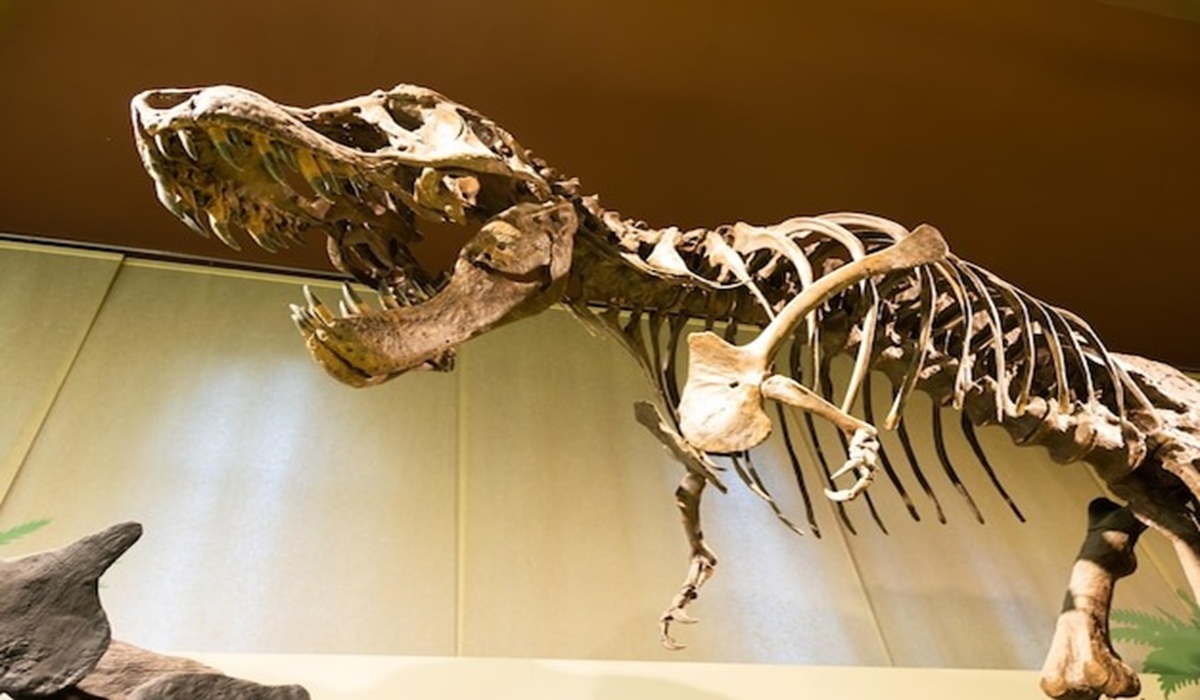
Tyrannosaurus rex (T-Rex) has an intriguing anatomy. Beneath its massive body and deadly jaws, the dinosaur is often the subject of jokes due to its small forelimbs. Now, scientists may have found the reason behind the T-Rex’s tiny arms. A recent study reported by Science Alert suggests that the reduction of the T-Rex’s forelimbs likely occurred because the dinosaur increasingly relied on its head and jaws to hunt.
Researchers explain that as prey size grew larger in prehistoric times, predatory dinosaur groups such as tyrannosaurs began developing stronger jaws as their primary weapon. With the arms’ function diminished, their size gradually decreased through evolution.
“We want to understand what drives this change and find a strong link between short arms and a large, robust head,” said Charlie Roger Scherer, a vertebrate palaeontologist at University College London. According to Scherer, the dinosaur’s head eventually took over the function of the forelimbs as the main tool for attacking prey. He described this phenomenon as the “use it or lose it” principle, whereby body parts that are rarely used will shrink over time.
In the same period, sauropod dinosaurs evolved into the largest land animals ever to have lived on Earth. Some of them reached lengths of around 30 metres. In such circumstances, even strong arms were not effective enough to restrain huge prey. This is why predators such as the T-Rex began to rely on an extraordinarily powerful bite.
The study notes that the jaws of giant theropods possessed the strongest bite force among land animals studied. “Attacking and restraining prey with the jaws is likely far more effective than scratching with the arms,” said Scherer.
Although the T-Rex remains the best-known example, the short-arm phenomenon has also been observed in various other theropod groups, i.e., carnivorous dinosaurs with similar body types. In the study, researchers compared the size of the forelimb with skull length and bite force across 61 theropod species. The results showed a strong association between short arms and robust skulls in five families of predatory dinosaurs: Tyrannosauridae, Abelisauridae, Carcharodontosauridae, Megalosauridae, and Ceratosauridae.
Interestingly, body size did not always determine arm length. Some predators still possessed small arms even when their bodies were not particularly large, provided they had heads and jaws that were strong. Researchers also found varying patterns of arm reduction across species. In some dinosaurs, the entire arm shrank together, while in others only certain parts reduced more drastically.
Despite their small appearance, the T-Rex’s arms were not weak. Scientists estimate the dinosaur could still lift more than 100 kilograms using the muscles in its forelimbs. As a result, experts suppose the arms retained some function. Some theories suggest the T-Rex may have used its arms to help it stand after resting, to grasp a mate during mating, or to injure prey with its claws. There is also a unique theory that short arms evolved so they would not be easily bitten by rivals when competing for food. However, the researchers note that if their hypothesis is correct, the development of the large head likely occurred before the arms began to shrink.
“Evolving, it would not make sense for a predator to lose its weapon without having a more effective substitute,” said Scherer.
A Yale and Princeton study suggests that dinosaurs emerged around 250 million years ago, earlier than the oldest fossil record, prompted by ecological opportunities following a mass extinction. The Carnian Pluvial Event, an extreme climate episode spanning two million years, triggered both mass extinction and the rise of dinosaurs. Recent research from Yale and Princeton indicates dinosaurs may have appeared about 250 million years ago, earlier than the oldest fossil record. Other studies reveal herbivorous dinosaurs did not eat haphazardly but used their front teeth to select parts of plants. Research from the Chinese Academy of Sciences shows wear patterns on Psittacosaurus teeth that indicate feeding habits.