
Why Do Tectonic Earthquakes Frequently Occur in Indonesia? The Geological Explanation
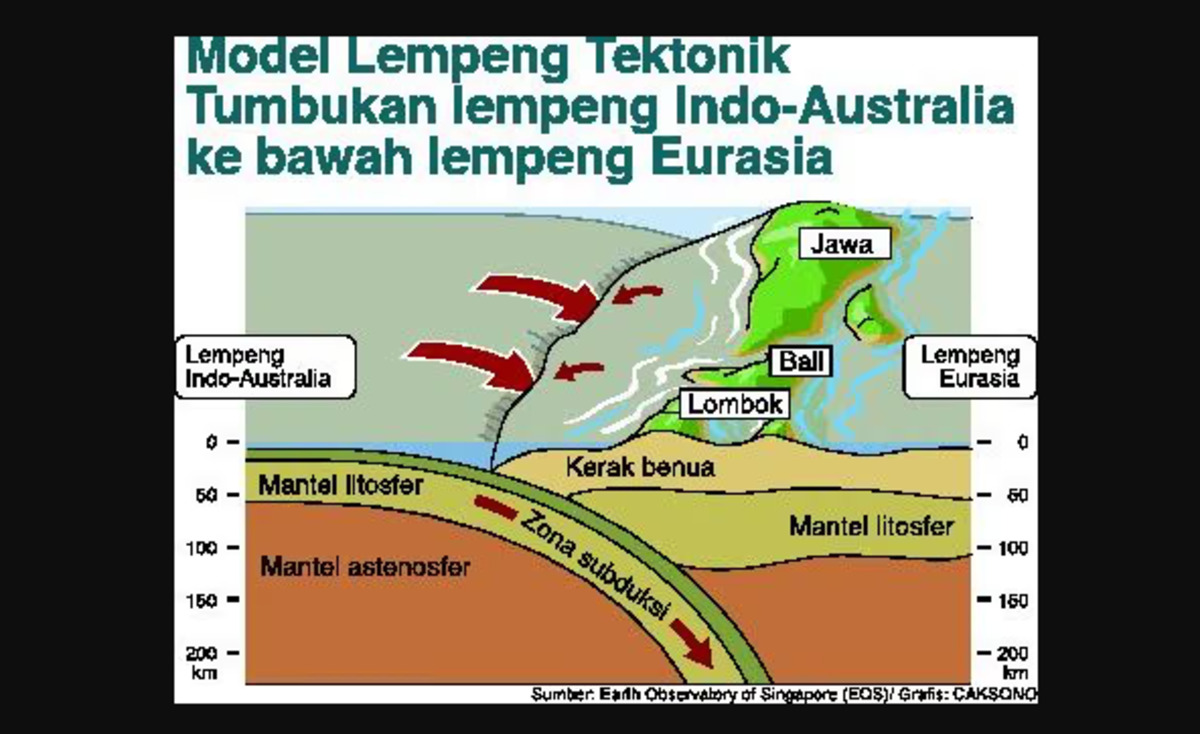
Indonesia is one of the countries with the highest seismic activity in the world. Almost every day, earth tremors are recorded by meteorological and geophysical sensors across the archipelago, ranging from small, imperceptible vibrations to large, destructive shocks. This phenomenon is not a mere coincidence, but a logical consequence of Indonesia’s geographical and geological position at the intersection of Earth’s massive forces.
In general, tectonic earthquakes occur due to the release of energy from the shifting of Earth’s plates. In Indonesia, the high frequency of earthquakes is closely related to the complex interaction between major tectonic plates and the presence of active mountain ranges. Understanding the reasons behind this phenomenon is crucial as a foundation for sustainable disaster mitigation.
The primary reason why Indonesia frequently experiences tectonic earthquakes is its position at the meeting point of three major tectonic plates: the Indo-Australian Plate, the Eurasian Plate, and the Pacific Plate. In addition to these three main plates, the Philippine Sea Plate also influences the tectonic stability in the eastern region of Indonesia.
The movement of these plates is not smooth. Friction and energy accumulation occur in these convergence zones. When the rocks in these zones can no longer withstand the pressure, energy is released suddenly in the form of seismic waves known as earthquakes.
The interaction between plates in Indonesia creates what is known as subduction zones. These zones extend from western Sumatra, southern Java, Bali, and Nusa Tenggara, to the regions of Maluku and Sulawesi. In subduction zones, the heavier oceanic plate dives beneath the lighter continental plate.
This subduction process creates deep oceanic trenches and serves as the primary source of megathrust earthquakes. Megathrust earthquakes have the potential for immense magnitude (above 8.0) and often trigger tsunamis due to the vertical deformation of the seabed.
Indonesia is located on the Pacific Ring of Fire. This path is a chain of active volcanoes and fault zones encircling the Pacific Ocean. Approximately 90% of the world’s earthquakes occur along this path.
The existence of the Ring of Fire is not only related to volcanic activity but also indicates that the Earth’s crust in this region is highly unstable. Active faults formed by the dynamics of the Ring of Fire act as triggers for shallow tectonic earthquakes, which are often more destructive to residential areas.
In addition to earthquakes originating from the sea (subduction zones), Indonesia is also filled with a network of active faults on land. These faults are formed due to the immense pressure from the movement of large plates that propagates into the continental crust.
Some famous large faults in Indonesia include various active fault lines. Earthquakes originating from land faults usually have shallow depths. Although their magnitude may not be as large as sublec subduction earthquakes, their destructive power can be very high because the epicentre is very close to the surface and human infrastructure.
Tectonic earthquakes cannot be accurately predicted in terms of timing. However, geologists can map areas with the highest potential for energy accumulation (seismic gaps) to increase vigilance.
These geological conditions bring dual consequences for Indonesia. On one hand, millions of years of tectonic and volcanic activity have created fertile soil and abundant mineral wealth. On the other hand, the Indonesian people must live alongside the constant risk of disaster.
The high frequency of earthquakes demands strict infrastructure construction standards, such as the implementation of earthquake-resistant buildings, as well as continuous disaster mitigation education for the community so that the risk of loss of life and material damage can be minimised.
Source: jawawa.id (https://jawawa.id/newsitem/why-do-tectonic-earthquakes-frequently-occur-in-indonesia-the-geological-explanation-1789142136)
Originally published by Media Indonesia (https://mediaindonesia.com/humaniora/932448/mengapa-gempa-tektonik-sering-terjadi-di-indonesia-ini-penjelasan-geologisnya), translated from Indonesian