
Why do ships lose stability when facing large waves?
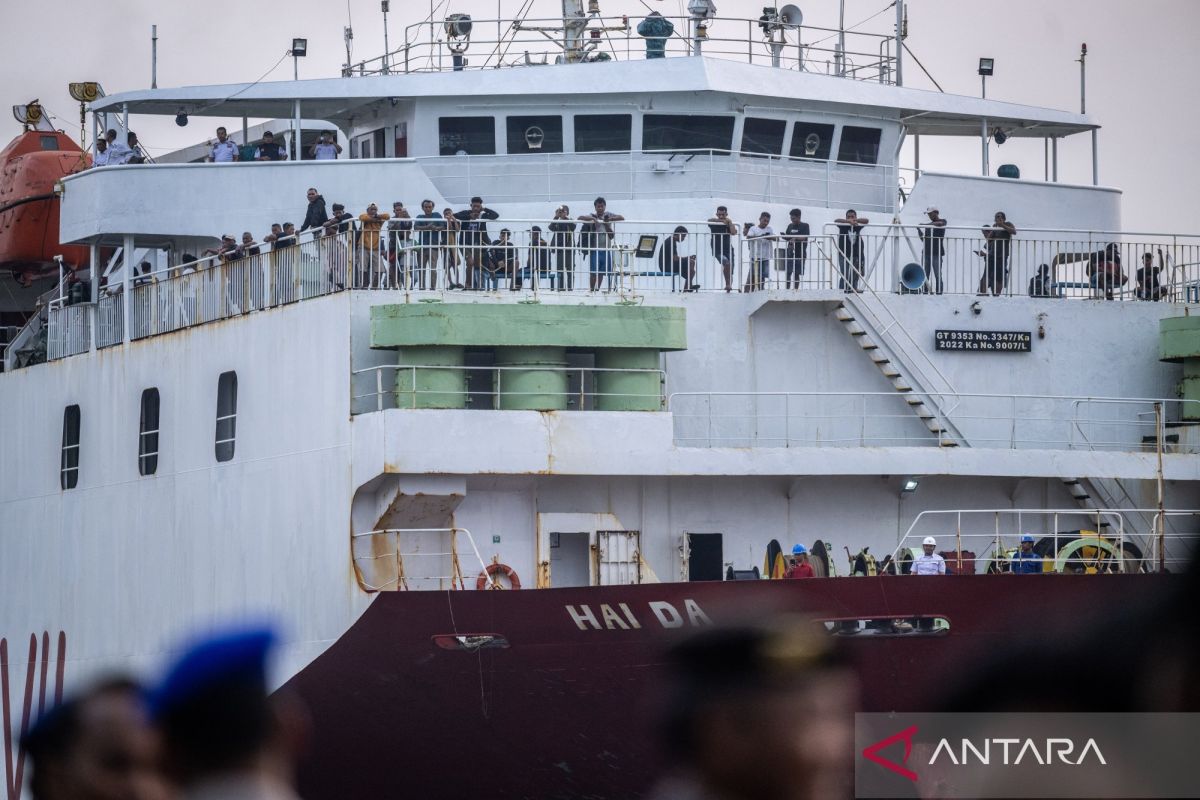
Jakarta (ANTARA) - Incidents involving ships in Indonesian waters have again drawn attention after KM Virgo Transport 8, sailing from Surabaya to Banjarmasin, met with an accident in the Java Sea. The vessel had previously been reported to be facing bad weather, and the captain reported that the ship was listing before contact was lost. In the latest development, the SAR team is still searching for passengers who have not yet been found. Reuters reported that waves at the scene could reach around three metres when the vessel capsized.
At almost the same time, the search operation for five journalists and three others who lost contact in the waters of the Sunda Strait while covering the eruption of Mount Anak Krakatau is still under way. Entering its seventh day, Basarnas deployed 18 vessels and one helicopter to expand the search area to 6,649 square nautical miles.
These two events once again show that sea conditions can change rapidly. One of the risks that needs to be understood is the loss of a ship’s stability when it faces large waves.
So why can a ship of such enormous size list, capsize, or even sink when struck by waves?
Simply put, stability is a ship’s ability to remain in a balanced position when subjected to external forces, including waves, wind, currents, or the movement of cargo.
A ship does not always have to be perfectly upright. When struck by waves from the side, for instance, the hull can temporarily lean. As long as the vessel still has the ability to return to its original position, the condition remains within stable limits.
In naval science, this ability relates to the relationship between the ship’s centre of gravity, its centre of buoyancy, and the shape of the hull. Changes in the position of cargo can also alter this condition.
Ocean waves do not merely make a ship rise and fall. When waves come from a certain direction, especially from the side, water pressure can push the hull, causing the ship to lean.
The larger the waves and the stronger the forces acting on the ship, the greater the angle of heel.
The situation becomes more dangerous when the ship is positioned so that waves continuously push against the same side, or when waves arrive in a pattern that is unfavourable to the ship’s movement.
For this reason, the size of a ship alone cannot guarantee that it will always be safe when facing large waves.
Shifting cargo can also disturb balance
A ship’s stability is not determined by hull shape alone. The distribution of weight inside the vessel is also crucial.
Imagine a box containing heavy objects. When those objects shift to one side, the box tips over more easily. The same simple principle applies to ships.
If cargo shifts due to the movement of the ship and waves, the vessel’s centre of gravity can change. This can make it increasingly difficult for the ship to return to an upright position.
For vehicle ferries, for example, the arrangement and securing of vehicles is an essential part of safety. Poorly distributed cargo can affect the ship’s balance.
Once a ship has taken on a severe list, seawater can enter through open or damaged sections.
The ingress of water does not simply make the ship heavier. Water moving freely inside the ship’s compartments can also affect weight distribution and reduce the vessel’s ability to right itself.
This phenomenon is known in ship stability science as the free surface effect.
In simple terms, water sloshing from one side to the other can shift the ship’s effective centre of gravity as it rolls. As a result, the ship can become increasingly unstable.
Waves from the wrong direction can become a problem
Ships are designed to face a variety of sea conditions, but the direction from which waves approach remains a critical factor.
Waves coming from ahead or astern produce a different response compared with waves striking from the side.
When waves hit a ship’s flank, the vessel can experience rolling motion. If the rolling grows more severe, the risk of the ship losing stability increases.
In poor sea conditions, the captain and crew must consider the direction of the waves, the ship’s speed, the condition of the cargo, and the vessel’s ability to handle the situation.
Why can a ship end up capsizing?
A ship can capsize when its angle of heel becomes too great and the force that should restore it to an upright position can no longer counterbalance it.
At a certain point, a ship can pass beyond its stability limit. After that, it can continue listing until it finally turns over.
This process is usually not caused by a single factor. Wave conditions, wind, cargo distribution, flooding, the vessel’s characteristics, and operational decisions can all be interrelated.
Therefore, the precise cause of a capsizing must be determined through examination and investigation of the ship’s condition and the circumstances at the time of the accident.
Not necessarily.
Larger ships generally do behave differently from smaller ones when facing waves. However, safety is not determined by size alone.
The ship’s design, hull condition, cargo distribution, centre of gravity, weather conditions, wave height, wave direction, and the way the ship is operated all have an influence.
That is why even a very large ship still has limits to the sea conditions it can withstand.
The case of KM Virgo Transport 8 shows how bad weather can play a crucial part in a maritime accident. According to initial reports, the captain had already reported bad weather before then reporting that the ship was listing.
During the SAR operation, choppy seas and strong winds have also posed challenges for rescue teams.
However, this does not automatically mean the waves were the sole cause of the accident. The exact cause still requires a thorough investigation.
The same applies to various other ship accidents. Terms such as ‘struck by waves’ describe the circumstances, but do not necessarily explain the full chain of causes behind a ship’s loss of stability.
Ultimately, ship stability is the result of many interrelated factors. Large waves can exert very powerful forces, but how a ship responds to those forces is also shaped by its design, cargo, weight distribution, condition, and manner of operation.
Therefore, when sea weather begins to deteriorate, operational decisions and preparedness become just as important as the strength of the ship itself, as summarised by Antara from various experts.