
Why do Komodo dragons only exist in Indonesia? Here's the reason
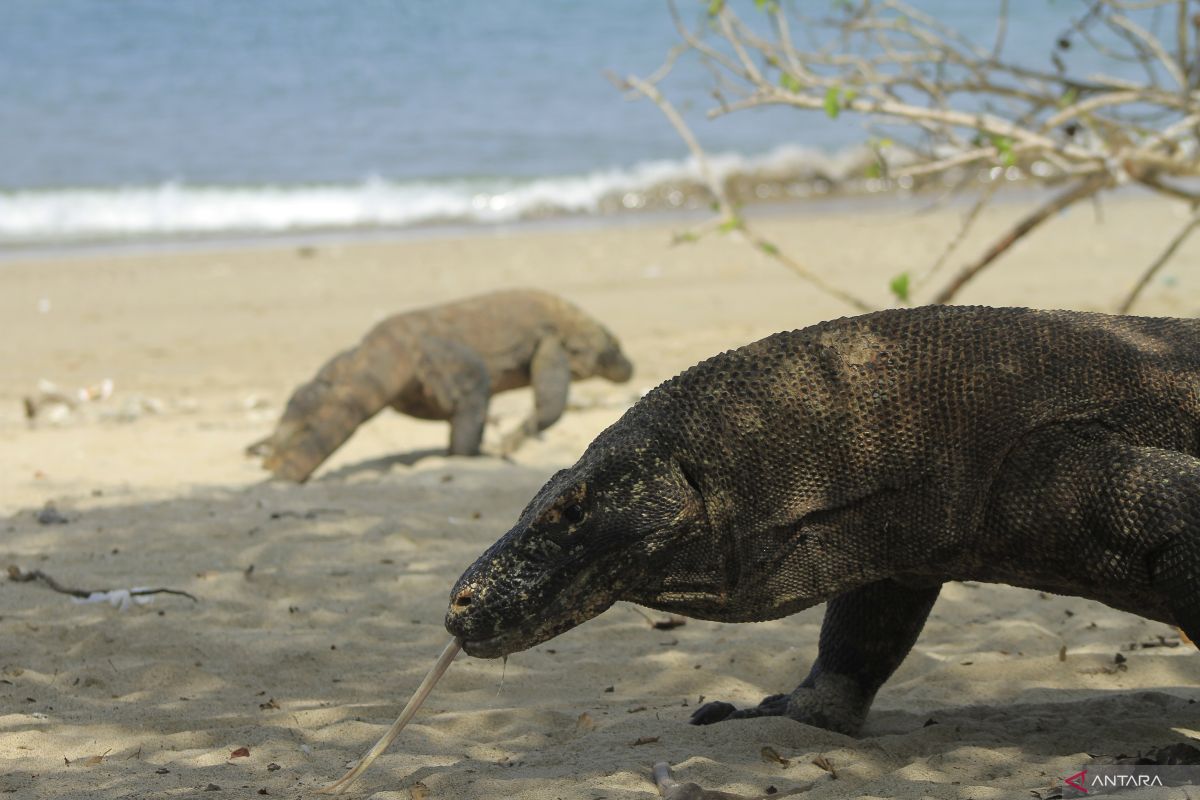
Jakarta (ANTARA) - The Komodo dragon is one of the animals most closely associated with Indonesia. This reptile, scientifically named Varanus komodoensis, has a large body and distinctive appearance, making it easily recognisable compared with other lizard species.
Interestingly, the Komodo dragon is endemic to Indonesia. This means that, in the wild, it is found only in certain parts of Indonesia and has no natural wild population in any other country.
So why can the Komodo dragon only be found in Indonesia?
Its natural habitat lies on several islands in East Nusa Tenggara. Besides Komodo Island, the animal is also found on Rinca Island, Gili Motang, and parts of Flores Island.
Komodo National Park, located between Flores and Sumbawa islands, is one of the key areas for the species’ survival. The area has distinctive natural conditions, ranging from savanna grasslands and monsoon forests to coastal zones.
A relatively dry and hot environment is one of the defining characteristics of a suitable Komodo habitat. The Indonesian government has also designated the area as a national park to protect the Komodo dragon and its ecosystem.
Documents from the Ministry of Environment and Forestry describe Komodo National Park as the habitat of Varanus komodoensis, an ecosystem featuring extensive savanna grasslands, limited water sources and fairly high temperatures.
Shaped by a long evolutionary process
The presence of the Komodo dragon only in certain regions did not happen suddenly. The archipelagic geography played a role in the animal’s evolution and distribution.
The islands where Komodo dragons live are separated by the sea. Over a very long period, this caused their populations to develop in relatively isolated environments.
Geographic isolation can cause a population to change and adapt to its surroundings. Through an evolutionary process spanning many generations, these characteristics became increasingly distinctive.
Because its habitat is limited to certain islands, the Komodo dragon has ultimately become one of the world’s best-known examples of an endemic animal.
Food is also available in its habitat
The Komodo dragon is a predator occupying a key position in its ecosystem. One of its main food sources is the Timor deer, although it can also prey on various other animals found in its habitat.
The availability of these food sources makes East Nusa Tenggara a habitat that supports the Komodo dragon’s survival.
Why has the Komodo dragon not spread to other countries?
One reason relates to geography. Its natural habitat consists of islands separated by the sea, and the movement of land animals from one island to another naturally faces limits.
Moreover, the Komodo dragon requires specific environmental conditions and food sources to survive. Not all regions have the right combination of habitat, climate and food to sustain its population.
The long history of evolution and geographic change over vast timescales has also shaped the Komodo dragon’s present-day distribution.
In other words, the Komodo dragon did not simply “choose” to live in Indonesia. It is the product of a very long evolutionary journey that adapted to the distinctive island environment of East Nusa Tenggara.
A symbol of Indonesia’s natural wealth
The Komodo dragon’s uniqueness gives the animal significant scientific and conservation value. Komodo National Park has even been designated a UNESCO World Heritage Site since 1991.
This status underlines the importance of protecting the Komodo dragon’s habitat and the surrounding ecosystem. Threats to the habitat can have a direct impact on the survival of the population, as the species’ range is relatively limited.
In short, the reason the Komodo dragon lives naturally only in Indonesia is closely tied to the archipelago’s geography, the evolutionary process, habitat conditions and the availability of food sources.
The existence of this ancient animal also serves as a reminder that Indonesia possesses biodiversity not always found elsewhere in the world. Protecting its habitat means helping to preserve one of Indonesia’s most unique natural heritage treasures.