
Why Disaster Go-Bags Should Contain Three Days’ Worth of Emergency Supplies
Jakarta, CNBC Indonesia — At least 35 countries have asked their citizens to prepare for emergencies by stockpiling food, water and medicines.
Thailand is the latest country in Asia to join this preparedness drive. The Department of Disaster Prevention and Mitigation (DDPM) is now actively urging every household to prepare an emergency bag for the first 72 hours.
Citing Newsweek, The Nation and Anadolu Agency on Friday (6 November 2026), the global call is linked to the threats of war, extreme weather and cyberattacks. Countries are beginning to recommend different levels and periods of preparedness for their populations.
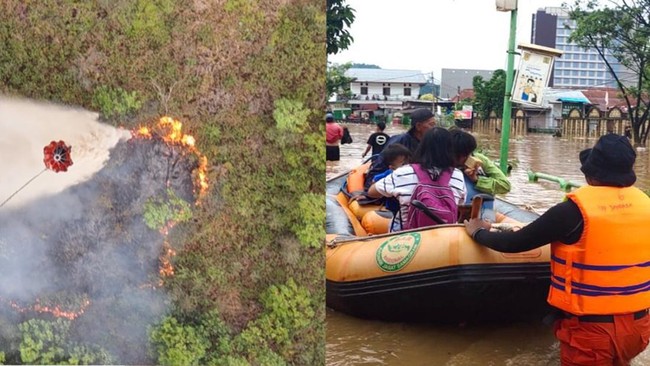
What about Indonesia? The country is facing forest and land fires amid the El Niño climate phenomenon during the dry season, as well as heavy rain in other parts of the archipelago.
The National Disaster Mitigation Agency (BNPB) has urged the public to remain alert to potential hydrometeorological disasters caused by heavy rain accompanied by lightning, strong winds or tornadoes, floods and landslides.
BNPB has reminded residents to stay prepared and put together bags containing emergency supplies.
The public is advised to check weather forecasts and early warnings regularly through official Meteorology, Climatology and Geophysics Agency (BMKG) channels. People should also clear drains, gutters and roof channels to prevent blockages and pooling; prune tree branches that are overgrown, brittle or close to power lines and buildings; and understand evacuation routes.
“Understand evacuation routes and prepare a disaster go-bag containing emergency supplies for three days,” said the acting head of BNPB’s Data, Information and Disaster Communications Centre in an official statement on Tuesday (3 November 2026).
Why three days?
Why does the advice recommend putting enough supplies for three days in an emergency go-bag?
The recommendation to fill an emergency bag with essentials for three days is not unique to Indonesia. Other countries, including the United Kingdom, Japan and South Korea, have similar guidance.
Daryono of the Indonesian Disaster Experts Association (IABI) explained that the requirement to prepare a disaster go-bag with at least 72 hours’ worth of supplies has a sound basis in emergency management and disaster response.
“The 72-hour period is a critical initial phase after a major disaster. Transport access, communications networks, electricity, clean water, health facilities and logistics distribution may all be disrupted at the same time,” he said, as quoted on Saturday (7 November 2027).
“During this phase, rescue workers and the government usually prioritise search and rescue, treating the injured and opening access to affected areas. As a result, basic aid may not reach everyone quickly or evenly,” he explained.
For that reason, individuals and families are expected to be able to manage independently for at least the first three days.
The underlying principle, Daryono said, is “self-sufficiency during the initial emergency phase”: the ability of people to meet their basic needs independently while normal services have yet to recover.
“Why choose three days rather than one or two? Because 72 hours is used as a minimum benchmark for preparedness planning, not as a guarantee that aid will arrive on the third day,” he stressed.
“In a major disaster, assessing damage, mobilising resources, reopening logistics routes and distributing aid all take time. In a very widespread disaster, or one involving isolated areas or severe infrastructure damage, service disruptions may last more than three days,” Daryono said.
He added that some preparedness guidelines therefore recommend keeping supplies for seven days or more, depending on the type of hazard and local conditions.
“What should a disaster go-bag contain? Priorities include drinking water, long-life ready-to-eat food, personal medicines, first-aid supplies, a torch, batteries or a power bank, a whistle, masks, clothing, hygiene items, cash, and copies of important documents in waterproof packaging,” he said.
“Special consideration should be given to the needs of babies, older people, people with disabilities and those with chronic illnesses. As a guide for initial planning, allow around two to three litres of drinking water per person per day, adjusting for health, climate and activity levels,” Daryono said.
The total amount of water needed for drinking and sanitation will, of course, be greater.
“Families should also prepare separate supplies at home, because not everything needed for three days can be carried in a single evacuation bag,” he said.
Daryono stressed that the more families able to meet their own basic needs during the first 72 hours, the less pressure there will be on emergency assistance systems.
“This allows responders to give greater priority to vulnerable groups and people who urgently need help,” he said.
“This is the essence of modern preparedness: building a society that does not simply wait for help, but is capable of protecting and rescuing itself from the moment a disaster occurs,” Daryono said.
Source: jawawa.id (https://jawawa.id/newsitem/why-disaster-go-bags-should-contain-three-days-worth-of-emergency-supplies-1794041425)
Originally published by CNBC Indonesia (https://www.cnbcindonesia.com/news/20261107124715-4-783174/alasan-isi-tas-bencana-harus-berisi-kebutuhan-darurat-3-hari), translated from Indonesian