
Why Could the Argo Bromo Anggrek Train Collide with the KRL at Bekasi Timur Station?
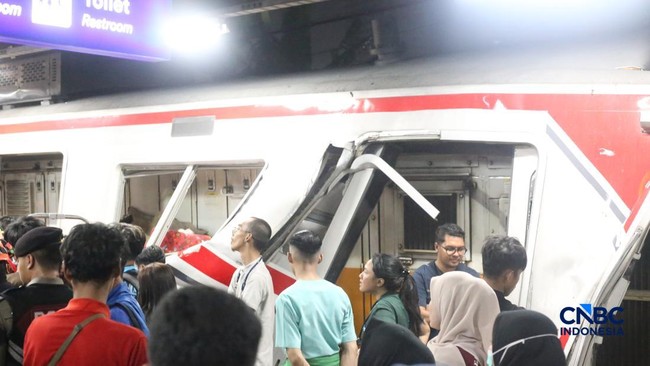
Jakarta, CNBC Indonesia - On Monday evening, 27 April 2026, around 21:00 WIB, the Argo Bromo Anggrek train on the Gambir-Surabaya Pasar Turi route collided with the rear of KRL Tokyo Metro (TM) 5568A bound for Kampung Bandan-Cikarang, which was stationary on the platform at Bekasi Timur Station. The Argo Bromo Anggrek train slammed into it forcefully, causing the rear carriage to crumple.
As a result of the incident, the busy Bekasi-Cibitung rail line was paralysed. Seven people were killed, and 82 others were injured and are currently receiving medical treatment. So, the question arises: why was the Argo Bromo Anggrek able to collide with the KRL Tokyo Metro (TM) 5568A on the same track?
The event of the KRL being struck by the Argo Bromo Anggrek began with the KRL PLB 5181 on the Cikarang-Angke route hitting a Green SM taxi at the Ampera Road level crossing in Bekasi on Monday evening. This was the trigger for the fatal collision between the KRL and the Argo Bromo Anggrek at Bekasi Timur Station.
That incident caused the KRL PLB 5568A bound for Kampung Bandan-Cikarang to stop at Bekasi Timur Station, waiting for the Cikarang-Angke-bound KRL that had hit the taxi to pass through again. However, while stationary, the Kampung Bandan-Cikarang-bound KRL PLB 5568A was struck by the Argo Bromo Anggrek on the Gambir-Pasar Turi route.
Public transportation expert in the railway sector, Joni Martinus, spoke out. He explained that the absolute block system signalling principle in Indonesia’s railways stipulates that if one train is in a track section, the entry signal from the adjacent station must indicate red. Meanwhile, the following train is prohibited from entering because there is still a train in the same block section.
Under railway safety principles, there must not be two trains, whether in opposite or the same direction, in one block section as it is dangerous and violates safety principles.
“The fact that the Argo Bromo Anggrek was able to enter and collide with the KRL in front of it is something that must be thoroughly investigated and given attention by the KNKT,” Joni told CNBC Indonesia on Tuesday (28/4/2026).
According to him, in general, there are several factors that could cause a train to be rear-ended, namely:
Violation of a red signal (stop indication) or signal passed at danger
Signalling system failure resulting in the wrong aspect being displayed (wrong side failure)
Miscommunication regarding speed limits in procedures for cautiously passing a red signal
Deviation from procedures allowing a train to enter a track still occupied by another train.
Technical issues, such as brake failure where the train suffers damage to the braking system and cannot stop in time even though the signal is visible
Concentration factors, loss of concentration by the driver reducing vigilance in monitoring the track ahead.
Joni expressed his condolences and deep sorrow over the incident that caused loss of life. He hopes this will serve as a point of attention, evaluation, and improvement for KAI and KCI as well as related parties, so that such incidents do not recur, and urges the KNKT to promptly conduct a meticulous investigation to find the causes for future transportation improvements that are safer.
“Evaluation and improvement must be carried out comprehensively, such as enhancing and improving human resource development, implementing strict operational procedures, and ensuring the reliability of facilities and infrastructure,” he added.
Furthermore, Joni emphasised that essentially, the transportation business is a safety and service business, so there should be no loss of life, and all related parties must commit to ensuring such incidents do not happen again. In essence, preventing train accidents requires layered interventions in various fields, including operational procedures, human factors, technology, and regulatory oversight. On the other hand, Joni gave a positive response to the swift actions taken by KAI and KCI in the process of evacuating victims and affected train materials.
Transport Minister Dudy Purwagandhi visited the scene at Bekasi Timur Station where the collision between the Argo Bromo Anggrek and the KRL occurred. He stated that the Ministry of Transportation expresses its concern over the incident involving the two train services.
The Ministry of Transportation will continue to coordinate intensively with all related parties to ensure the evacuation process runs optimally in line with developments on the ground.
“In addition, the Ministry of Transportation also supports the investigative steps by the KNKT and related parties to delve into the causes of the incident,” he said.