
Why Could Arab Parties’ Vote Share Surge Dramatically in Israel’s Election?
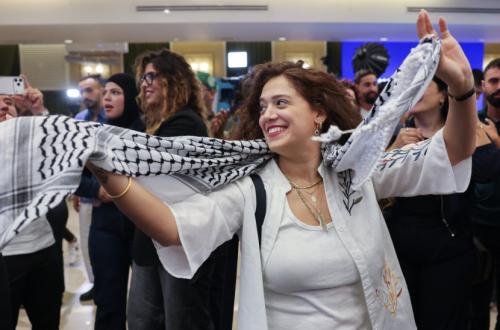
NAZARETH — Amid the rush-hour traffic in Nazareth, Israel’s largest city with an Arab majority, a group of students can be seen handing out leaflets by the roadside. They are urging motorists to exercise their right to vote in a closely fought election.
Several opinion polls suggest Arab parties could become the main kingmakers in Israel’s political landscape.
Past political disillusionment has often suppressed turnout among Arab citizens of Israel, who make up about a fifth of the country’s population and often identify as Palestinians with Israeli citizenship. But this election has brought a strong push to unseat the most right-wing governing coalition in Israel’s history: an alliance between veteran Prime Minister Benjamin Netanyahu and far-right and ultra-Orthodox parties.
“I see it as our duty to bring down this extremist government. They treat us like second-class citizens,” said Arkan Badran, 23, one of the students handing out leaflets. “I urge all young men and women to vote for the Arab parties that represent our voice, because this concerns our future.”
Coalition obstacles
Most major Jewish parties have ruled out forming a government coalition with Arab parties. Most polls indicate that neither Netanyahu’s bloc and its allies nor the main opposition “Change Bloc”, led by former military chief of staff and centre-right politician Gadi Eisenkot, has a clear path to a parliamentary majority.
If those projections are accurate, anti-Netanyahu parties seeking to form a post-election government face two difficult choices: break their campaign pledge not to work with Netanyahu, or reach a political agreement with the predominantly Arab parties.
The main obstacle is Eisenkot’s firm opposition to forming a government with Arab parties, citing a lack of shared fundamental values.
Israel’s political and social dynamics have shifted sharply since the deadly Hamas-led attack of 7 October 2023 and the ensuing war in Gaza. Distrust and hostility towards the country’s Arab minority are reported to have intensified.
“Since the 7 October attack, we have been treated as if we were the enemy of this country,” said Suha Salman Mousa of the Mossawa Centre in Nazareth, an organisation that advocates equal rights for Arab citizens. “The space for freedom of expression is shrinking. There have been mass arrests, and people have lost their jobs simply because of social media posts or because they opposed the war in Gaza.”
Mousa accused ministers of “systematic discrimination and incitement” against Arab citizens of Israel. Civil society groups say the government has disproportionately cut funding for Arab communities. The government, in turn, says the reductions are necessary to fund defence and security during wartime.
Political tensions have also spilled into public life, with campaigns targeting Arab doctors in Israeli hospitals and racially motivated attacks by Jewish Israelis on Arab bus drivers.
Some campaign messages have exploited these tensions to deepen social divisions. Far-right Finance Minister Bezalel Smotrich has pledged to “Judaise” parts of the northern Galilee and southern Negev, areas with large Arab populations, while linking the move to the expansion of settlements in the occupied West Bank.
Campaign rhetoric
Most Arab citizens of Israel are descendants of Palestinians who remained in the territory that became Israel during the 1948 war of the country’s founding—a conflict that forced hundreds of thousands of Palestinians to flee or leave their homes. The current Israeli government often portrays their presence as a threat to the country’s Jewish identity.
Recently, Prime Minister Netanyahu claimed that his political rivals planned to join forces with Arab groups to form a “dangerous government”.
To reinforce that message, his campaign team put up large billboards, including at a main road junction at the entrance to Nazareth. The billboards present a stark choice—“Right or Palestinian”—and show leading opposition figures, including right-wing politicians, as if they represented the latter option. Netanyahu’s campaign team has also used artificial-intelligence videos depicting his political opponents embracing Arab leaders.