
Why China Became an Electric Vehicle Powerhouse: Deputy Minister Stella Explains Its Formula
Jakarta, CNBC Indonesia — China has become a major force in the global electric vehicle industry through research and development, the provision of skilled workers, and government policy support. Indonesia is now seeking to build a similar foundation so that it does not remain merely a market for electric vehicles produced overseas.
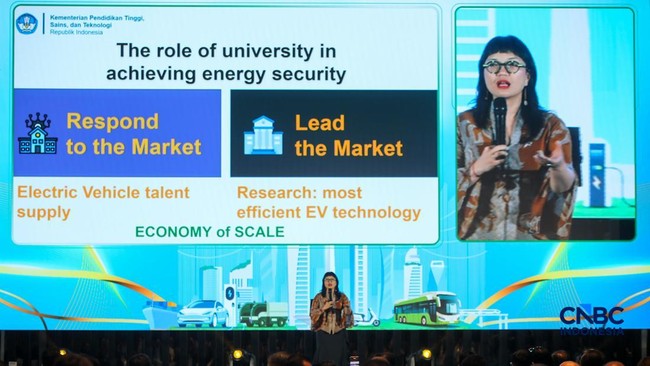
Deputy Higher Education, Science and Technology Minister Stella Christie said success in the electric vehicle industry requires the ability both to create technology and to understand market needs. Universities need to serve two purposes: producing innovations that open up new markets and developing solutions for the needs of existing industries.
“There are two roles. The first is to respond to the market. The other is to lead the market. Those are the two roles universities actually have,” she said in Central Jakarta on Wednesday (28 October 2026).
China’s experience shows that industrial development does not happen overnight. The rapid changes seen in the market are the result of a long process involving research, technological development and the building of production capacity.
“We know that the leader in the EV industry, the Chinese EV market, started with research. There were no EVs at all. I went to China many years ago as a student, when I was studying at Harvard, and spent a semester there. There were no electric bicycles, electric motorbikes or electric vehicles at all. Then it seemed as if everything changed overnight, although in fact it did not,” Stella said.
For Indonesia, the main challenge is to build an ecosystem that connects research findings with manufacturing needs. The availability of experts, suitable educational facilities and industry partnerships are important both to attract investment and to improve the country’s technological capabilities.
“If we only respond to the market, we cannot anticipate what the market will need. That is why universities need research innovations,” she said.
The government is seeking to strengthen these links by changing its research funding arrangements. Much of the research agenda intended to address industrial problems is developed by asking businesses directly to identify issues that need technological solutions.
“At the Ministry of Higher Education, Science and Technology, we are very focused on industry. With the additional funding we have received, we have said that, to decide which research to fund, we will ask industry to tell us what problems need to be researched and solved,” she said.
Research efforts also need to be accompanied by improvements in human resources. Without a supply of skilled workers at home, manufacturing investment may continue to rely on experts from abroad.
Stella said the relationship between educational institutions and industrial investment was an important lesson Indonesia could apply. Developing local expertise will help companies operate more efficiently while strengthening the foundations of the national industry.
“If we want to know one of the interesting things about how China came to dominate the world of electric cars, the answer is what I mentioned earlier: outstanding research, a supply of talent that responds to market needs, and, behind all of it, policies that support research,” she said.
Source: jawawa.id (https://jawawa.id/newsitem/why-china-became-an-electric-vehicle-powerhouse-deputy-minister-stella-explains-its-formula-1793184689)
Originally published by CNBC Indonesia (https://www.cnbcindonesia.com/news/20261028152556-4-780254/pantas-china-jadi-raksasa-mobil-listrik-wamen-stella-tunjuk-jurusnya), translated from Indonesian