
Why Balai Karangan Durian Farmers Need to Organise and Seek Geographical Indication Protection
Each harvest season, the name “Balai Karangan” travels further than the fruit itself in West Kalimantan. In August 2026, fruit stalls in Pontianak were selling durians under the name of the village on the West Kalimantan–Sarawak border as their main selling point.
The name sells. But one question is rarely asked: who actually has the right to use the name “Balai Karangan Durian”? And what can farmers do if one day it is attached to durians from elsewhere?
For now, the answer is not encouraging. According to research by the University of Indonesia’s Patriot Expedition Team (TEP UI), which has been working in KT Sekayam-Entikong over the past two months, Balai Karangan Durian has not yet been protected as a Geographical Indication (GI). In addition, its farmers have no association through which they can jointly safeguard quality and care for durian trees as an ancestral legacy.
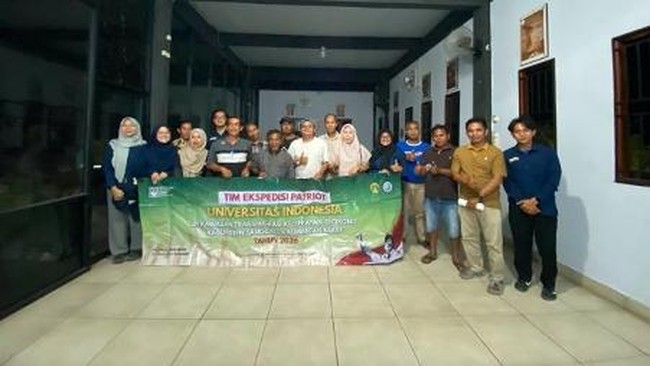
For this reason, the 2026 TEP UI team, led by Prof Heru Susetyo and accompanied by members Feymi Angelina, Khanza Qotrunnada, Nismaya Bismi Rafa, Damhal Id and Gusti Septian Dwi Cahyo, is seeking to support the institutional development of Balai Karangan durian farmers as a foundation for GI protection and plant variety protection.
The foundations are already in place
Balai Karangan Durian is not starting from scratch. Sekayam District in Sanggau Regency has long hosted local durian competitions. One contest was held in the grounds of the Sekayam sub-district office, with more than 100 farmers taking part, while the local agriculture office has recorded around 200 leading durian varieties in the regency.
More specifically, Soni Setiawan, head of horticulture at the Sanggau Regency Food Security, Food Crops, Horticulture and Fisheries Office (DKPTPHP), said that most of the leading varieties have been found along the banks of the Sekayam River.
The social foundations are also beginning to take shape. At a meeting with TEP UI on 6 October 2026, farmers expressed a desire to organise and showed an initial awareness of the importance of protecting their intellectual property. They have even appointed Pak Tam (Pak Gunawan) as community leader.
This step deserves recognition. However, a community formed through a verbal agreement is not yet a legal entity. It cannot sign contracts, submit an application to the Ministry of Law or sue parties that misuse the name of their village.
Why a Geographical Indication?
Among the various forms of intellectual property protection, a Geographical Indication (GI) is the most suitable for Balai Karangan durian. Law No. 20/2016 on Marks and Geographical Indications defines a GI as a sign indicating the place of origin of a product which, because of geographical factors—natural, human or both—gives it a particular reputation, quality and characteristic. GI rights remain in force as long as that reputation, quality and characteristic are maintained.
There are at least three reasons why this scheme is appropriate. First, a GI is collective. It is not owned by one person or company, but by the producer community in the area. This reflects the fact that the reputation of Balai Karangan durian has been built over generations by many farming families.
Second, a GI is tied to a place. The name “Balai Karangan” may legitimately be used only for durians that genuinely come from the designated area and meet its quality standards.
Third, registration of a GI acts as a safeguard against trademarks. An application for a mark that is identical or similar to a registered GI must be rejected, preventing a business from claiming the village’s name as its own private trademark.
Durian is no stranger to the GI system. Banyuwangi Red Durian has received a GI certificate from the Ministry of Law. In Banggai Regency, Central Sulawesi, Asaan Pagimana and Nambo durians are now managed by a Geographical Indication Protection Society (MPIG), which is expected to lead quality oversight. If durians from East Java and Sulawesi can obtain protection, there is no reason for those from the West Kalimantan border with Sarawak, Malaysia, to be left behind.
Why must farmers organise first?
This is where an institution becomes crucial. Article 53, paragraph 3 of Law No. 20/2016 names two types of GI applicant: an institution representing the community in the geographical area that produces the goods, and a provincial, regency or municipal government.
Its implementing rules, Minister of Law and Human Rights Regulation No. 12/2019, as amended by Regulation No. 10/2022, further specify who may apply. In other words, an informal community is not enough. Farmers need an organisation with articles of association, an elected leadership and a clear legal basis for its establishment.
The Sanggau Regency Government could submit an application. But leaving the entire process to the local government without a strong farmers’ organisation carries risks: a certificate may be issued, but quality monitoring in orchards, label management and the distribution of benefits may not happen because no organisation is responsible for them day to day.
Agricultural law, meanwhile, provides several organisational options. Law No. 19/2013 on the Protection and Empowerment of Farmers recognises farmer groups, associations of farmer groups and agricultural commodity associations, as well as farmers’ economic institutions, which may or may not have legal-entity status.
In Constitutional Court Decision No. 87/PUU-XI/2013, the court affirmed that the list of institutional forms in Article 70, paragraph 1 of the law should be understood to include institutions established by farmers themselves.
Balai Karangan farmers are therefore free to choose the structure that best suits them, whether a co-operative, association, producers’ association or MPIG (Geographical Indication Care Society). They are also entitled to government support under Agriculture Minister Regulation No. 67/2016 on the Development of Farmers’ Institutions.
The experience of Banyuwangi offers a practical sequence. Red durian farmers there first formed an association, which was then established as an MPIG and approved by the ministry. Only then did they submit a GI application, with support from the regency government.
The institution remains necessary after a certificate is issued. Law No. 20/2016 sets out forms of GI infringement, including using a GI on products that do not meet the Product Description Document and using it in a way that misleads the public about a product’s origin. Claims over such violations may be brought by producers entitled to use the GI or by an institution representing the community in the area. Without an organisation, rights on paper are difficult to enforce in practice.
Two sides of the same coin
Farmers’ associations and GIs need one another. An association applies for, manages and protects a GI; the GI becomes a legal and economic asset that adds value for all its members. An association without a GI only strengthens bargaining power in the short term, while a GI without an association risks becoming a certificate left in a drawer.
The core of a GI application is the Product Description Document, which demonstrates the connection between the durian’s quality and its place of origin. For Balai Karangan Durian, or any agricultural product in Indonesia, the document should include at least:
the GI name and the type of goods protected, including a decision on whether processed durian products are covered;
distinguishing characteristics, such as aroma, flavour, texture, colour and flesh thickness, size and sweetness, supported by test data;
a description of natural factors (soil, climate, rainfall, elevation and the Sekayam forest ecosystem) and human factors (traditional knowledge, selection of parent trees, and harvesting and post-harvest practices);
the history, traditions and public recognition associated with the name “Balai Karangan Durian”;
a map and boundaries of the production area; and
production processes, quality-testing methods, monitoring arrangements and the label to be used.
Two issues need to be addressed frankly from the outset. The first is varietal diversity. With dozens of distinctive types, farmers must decide whether the GI will protect “durian from the Balai Karangan area” in general, subject to minimum quality standards, or only a selected group of varieties. The first option is more inclusive; the second makes it easier to demonstrate distinctiveness.
The second issue is the geographical boundary. Neighbouring villages in Sekayam District also produce excellent durians, so the boundary should be drawn according to shared characteristics rather than administrative lines alone, and agreed collectively to avoid conflict between villages.
Obligations do not end with certification. Under Minister of Law and Human Rights Regulation No. 10/2022, GI product packaging must display the Indonesian GI logo, the certificate number and a product-origin code containing the place of origin and harvest date. Such traceability is possible only if an institution keeps records of members, orchards and harvests.
The process is not quick. Tangkit Baru pineapple in Jambi, for example, took around ten years to obtain a GI certificate. That is precisely why the first step must be taken now, while momentum and farmers’ enthusiasm remain strong.
The durian’s fragrance—and its market—are promising
The name Balai Karangan has already reached Pontianak. The question is no longer whether this durian deserves protection, but who will benefit from the reputation of its name ten years from now. If farmers continue to act individually, the added value will flow everywhere except back to their orchards. If they organise and secure the name through a GI, the village name can become a shared asset to be protected and passed down.
In Balai Karangan, Pak Tam and his fellow farmers have taken the first step. It is now up to the local government, universities, civil society organisations, farmer-support organisations and other stakeholders to ensure that the next steps are not delayed.
The task is to organise and work towards obtaining a geographical indication for the durian. That way, it will not only have a fragrant aroma and crisp texture, but also a sustainable market—and farmers will prosper.
Source: jawawa.id (https://jawawa.id/newsitem/why-balai-karangan-durian-farmers-need-to-organise-and-seek-geographical-indication-protection-1793587892)
Originally published by CNBC Indonesia (https://www.cnbcindonesia.com/opini/20261102090001-14-781391/urgensi-berserikat-dan-indikasi-geografis-petani-durian-balai-karangan), translated from Indonesian