
Why Anwar Ibrahim Is Offering Tax Cuts and Raising Malaysia’s Minimum Wage by Rp1.3 Million
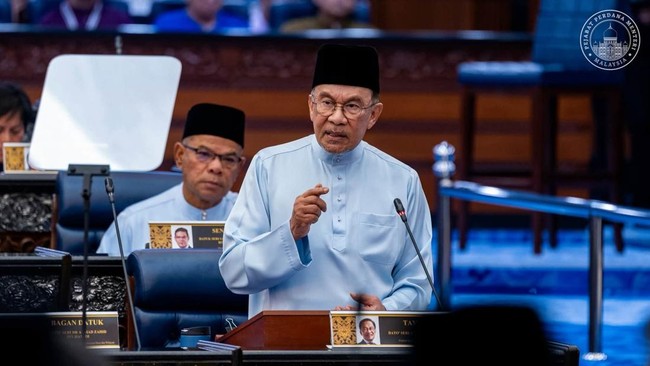
Jakarta, CNBC Indonesia — The Malaysian government has officially launched a series of tax-relief measures and announced a minimum-wage increase for next year. The populist measures are intended to boost household incomes and support small businesses ahead of a possible general election, as the government faces fiscal pressure from a surge in global oil prices.
Channel News Asia reported that Malaysian Prime Minister Anwar Ibrahim proposed a large, expansionary budget of 459.8 billion ringgit (Rp2,013.92 trillion) for 2027. This is significantly higher than the 444.1 billion ringgit (Rp1,945.15 trillion) allocated this year. Anwar pledged to introduce reforms that would ensure the country’s strong economic growth is felt directly by ordinary people.
“Our question is not only how the economy is built, but whether its growth will create room for families to build savings, workers to enjoy more dignified wages, and small businesses to continue growing,” he told parliament, according to Channel News Asia on Saturday (10 October 2026).
The proposed operating budget is worth 376.8 billion ringgit (Rp1,650.38 trillion), while the development budget is valued at 83 billion ringgit (Rp363.54 trillion).
The major announcement comes several months after Anwar’s Pakatan Harapan (PH) coalition suffered significant setbacks in the Johor and Negeri Sembilan state elections. This has added to political pressure on his government ahead of the 16th general election, which must be held by February 2028 at the latest, as well as the Melaka state election on 14 November.
Minimum wage increase and funding for ride-hailing workers
The government confirmed that the minimum monthly wage, currently set at 1,700 ringgit (Rp7.44 million), will rise to 2,000 ringgit (Rp8.76 million) from June next year. However, micro, small and medium-sized enterprises with annual revenue below 50 million ringgit (Rp219 billion) will be temporarily exempted from the rule to give them time to adjust.
Malaysia will also introduce a minimum starting salary of 2,500 ringgit (Rp10.95 million) a month for semi-skilled workers and university graduates. In state-owned enterprises and government investment companies, the benchmark for a living wage will rise to 3,400 ringgit (Rp14.89 million) from 3,100 ringgit (Rp13.57 million), a move expected to benefit around 230,000 workers.
The government is also addressing the needs of around 600,000 online transport drivers and couriers. It and ride-hailing giant Grab have agreed to fund a 160 million ringgit (Rp700.8 billion) support package from next year to increase gig workers’ net incomes.
“The Madani government will safeguard the welfare of gig workers by providing more comprehensive protection,” Anwar said.
Wide-ranging tax cuts
To ease the cost-of-living pressures on middle-income workers (the M40 group), the government will raise the personal income-tax relief limit from 9,000 ringgit (Rp39.42 million) to 12,000 ringgit (Rp52.56 million). This is the first revision since 2010.
“The government has heard the concerns of the middle-income group (M40), who have patiently persevered despite also being squeezed by the cost of living,” he said.
Under the new rates, individuals with taxable incomes between 70,000 ringgit (Rp306.6 million) and 100,000 ringgit (Rp438 million) will see their tax rate fall to 18%. Those earning between 100,000 and 150,000 ringgit (Rp657 million) will have their rate reduced to 24%.
Tax relief will also be expanded: medical tax relief will now cover postnatal care, while full tax exemption will apply to care costs for parents and grandparents, rather than only their healthcare expenses.
Petronas’ major contribution and the fiscal deficit
Malaysia’s economy is forecast to grow by 4.2% to 5.2% in 2027, according to the fiscal and economic outlook report. The 2026 growth forecast has also been revised to the upper range of 4.8% to 5.3%, after growth reached 5.7% in the first half. Headline inflation is forecast to range between 1.8% and 2.8% in 2027, reflecting the continued impact of high energy and food-input costs.
Government revenue is projected to rise by 4.7% to 380.8 billion ringgit (Rp1,667.9 trillion) in 2027, from an estimated 363.6 billion ringgit (Rp1,592.56 trillion) this year.
National energy giant Petronas is expected to contribute 32 billion ringgit (Rp140.16 trillion) in 2027, a sharp increase from the revised 27 billion ringgit (Rp118.26 trillion) this year and well above the initial 2026 estimate of just 20 billion ringgit (Rp87.6 trillion).
Malaysia’s annual subsidy bill, swollen by high energy costs linked to the US-Israel war in Iran, is expected to push social assistance spending to 74.5 billion ringgit (Rp326.31 trillion) this year, up 34.7% from 2025. As a result, the 2026 fiscal-deficit target has been revised upwards to 3.6% from 3.5%, before it is forecast to fall to 3.3% in 2027 alongside a reduction in subsidy costs to 72.7 billion ringgit (Rp318.42 trillion). Despite the increase, Anwar firmly dismissed concerns about fiscal slippage.
“This does not mean we are straying from fiscal consolidation. It shows the value of building capacity to respond when circumstances demand it,” Anwar concluded.
Source: jawawa.id (https://jawawa.id/newsitem/why-anwar-ibrahim-is-offering-tax-cuts-and-raising-malaysias-minimum-wage-by-rp1-3-million-1791643866)
Originally published by CNBC Indonesia (https://www.cnbcindonesia.com/news/20261010194359-4-774971/alasan-anwar-ibrahim-obral-diskon-pajak-umr-malaysia-naik-rp13-juta), translated from Indonesian