
Why Aircraft Cannot Fly When a Volcano Erupts: Can Engines Cut Out?
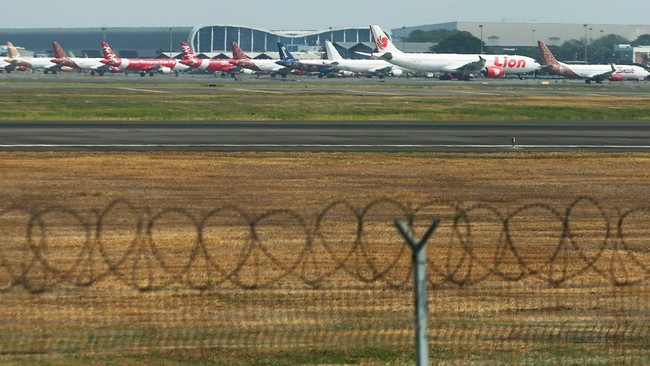
Flight activity to and from the Jakarta region and its surroundings has been disrupted by the eruption of Mount Anak Krakatau in the Sunda Strait.
A total of eight airports were forced to suspend operations temporarily on Sunday (6/9/2026) after volcanic ash was detected entering airspace and airport areas.
The eight airports were Soekarno-Hatta International Airport, Halim Perdanakusuma Airport, Husein Sastranegara Airport, Pondok Cabe Airport, Budiarto Airport, Radin Inten II Airport, Taufik Kiemas Airport, and Atung Bungsu Airport in Pagar Alam.
The closures affected 1,558 flights and around 170,000 passengers. At Soekarno-Hatta Airport alone, 963 arrival and departure schedules were affected up to Sunday evening.
However, Atung Bungsu Airport (WIPY) in Pagar Alam, South Sumatra, reopened on Monday (7/9/2026) at 08.12 Western Indonesia Time. The reopening was issued through NOTAM C1107/26 NOTAMC C1105/26.
The flight disruption began after Mount Anak Krakatau erupted again.
“An eruption of Mount Anak Krakatau occurred on Sunday, 6 September 2026, at 03.53 Western Indonesia Time. The eruption was recorded on the seismograph with a maximum amplitude of 46 mm and a duration of 30 seconds,” the Geological Agency wrote on its official X account.
Based on the Meteorology, Climatology and Geophysics Agency’s (BMKG) satellite image analysis at 08.00 Western Indonesia Time on Sunday, the spread of volcanic ash was observed forming two clusters covering Banten, DKI Jakarta, West Java, Lampung and as far as Bengkulu.
Ash at altitudes of up to 20,000 feet moved towards the north-east to the south. Meanwhile, ash reaching 50,000 feet moved towards the south-west to the north-west.
So why can volcanic ash from an eruption bring flights to a halt?
What Is Volcanic Ash?
By way of illustration, volcanic ash produced by a volcanic eruption is a collection of rock, mineral and volcanic glass particles ejected when gas pressure inside the volcano shatters the magma and surrounding material during an eruption.
Particles classified as volcanic ash measure less than 2 millimetres. Some are so fine that they are not easily seen by the naked eye.
Chemically, volcanic ash is generally dominated by silicate material composed of silicon and oxygen. One of its main compounds is silica or silicon dioxide (SiO2), a hard substance that is also the main component of sand, quartz and glass.
Volcanic ash may also contain aluminium, iron, calcium, magnesium, sodium, potassium and various other minerals.
Its composition differs from one volcano to another, depending on the type of magma and rock shattered during the eruption. However, volcanic ash generally shares the same characteristics: hard, sharp and abrasive, capable of eroding surfaces.
The irregular shape of the particles makes volcanic ash resemble tiny fragments of rock and glass. It is this character that makes it dangerous for aircraft.
Below are four effects of volcanic ash that can endanger aviation.
- A Threat to Aircraft Engines
The greatest threat from volcanic ash lies in aircraft engines, particularly on jet-engined aircraft.
To generate power, jet engines must draw in very large volumes of air. If the aircraft is in an area containing volcanic ash particles, the rock and volcanic glass particles will be sucked into the engine along with the air.
At the front of the engine, these particles can erode the blades of the engine fan and compressor. The effect is similar to sand being blasted at high speed against the engine’s surface.
A greater danger arises when the ash enters the combustion chamber. Temperatures in this section are extremely high and can exceed the melting point of some of the silicate material in volcanic ash.
As a result, the ash can melt and turn into a material resembling liquid glass. As it moves to cooler parts of the engine, this material solidifies again and adheres to the blades and turbine passages.
These deposits can obstruct airflow, block cooling holes and raise engine temperature. The consequence is that jet engines may suffer compressor disruption, loss of thrust, or even complete failure, known as flameout.
Volcanic ash can also enter the aircraft’s ventilation and cooling systems.
Accumulated particles have the potential to disrupt electronic systems, hydraulics and the air supply inside the cabin.
The risk of damage increases when engines are working at high power, such as during take-off. For this reason, the presence of volcanic ash around airports is extremely dangerous.
- Disrupting the Pilot’s Visibility
Volcanic ash can strike the cockpit windows when the aircraft is travelling at speeds of hundreds of kilometres per hour.
The hard rock and glass particles will erode the surface of the glass. If the exposure is thick enough, cockpit windows can become opaque, like glass rubbed with sandpaper.
Such conditions clearly make it difficult for pilots to see out, especially during approach and landing. Ash can also erode landing lights and the aircraft’s leading surfaces.
But the problem is not only direct visual impairment.
- Reducing the Accuracy of Aircraft Instruments
Besides disrupting pilots’ visibility, volcanic ash particles can also block the pitot-static system used to measure the aircraft’s speed, altitude and surrounding air pressure. If this system is disrupted, the speed indicator may display inaccurate information.
Ash clouds are also not always easy to identify from inside the cockpit. At night, or when mixed with ordinary clouds, pilots may not realise the aircraft is approaching an area contaminated with volcanic ash.
Aircraft weather radar is essentially designed to detect water content such as rain, not dry volcanic ash particles.
For this reason, ash clouds do not always appear on the aircraft’s radar or on air traffic controllers’ radar.
Pilots must rely on satellite information, SIGMET warnings, Volcanic Ash Advisories, reports from other aircraft, and directions from air traffic control to avoid them.
- Dangerous for Runway Surfaces
Volcanic ash that has already fallen to the ground can also disrupt flight operations.
Ash deposits on the runway can reduce tyre grip during landing and braking. The risk grows higher when the ash mixes with rainwater, making the runway surface more slippery.
Aircraft movement can also stir up ash that has already settled. Air blasted from the engines as the aircraft moves or takes off can lift ash particles back into the air.
That ash can then be sucked into aircraft engines or reduce visibility for other aircraft behind it.
The use of reverse thrust during landing also risks throwing ash up from the runway surface.
A History of Flight Disruption Caused by Volcanic Ash
The danger volcanic ash poses to aviation drew the world’s serious attention after two serious incidents occurred in Indonesian skies in 1982.
On 24 June 1982, a British Airways Boeing 747 flew from Kuala Lumpur to Perth at an altitude of around 37,000 feet, or 11,300 metres.
Without the crew realising it, the flight entered a volcanic ash cloud originating from the eruption of Mount Galunggung in West Java.
All four of the aircraft’s engines lost thrust.
The aircraft flew without power for around 16 minutes and descended to an altitude of about 12,000 feet. After exiting the ash cloud and entering cleaner air, the pilots managed to restart three of the engines.
The aircraft eventually made a safe emergency landing in Jakarta.
Three weeks later, a Singapore Airlines Boeing 747 flying to Melbourne experienced a similar event. Two of its engines lost power after the aircraft entered ash from Mount Galunggung.
That aircraft was also successfully diverted and landed in Jakarta.
Investigations showed that the aircraft’s engines had been disrupted after ingesting volcanic ash. The engines could only be restarted after the aircraft descended and left the ash layer.
Following these incidents, the International Civil Aviation Organization (ICAO) worked with the World Meteorological Organization (WMO) and several other bodies to develop warning systems and procedures for handling volcanic ash.
That cooperation later developed into the International Airways Volcano Watch (IAVW), a global monitoring system tasked with ensuring that information on eruptions and volcanic ash movement is quickly relayed to aviation authorities, airlines, air traffic controllers and pilots.
That information forms the basis for issuing flight warnings, rerouting aircraft, delaying journeys, and temporarily closing affected airspace and airports.