
Whoosh vs Malaysia’s ECRL: Which Rail Project Comes Out on Top?
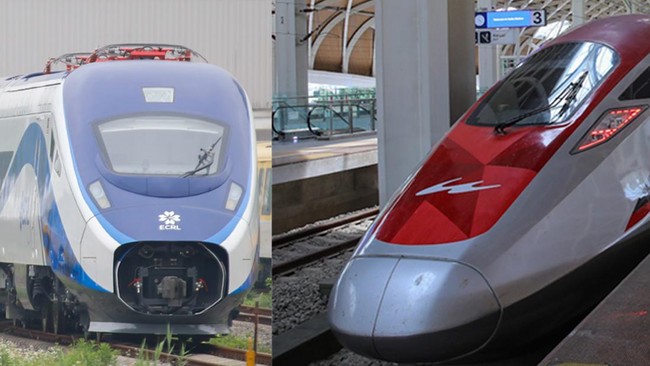
Jakarta, CNBC Indonesia — The East Coast Rail Link (ECRL), a semi-high-speed railway in Malaysia’s east coast region, is under construction, with its first phase due to begin operating in the near future.
According to the official ECRL website, the 665-kilometre infrastructure project is designed to strengthen interregional connectivity and support passenger mobility and freight distribution.
ECRL will connect four states — Kelantan, Terengganu, Pahang and Selangor — along a route from Kota Bharu to Port Klang.
Passenger trains on the line are designed to operate at a maximum speed of 160 kilometres per hour, while an express journey from Gombak to Kota Bharu is expected to take about four hours.
The line will open in two phases. The first phase, linking Kota Bharu and Gombak, is targeted to begin operations in January 2027, while the second phase, from Gombak to Port Klang, is scheduled to open in January 2028.
The ECRL route starts in Kota Bharu, Kelantan, which is planned to become a major transport hub in north-eastern Malaysia. From there, it heads south-west through Pasir Puteh, expanding transport access in southern Kelantan.
After leaving Kelantan, the railway enters Terengganu and passes through several towns along the state’s coast. Planned main stations include Jerteh, Bandar Permaisuri, Kuala Terengganu, Dungun, Kemasik and Chukai.
The route continues into Pahang, passing through Cherating, Kuantan Port City, Kota SAS, Paya Besar, Maran, Temerloh and Bentong. On this section, ECRL will cross the Titiwangsa Mountains through tunnels and viaducts designed to tackle the region’s terrain.
The first phase will end at Gombak Integrated Terminal in Selangor, providing a connection to the Klang Valley. The second phase will extend the line from Gombak to Port Klang, passing through Serendah, Puncak Alam and Kapar.
As well as carrying passengers, ECRL is designed to transport freight in support of logistics and trade. The line is expected to improve connectivity between industrial areas, residential centres and ports, and to encourage economic growth along the rail corridor.
However, the project’s official information lists January 2027 for the first phase and January 2028 for the second. Any claim that operations will begin in December therefore needs further confirmation, as it differs from the schedule published on the official ECRL website.
ECRL passenger train specifications
ECRL passenger services will use CR200J electric multiple units (EMUs), manufactured by CRRC Dalian in Liaoning, China.
The trains have a design maximum speed of up to 200 km/h and an operating maximum of 160 km/h, placing them in the semi-high-speed category. Eleven trainsets are planned, each comprising six cars: one power car and five trailer cars.
The railway uses the international standard gauge of 1,435 mm. Each train can carry up to 425 passengers.
Comparison with Indonesia’s Whoosh
Although Malaysia describes ECRL as a high-speed train, its specifications place it in the semi-high-speed category, with a maximum speed of 160–200 km/h. Its passenger trains are CR200J EMUs.
Indonesia’s Whoosh, by contrast, is a high-speed railway, with a design maximum speed of 420 km/h and an operating maximum of 350 km/h. It uses CR400AF, also known as KCIC400AF, trainsets.
Another difference is the type of service. ECRL will carry both passengers and freight, while Whoosh serves passengers only.
Although ECRL is still a semi-high-speed railway, its planned route is longer than the KCIC or Whoosh line: ECRL is planned to cover 665 km, compared with the current 142.3 km for KCIC.
Indonesia’s Whoosh high-speed railway
Classification: High-speed rail
Maximum speed: 420 km/h (design); 350 km/h (operating)
Route length: 142.3 km
Full journey time: 54 minutes
Service focus: Passenger transport only
Track gauge: 1,435 mm
Train type: CR400AF (KCIC400AF)
Manufacturer: CRRC Qingdao Sifang
Train formation: Eight cars (four motor cars and four trailer cars)
Classes: Three (First Class, Business Class and Premium Economy)
Malaysia’s ECRL
Classification: Semi-high-speed rail
Maximum speed: 200 km/h (design); 160 km/h (operating)
Route length: 665 km
Full journey time: Four hours
Service focus: Freight, targeted to account for 70% of revenue, and passengers (30%)
Track gauge: 1,435 mm
Train type: CR200J
Manufacturer: CRRC Dalian
Train formation: Six cars (one power car and five trailer cars)
Classes: Two (Business Class and Premium Economy)
Source: jawawa.id (https://jawawa.id/newsitem/whoosh-vs-malaysias-ecrl-which-rail-project-comes-out-on-top-1794264625)
Originally published by CNBC Indonesia (https://www.cnbcindonesia.com/news/20261109132202-4-783551/adu-kekuatan-whoosh-vs-kereta-cepat-malaysia-ecrl-unggul-mana), translated from Indonesian