
Whoosh Shareholder Losses Swell to Rp 5.13 Trillion
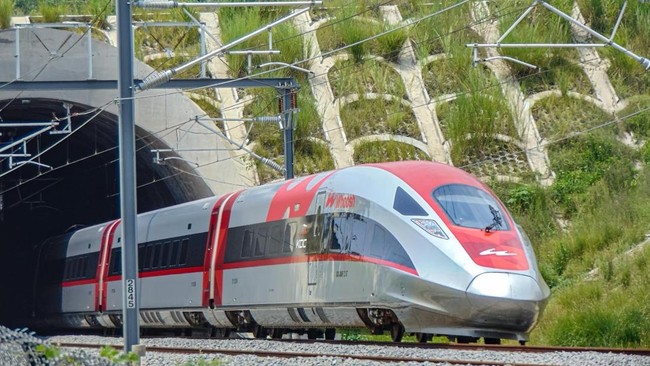
The losses from the Jakarta-Bandung High-Speed Railway (KCJB) project, operated by PT Kereta Cepat Indonesia China (KCIC), continue to expand. According to the interim consolidated financial statements of PT Kereta Api Indonesia (Persero) for the six-month period ending 30 June 2026, PT Pilar Sinergi BUMN Indonesia (PSBI)—the state-owned enterprise consortium and direct shareholder of KCIC—recorded a net loss of Rp 5.13 trillion in the first six months of this year alone.
This figure exceeds the total loss recorded throughout 2/2025, which was Rp 4.99 trillion, indicating that the rate of loss expansion is accelerating significantly compared to the previous year. As the majority shareholder of PSBI with a 58.53% stake, KAI bears the largest portion of this burden.
Data disclosed in KAI’s financial notes reveals a sharp deterioration in PSBI’s balance sheet, which has now entered a deficit. Notably, PSBI’s total liabilities (Rp 21.55 trillion) have exceeded its total assets (Rp 21.53 trillion). This means that, technically, PSBI is in a state of negative equity, where its assets are no longer sufficient to cover its obligations. This is a stark contrast to the end of 2025, when PSBI maintained a positive equity cushion of approximately Rp 5.1 trillion. The combination of shrinking assets and rising liabilities confirms a real solvency pressure on the entity.
In KAI’s consolidated profit and loss statement, the impact of the PSBI/Whoosh losses is clearly reflected in the ‘Share of Net Loss of Associates and Joint Ventures’ line item. Ironically, KAI’s core railway business grew solidly, with transport revenue rising by 6.7% and operating profit surging by 26% year-on-year. However, this growth momentum was almost entirely eroded by the Whoosh loss share, which jumped more than threefold from Rp 948 billion to Rp 3 trillion. Consequently, KAI’s consolidated net profit plummeted by 73% to just Rp 314 billion, failing to reflect its otherwise strong operational performance.
As a direct consequence, the recorded value of KAI’s investment in PSBI was drastically slashed from Rp 4.79 trillion (at the end of 2025) to just Rp 1.79 trillion as of June 2026. KAI has even recorded an impairment reserve of Rp 1.55 trillion in anticipation of further risks.
Funds continue to flow into the high-speed rail project. KAI’s cash flow statements confirm that the company continues to inject fresh funds to support the KCJB project’s sustainability despite growing losses:
Loans provided to Associates (PSBI/KCIC): Rp 475 billion disbursed during H1 2026, continuing a pattern from the previous year (Rp 1.80 trillion in H1 2025).
Additional investment placements in PSBI: Rp 15.5 billion.
Withdrawal of the KCJB project Sinking Fund: Rp 754.7 billion was drawn from funds previously set aside specifically for this project—more than double the withdrawal in H1 2025 (Rp 349.6 billion), indicating increasingly urgent liquidity needs for the project.
The KCJB Sinking Fund balance now stands at Rp 1.43 trillion, down from Rp 1.96 trillion at the end of 2025, narrowing the financial buffer for future project needs.
KAI’s total cash and cash equivalents also declined significantly, from Rp 6.76 trillion to Rp 4.85 trillion within six months, partly due to cash outflows to support PSBI and the KCJB project.
The financial reports also reveal a complex, multi-layered project funding structure. KAI borrows from loan facilities with total commitments of USD 325.62 million (Facility A) and the equivalent of USD 217.08 million in RMB (Facility B), with interest rates of 3.2%-3.3% per annum. These loans are guaranteed by the Government through PT Penjaminan Infrastruktur Indonesia (PT PII), based on Ministry of Finance Regulation No. 239/KM.8/2023. These funds are then passed by KAI to PSBI as shareholder loans, which PSBI subsequently passes to KCIC to fund project cost overruns and operational shortfalls. As of 30 June 2026, the total loans disbursed by KAI to PSBI specifically for operational shortfall schemes reached Rp 1.72 trillion.
KAI’s total exposure to the Whoosh/PSBI ecosystem—combining equity investments, shareholder loans, and related receivables—is estimated to reach approximately Rp 11.7 trillion, or about 11% of KAI’s total recorded assets of Rp 104.79 trillion as of June 2026. Such a high concentration of risk in a single associate entity is significant for KAI. Key implications include ongoing pressure on group net profits until KCIC/Whoosh reaches operational break-even, the potential need for further capital injections or loans to PSBI/KCIC, and a narrowing margin for KAI to support future liquidity needs without adding new burdens to the parent company’s balance sheet.