
Whoosh Share Transfer Sparks Debate
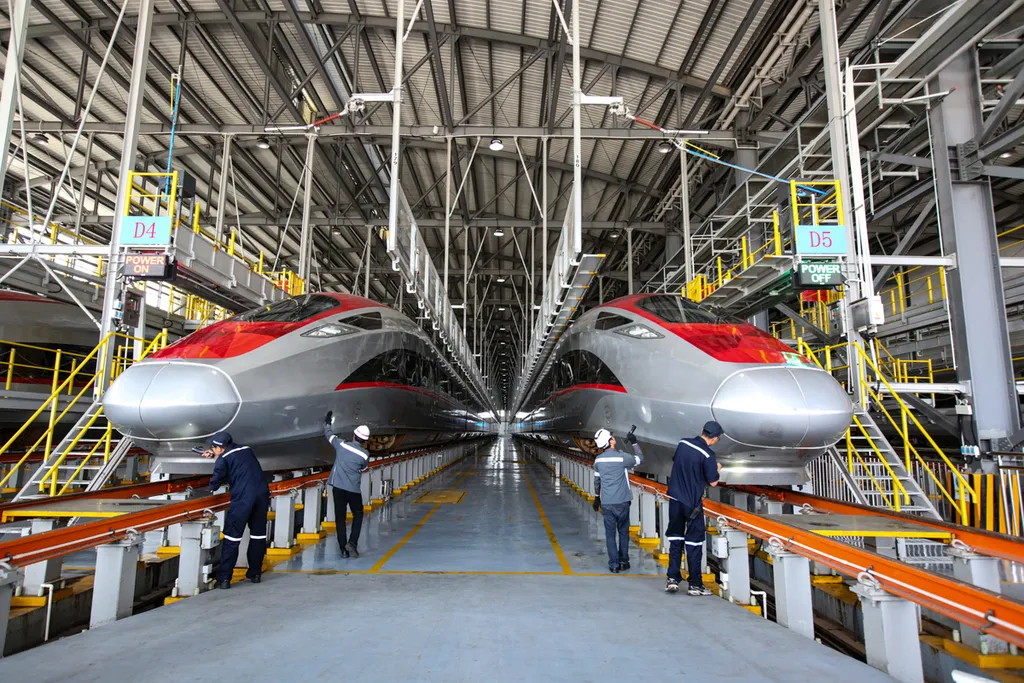
JAKARTA, KOMPAS – The government and the Danantara Investment Management Agency are seeking to settle the Jakarta-Bandung High-Speed Rail debt by taking over the state-owned enterprise consortium’s share ownership in PT Kereta Cepat Indonesia-China. However, this decision risks merely shifting the financial problem from one entity to another, making the use of the State Revenue and Expenditure Budget unavoidable.
The aim of the takeover is to ensure the repayment of the Kereta Cepat Indonesia-China (KCIC) debt does not burden the State Revenue and Expenditure Budget (APBN). According to the plan, the Ministry of Finance will repay the KCIC debt through a special mission vehicle (SMV), an agency under the ministry.
Senior Advisor at the Management Institute of the Faculty of Economics and Business, University of Indonesia, Toto Pranoto, stated in Jakarta on Friday (7/8/2026) that transferring the debt to an SMV, such as PT Sarana Multi Infrastruktur (Persero) or SMI, would not completely resolve the issue. He argued the action only shifts the burden from the PT Pilar Sinergi BUMN Indonesia (PSBI) consortium.
The PSBI consortium, which holds a 40 per cent stake in KCIC, consists of PT Kereta Api Indonesia (Persero), PT Wijaya Karya (Persero) Tbk, PT Jasa Marga (Persero) Tbk, and PT Perkebunan Nusantara III (Persero). The remaining stake is owned by Beijing Yawan HSR Co Ltd.
“The problem is the burden is so large it could disrupt SMI’s operations in other infrastructure projects. Ultimately, it will be bailed out by the APBN,” Toto said.
Toto added that the government’s takeover of PSBI’s share ownership could set a bad precedent. When a project assigned to a state-owned enterprise encounters problems, the solution will be borne by the government, weakening the fighting mentality of state-owned enterprises.
Toto also reminded that, based on the initial contract, the Jakarta-Bandung High-Speed Rail project, known as Whoosh, was supposed to be business-to-business. The commitment was not to involve state funds.
“With this case, it could create a reputation problem with global investors regarding legal certainty. In terms of governance, the Ministry of Finance’s function as a regulator becomes mixed with its role as an operator or project owner, making a conflict of interest difficult to avoid,” Toto said.
The most apparent conflict of interest is that the Ministry of Finance finds it difficult to enforce fiscal discipline while also having an interest in repaying the Whoosh debt as the owner. Ultimately, even with the involvement of an SMV, the risk of using the APBN remains unavoidable. This is because the capital capacity of an SMV like SMI is relatively small compared to the Whoosh project’s massive debt.
“I am concerned that without a significant equity injection into SMI, other infrastructure development programmes, such as clean water facilities and hospital revitalisation, could be disrupted,” Toto said.
As an alternative solution, Toto suggested the government could seek other investors interested in divesting a portion of the state-owned enterprises’ shares in the PSBI consortium. This is not an easy task, especially as Whoosh has only served around 16.9 million passengers since its operation began in October 2023 until the end of July 2026. Changes to several business schemes must be implemented, including increasing non-fare box revenue or extending the line to East Java.
The government and Danantara are discussing the plan to take over KCIC shares. The agreement was reached during a meeting between Minister of Finance Purbaya Yudhi Sadewa and Danantara Chief Operating Officer Dony Oskaria in Jakarta on Wednesday (5/8/2026). The government is targeting the ownership transfer process to be completed by mid-September 2026.
Purbaya stated that the management of KCIC shares would be handled by an SMV under the Ministry of Finance. However, he stressed that this step does not mean the high-speed rail project’s obligations will be directly charged to the APBN.
“It is transferred to the Ministry of Finance, but we will use one of the fiscal SMV arms to manage it. So, it does not directly become the responsibility of the APBN, even though it is managed by the government,” Purbaya said.
The KCJB project was designated a National Strategic Project in 2016 with a staggering investment value. The total cost of the project reached 7.27 billion US dollars, or Rp 130.27 trillion at an exchange rate of Rp 17,919 per US dollar. This figure includes a cost overrun of 1.2 billion US dollars.
Senior economist at Paramadina University, Wijayanto Samirin, said the KCIC debt borne by the PSBI consortium has burdened its member state-owned enterprises, particularly KAI and Wika. Wika is currently experiencing solvency and cash flow issues.
“KAI is in a better financial position, but if it is burdened with KCIC instalments, its finances will not be strong enough to bear it, and its operational activities and service quality will be disrupted. Yet, KAI is greatly needed by the public and is a successful icon of the government,” Wijayanto said.
Unlike Toto, Wijayanto assessed that the Ministry of Finance’s idea to settle the KCIC debt through an SMV by taking over the payment responsibility is the right decision. This is especially because the Whoosh project is a state-assigned project that was beyond the capacity of the state-owned enterprises under the PSBI consortium. In its agreement with China, the government provided a guarantee for the debt.
The problem, if this is followed by the takeover of PSBI’s shares, is the concern that KCIC’s operational quality will be disrupted and become inefficient because it is not integrated with KAI’s network.
“Ideally, even though PSBI’s ownership falls under the SMV, operations should still be managed by KAI. An operational cooperation agreement between the SMV and KAI is needed,” he said.