
Who Is Prabowo Subianto’s Choice for Vice-President?
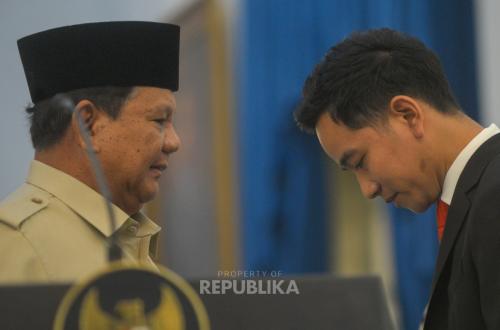
Gibran Rakabuming Raka’s resignation from the vice-presidency on 12 November 2026 opens a new chapter in Prabowo Subianto’s administration. For the first time since taking office as president, Prabowo faces a pivotal political decision: choosing a new figure to serve alongside him in governing until 2029.
Constitutionally, the President will put forward two vice-presidential candidates for the People’s Consultative Assembly (MPR) to elect. But the challenge facing Prabowo is more complicated than simply selecting two people who meet the constitutional requirements. The decision will affect political relations within the coalition, public perceptions of the government and even the political landscape ahead of the 2029 election. The key question, then, is not merely who is most qualified to be vice-president, but what kind of figure Prabowo needs in the current political climate.
I see at least three main criteria for President Prabowo to consider. First, the vice-presidential candidate should be able to represent the younger generation. Second, their appointment must not undermine the stability and cohesion of the coalition parties. Third, and perhaps most decisively, the candidate should be able to boost Prabowo’s public standing and trust.
Retaining young voters
There is one electoral reality from the 2024 presidential election that should not be ignored. A major source of strength for the Prabowo-Gibran ticket was its considerable support among young voters. According to a Kompas Research and Development exit poll during the 2024 election, the ticket received 65.9 per cent support among Generation Z voters. Among younger millennials, support reached 59.6 per cent. These figures were higher than the ticket’s support among older age groups.
We should not conclude that all this support from young people was due solely to Gibran’s presence. Prabowo’s popularity, the backing of President Joko Widodo at the time, and a political communications strategy more attuned to popular culture — the ‘Gemoy’ image, for example — also played an important role. Nevertheless, Gibran’s presence as a representative of the younger generation was one element that distinguished the ticket from its two rivals.
Prabowo and Gibran brought together two contrasting characters. Prabowo represented experience, firmness and senior leadership, while Gibran added a youthful dimension through both his age and his political communication style. This difference was part of the ticket’s appeal.
With Gibran’s departure, Prabowo risks losing an important element of the political combination that helped him win the 2024 presidential election. Maintaining a connection with young voters should therefore be an important consideration in choosing a new vice-president.
This is especially significant as Indonesia’s population and electorate are increasingly dominated by younger generations. KPU data show that Gen Z and millennial voters together accounted for more than half of the electorate in the 2024 election. Their political influence will grow further by 2029 as more Gen Z voters become eligible to vote.
Indonesia therefore needs a leader whose style resonates with young people: someone open and communicative, who understands digital transformation and pays attention to their concerns about jobs, education, social mobility and their economic future.
Maintaining coalition cohesion
The second criterion concerns the political stability of the government. Prabowo leads a broad coalition backed by several parties with different interests, histories and political ambitions. A large coalition offers the advantage of extensive parliamentary support. But the number of supporting parties does not automatically guarantee political cohesion. In practice, relations between parties are shaped by the distribution of power, access to policymaking and long-term political calculations.
Choosing a new vice-president could alter this balance. A figure from one of the coalition parties might benefit that party, but could also prompt resentment or concern among others. The vice-presidency is not merely a government post; it also carries strategic value in the next political contest.
Prabowo therefore needs a figure acceptable to most of his political allies, without sparking new rivalries that could disrupt the government’s work.
Coalition cohesion does not mean every party must receive the same political benefit. More important is a shared understanding that the choice of vice-president serves the collective interest of ensuring the government’s continuity and effectiveness.
A relatively non-confrontational figure, able to communicate across party lines and not seen as a direct threat to other groups’ political interests, would therefore have a distinct advantage.
Source: jawawa.id (https://jawawa.id/newsitem/who-is-prabowo-subiantos-choice-for-vice-president-1794703858)
Originally published by Republika (https://opini.republika.co.id/berita/toio8a487/siapa-wakil-presiden-pilihan-prabowo-subianto), translated from Indonesian