
Who Is Gadi Eisenkot, the Former General Set to Replace Netanyahu as Israel’s Prime Minister?
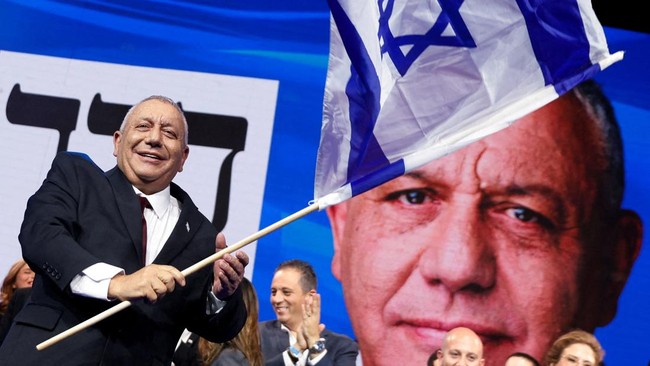
Gadi Eisenkot, a former chief of staff of the Israeli military, has emerged as a leading candidate to replace Benjamin Netanyahu as prime minister. The quietly spoken figure offers a different approach from Netanyahu, including efforts to unite society and a pledge to curb Israeli settler violence against Palestinians.
The South China Morning Post (SCMP) reported on Monday (9 November 2026) that Eisenkot’s prospects improved after Israeli President Isaac Herzog tasked him with forming the next government. The 66-year-old leads an opposition bloc that won 48 of the 120 seats in October’s election, while Netanyahu’s camp secured 53, leaving neither side with an outright majority.
Eisenkot has the backing of several parties, including a group whose members are predominantly Arab Israelis. The group could prove pivotal in forming a new government after winning a significant share of the vote.
It remains unclear whether Eisenkot is willing to rely on their support to form a coalition. The former Israeli military chief, who served from 2015 to 2019, has promised national reconciliation after years in which Netanyahu’s government was seen as deepening political divisions and shifting the country to the right.
He has also pledged to crack down on extremist settlers in the West Bank who frequently attack Palestinians. Eisenkot has described the violence as “Jewish terror” tolerated by the government.
Opposes a Palestinian state
Although he is offering a more moderate political approach, Eisenkot is not opposed to the use of military force. He opposes the establishment of a Palestinian state and has promised to end Hamas’s rule in Gaza within 18 months.
He says that goal could be achieved by implementing US President Donald Trump’s ceasefire plan or through a military operation to destroy the group’s armed wing.
The Dahiya Doctrine
Eisenkot’s military record has also drawn attention. While leading Israel’s military in the 2006 war against Hezbollah, he formulated a strategy known as the “Dahiya Doctrine”, involving the use of overwhelming military force against civilian infrastructure in areas controlled by militant groups.
The strategy has since been associated with extensive destruction in Gaza and has drawn international criticism, including accusations of violations of the laws of war, which Israel denies.
Born into a Moroccan Jewish family
Eisenkot also has a personal appeal that distinguishes him from Netanyahu. He comes from a Moroccan Jewish family and grew up in a working-class environment, unlike Netanyahu, who comes from an elite family.
If formally sworn in, Eisenkot would become Israel’s first prime minister from the Sephardic Jewish community, whose historical roots lie in the Middle East and North Africa. He has also won public sympathy after his son, Gal, and two nephews were killed in fighting in Gaza.
LGBTQ rights and policies for Arab Israelis
During his campaign, Eisenkot has sought to appeal to voters across the political spectrum. He has promised protections for the LGBTQ community, opposed the full annexation of the West Bank and the establishment of illegal settlement outposts, and pledged to safeguard judicial independence, the rule of law, minority rights and press freedom.
He has also promised to change the rules exempting ultra-Orthodox groups and Arab Israelis from compulsory military service, replacing them with a universal national service policy that could take the form of military service or civilian service. Eisenkot also wants to strengthen ties with the United States, which have deteriorated amid the conflicts in Gaza and Lebanon and tensions with Iran.
Source: jawawa.id (https://jawawa.id/newsitem/who-is-gadi-eisenkot-the-former-general-set-to-replace-netanyahu-as-israels-prime-minister-1794203438)
Originally published by CNBC Indonesia (https://www.cnbcindonesia.com/news/20261109084309-4-783405/siapa-gadi-eisenkot-eks-jenderal-ganti-netanyahu-jadi-pm-israel), translated from Indonesian