
Who Is Gadi Eisenkot, Israel’s President’s Choice to Replace Netanyahu?
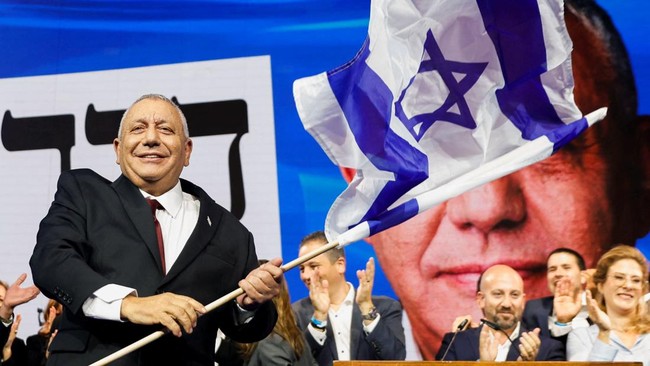
Jakarta, CNBC Indonesia – Israeli general Gadi Eisenkot has officially been appointed by President Isaac Herzog to form a new government, after Israel’s 27 October 2026 general election failed to produce a winner with a majority of seats in parliament.
If Eisenkot succeeds in forming a government, he will take over as prime minister from Benjamin Netanyahu. So, who is Gadi Eisenkot?
According to The Straits Times, Eisenkot was Chief of Staff of the Israeli military from 2015 to 2019. He is known as a quiet man, in contrast to Netanyahu, who is renowned for his provocative style and fluent American-accented English.
Eisenkot has pledged to crack down on extremist settlers in the West Bank who have attacked Palestinians with impunity, condemning recent incidents as “Jewish terror” backed by Netanyahu’s government.
However, the former military officer is not described as a peacemaker. He opposes the establishment of a Palestinian state and has vowed to end Hamas rule in Gaza and destroy the Islamist movement’s military wing.
While leading the military during the 2006 war with Hezbollah, Eisenkot devised what became known as the “Dahiya doctrine”.
Named after a Beirut suburb that was heavily damaged in the war, the doctrine entails Israel threatening to use overwhelming force against civilian infrastructure in areas controlled by the Lebanese militant group Hezbollah.
Israel has again applied the doctrine in Gaza, causing destruction that critics say amounts to war crimes, a charge Israel denies.
On international relations, Eisenkot has pledged to deepen Israel’s ties with its closest ally, the United States.
During the October 2026 election period, he drew widespread public sympathy after his son, Gal, and two nephews were killed in fighting in Gaza.
He would be Israel’s first Sephardi prime minister – Sephardi Jews are largely descended from communities with roots in the Middle East and North Africa.
Unlike Netanyahu, who comes from an elite family and whose father was a prominent professor in the United States, Eisenkot is the son of Moroccan Jewish parents and grew up on Israel’s geographic periphery.
CNN International noted that Israel’s top general grew up in Tiberias and Eilat, outside the country’s political centre of power. His story contrasts sharply with Netanyahu’s background in Jerusalem’s elite and political circles.
Eisenkot is the second of nine children and has five children of his own. He is a relative newcomer to politics, having spent most of his life in the Israel Defense Forces (IDF).
He joined the Golani Brigade in 1978 and rose through the ranks during a 40-year military career, becoming chief of staff from 2015 to 2019 under Netanyahu.
He entered politics in 2022 alongside another former chief of staff, Benny Gantz. After the Hamas-led attack on Israel on 7 October 2023, the two joined Netanyahu’s emergency war cabinet. They left in June 2024, citing the lack of a clear post-war strategy.
During his campaign, Eisenkot sought to appeal to opposing groups in Israeli society, pledging greater protection for the country’s LGBTQ community while defending Israeli control of the West Bank to religious Jews.
But he has rejected outright annexation of the territory and the establishment of unauthorised settlement outposts, which had been enabled by Netanyahu’s government and have recently fuelled increased violence against Palestinians.
On Gaza, Eisenkot has pledged to end Hamas rule within 18 months, either by implementing US President Donald Trump’s ceasefire plan – involving the gradual disarmament of Hamas and a transfer of power – or through a “creative operation” aimed at destroying the movement’s military wing.
Eisenkot has promised to limit exemptions from compulsory military service for religious students. He has also pledged a “universal national service law” requiring ultra-Orthodox Jews and Arab citizens to undertake military or civilian service.
He has sought to appeal to centrist and liberal voters by pledging to protect judicial independence, the rule of law, minority rights and press freedom.
These issues are central to Eisenkot’s position as a moderate politician, as many Israelis are concerned about what they see as the erosion of democratic institutions after years of Netanyahu’s rule.
Appointed by the president
According to Al Jazeera, on Sunday (8 November 2026), President Isaac Herzog announced on Saturday evening (7 November) that he would appoint Eisenkot to form a new government. The formal handover of the mandate is scheduled for Sunday (8 November 2026).
The decision followed Herzog’s consultations with political parties after Israel’s 27 October 2026 election failed to produce a winner with a parliamentary majority.
A total of 67 members of the Israeli parliament, or Knesset, including lawmakers from Arab-led parties, recommended Eisenkot to form a new government. Netanyahu received the backing of just 46 lawmakers.
Eisenkot, leader of the Yashar Party, has 28 days to form a coalition, with a possible 14-day extension. To command a majority, he needs the support of at least 61 of the Knesset’s 120 seats.
In last October’s election, the four-party alliance led by Eisenkot won 48 seats. Netanyahu’s right-wing bloc and religious parties secured 53.
Parties led by Arab Israelis achieved their best result in history, winning 19 seats. Despite receiving their support, Eisenkot has previously rejected the possibility of forming a government with them. If they joined his coalition, however, it could command 67 seats.
Another option for Eisenkot is to partner with two ultra-Orthodox Jewish parties, United Torah Judaism and Shas. Their support would give him exactly 61 seats. He could also seek to form a minority government with fewer than 61 seats, provided he wins a confidence vote in parliament.
Source: jawawa.id (https://jawawa.id/newsitem/who-is-gadi-eisenkot-israels-presidents-choice-to-replace-netanyahu-1794131455)
Originally published by CNBC Indonesia (https://www.cnbcindonesia.com/news/20261108124356-4-783277/siapa-gadi-eisenkot-pengganti-netanyahu-yang-ditunjuk-presiden-israel), translated from Indonesian