
Who is Ahmad Vahidi? The Veteran General Now Iran's "War Brain"
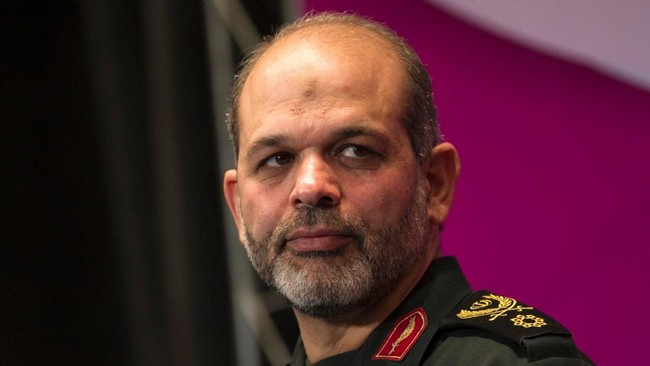
In the midst of the ongoing war, it is noteworthy to examine the figure of the general who now leads Iran’s retaliatory strikes against the United States (US) and Israel. The individual at the highest level is Ahmad Vahidi. He rose to lead the Islamic Revolutionary Guard Corps (IRGC) or Iranian Revolutionary Guard in early March 2026, replacing Mohammad Pakpour, who was killed in the initial phase of the joint US-Israel attack on Iran. In the structure of the Islamic Republic of Iran, the IRGC is not merely a conventional military force but one of the main pillars of national security, established to safeguard the Islamic Republic system and protect the revolution. Positioned at the forefront of Iran’s military power and directly under the authority of the Supreme Leader of Iran, Mojtaba Khamenei, the role of IRGC leader is highly strategic, particularly amid open warfare and the need to ensure command continuity. Vahidi himself is no stranger to Iran’s security world. He is a long-standing figure who rose through the ranks of the IRGC, beginning his career in intelligence, foreign operations, and later entering the core of government power. Background and Career Journey Ahmad Vahidi was born in 1958 in Shiraz, Iran. He joined the IRGC a year after the 1979 Iranian Revolution. From the outset, Vahidi’s career path was shaped not only in operational fields but also in the world of intelligence and state security organisations. Academically, Vahidi has a solid educational foundation. He studied electrical engineering and earned a doctorate in strategic studies. This educational background indicates that he was trained not only as a security apparatus but also as a figure who understands strategy and defence planning on a broader level. In his career progression, Vahidi was a relatively quick riser within the IRGC. He once served as deputy for internal security in the IRGC intelligence unit, then became head of IRGC intelligence in 1983. His name is also linked to the early formation of the Ministry of Intelligence and Security (MOIS), one of Iran’s most important intelligence agencies. This experience shows that Vahidi was shaped not only as a combat commander but also as a figure who understands intelligence work, internal security, and managing domestic threats. This becomes crucial capital for an IRGC leader, given that the Revolutionary Guard has functions far broader than conventional military. In the mid-1980s, Vahidi was also reportedly involved in secret contacts between Iran and parties close to the administration of US President Ronald Reagan. This episode illustrates that from an early stage, he operated in a highly sensitive space, namely the intersection of security, unofficial diplomacy, and national strategy. Once Led the Quds Force One of the most important phases in Ahmad Vahidi’s career was when he became the first commander of the Quds Force. This unit was formed as an IRGC branch managing Iran’s external operations, while consolidating previously scattered units into a single command structure. This position is vital because the Quds Force has long been known as one of Iran’s main instruments for building influence abroad. It is from here that Vahidi’s name carries significant weight in the history of Iran’s power projection machinery. He led the Quds Force until 1997 or 1998, before the position was taken over by Qassem Soleimani. Career Enters the Heart of Government After advancing in the IRGC and Quds Force, Vahidi’s career moved closer to the centre of Iranian power. He entered the Ministry of Defence and Armed Forces, initially as deputy for planning, then as principal deputy minister of defence. However, during Mahmoud Ahmadinejad’s second term starting in 2009, Vahidi became more prominent and subsequently served as Iran’s Minister of Defence. In his role as Minister of Defence, he promoted the development of various conventional Iranian weaponry, from tanks, fighter aircraft, missiles, to armoured vehicles. After that, he also led the Defense Strategic Research Center and sat on the Strategic Council on Foreign Affairs, an advisory body established by the Supreme Leader of Iran. Once Held Control of Domestic Security Before now reaching the pinnacle of IRGC command, Ahmad Vahidi also held a highly sensitive position, namely Minister of Interior of Iran in 2021 during President Ebrahim Raisi’s era. This position is crucial because the Ministry of Interior plays a major role in domestic security, including coordinating apparatus when the country faces social and political unrest. During his tenure, Vahidi is said to have strengthened the role of governors and appointed many figures with IRGC backgrounds to civilian positions. This shows that his approach to managing government is heavily influenced by security and state control logic. This experience in handling the domestic security sector makes Vahidi’s profile even more comprehensive.