
Who Are Priority Seats on KRL Actually For, When They're Still Occupied by General Passengers?
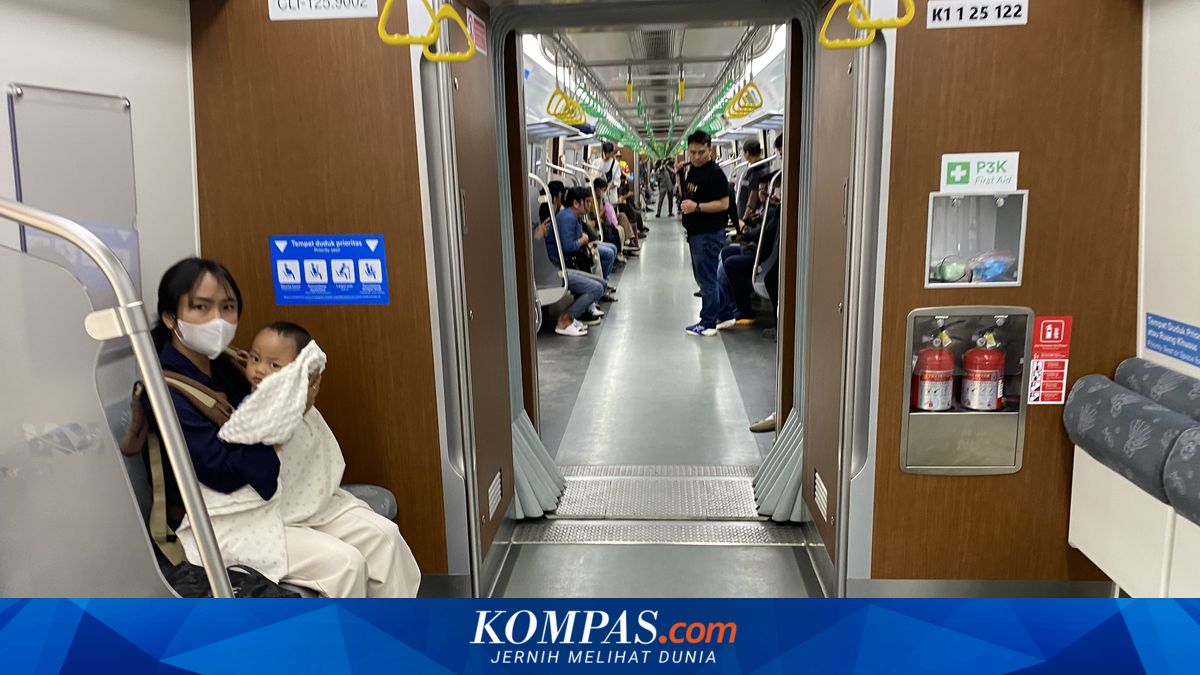
JAKARTA, KOMPAS.com — Journeys on the KRL Commuter Line outside peak hours are often considered more relaxed and comfortable. However, observations by Kompas.com on Wednesday (8/4/2026) showed a different reality.
Even though the train was not overly crowded, priority seats were still largely occupied by general passengers, making it difficult for vulnerable groups such as the elderly, pregnant women, and people with disabilities to find a seat.
Kompas.com tried boarding the KRL on the Manggarai–Jakarta Kota route using a 12-carriage set around 11.00 WIB.
While traversing the entire set, the atmosphere inside the train was relatively uncrowded. Passengers still had space to stand without being packed in. However, all seats, both general and priority, were fully occupied.
Some passengers sat casually, busy with their phones, or closed their eyes. At a glance, there was no difference between priority seats and regular ones.
Both appeared to be treated the same: first come, first served. However, upon closer inspection, a stark contrast emerged.
Of the total available priority seats, the majority were occupied by passengers who did not fall into the priority category. Only a few seemed to genuinely meet the criteria, such as the elderly or passengers with special conditions.
In that observation, Kompas.com only found about seven elderly passengers across the entire set. This number was disproportionate to the many available priority seats, most of which remained filled by general passengers.
In some carriages, passengers were seen sitting in priority seats without showing any signs of special needs.
Meanwhile, in other corners, the elderly sat alongside general passengers without clear separation or emphasis. During the journey, announcements continued to play through the loudspeakers inside the carriages.
Those announcements were clear and repeated, serving as reminders that priority seats have a specific function.
However, from the on-site monitoring, the appeals did not fully align with passenger behaviour.
For Hami (29), a pregnant woman from Depok, travelling by KRL is not just a routine but also a physical and emotional test. At seven months pregnant, she admitted she does not always get her rights as a priority passenger.
“I often have to stand. Even though I’m pregnant, my body gets tired quickly, and I sometimes feel dizzy,” she said when met at Manggarai Station on Wednesday.
She recounted that the most difficult situations occur during peak hours. Priority seats are often already full, even by passengers who do not belong to the priority category.
“Sometimes I stand right in front of the priority seats, but people pretend not to see or are busy with their phones,” she said.
Although she understands she has the right, Hami admitted she often feels reluctant to ask.
“By the rules, I know it’s my right. But honestly, sometimes it’s awkward to ask,” she said.
“Once I said I was pregnant, but the person just looked for a moment, then went back to their phone. They didn’t give up the seat,” she added.
Since then, she has chosen to stay silent.
However, standing for too long directly impacts her physical condition. She has also nearly fallen due to dizziness while standing in the train. For Hami, priority seats are not just a facility but a form of protection.
“This isn’t about who is more tired. But who needs it more,” she stated.
A similar story comes from Suyatno (67), a resident of Pasar Minggu who regularly uses the KRL for selling goods. He admitted he often does not get a seat, even when priority seats are available.
“Sometimes I see young people occupying priority seats. They might be tired too, but they should be aware,” said Suyatno.
Nevertheless, he rarely confronts them. As a result, he more often endures standing despite the risks. For Suyatno, there is a difference between ordinary fatigue and physical limitations due to age.
“Young people tired from work, I understand. But for me, this is already a factor of age,” he said.