
Who are Iran's "Super Revolutionaries", the Hardline Faction Opposed to the US?
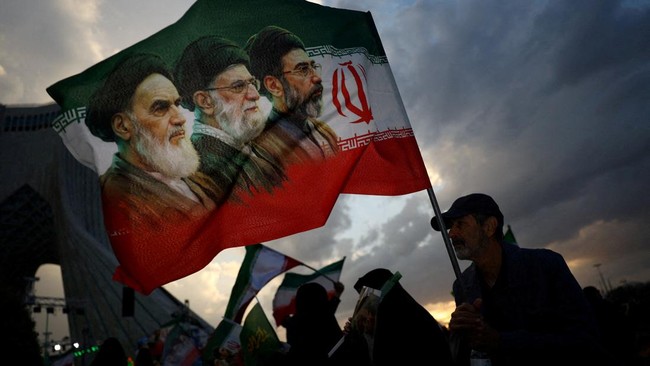
Jakarta, CNBC Indonesia - The hardline group in Iran known as “Jebhe-ye Paydari” or Front of Steadfastness is currently vigorously attempting to sabotage potential peace agreements between Tehran and Washington. This movement has emerged amid a critical stage of negotiations between the United States (US) and Iran, while also bolstering US President Donald Trump’s claims of internal divisions within the Islamic Republic.
Citing CNN, this group, nicknamed “Super Revolutionaries”, holds views similar to Trump’s that the 2015 nuclear deal was a mistake, albeit for different reasons. Their stance is considered highly anti-Western, even surpassing the standards of typical Iranian hardline conservatives, rendering the regime’s efforts to rein them in thus far unsuccessful.
“They view resistance against the United States and Israel as an eternal struggle. They believe in a Shiite state that must persist until the end of times and are highly fanatical about that religious ideology,” said Hamidreza Azizi, a guest researcher at the German Institute for International and Security Affairs.
The emergence of this group as the most vocal voice opposing reconciliation occurs amid a power struggle following the death of Ali Khamenei at the end of February 2026. Although the new Supreme Leader, Mojtaba Khamenei, has issued statements indicating unity, the Paydari group continues to sow division by accusing negotiators of disloyalty to the Islamic Republic and violating red lines set regarding the nuclear programme.
Radical Voices from the Centres of Power
This group is considered extremely radical even by established conservative circles in Iran, yet members of Jebhe-ye Paydari are embedded in influential centres of power. The faction is supported by senior media figures, top politicians such as Saeed Jalili who garnered 13 million votes in the 2024 election, and religious authorities with significant influence.
In an article on Raja News representing the Paydari Front, they sharply criticised Tehran’s openness to dialogue with US officials. They deemed such talks as a form of capitulation or surrender to an enemy that has killed their leaders.
“They (the US) realise that killing our leader, commanders, and beloved ones costs them nothing. They understand that even after they martyred our Imam (Ali Khamenei), there are still groups here willing to negotiate, shake hands with Witkoff, Vance, and Kushner, and smile at the murderers of our martyred Imam,” the article stated.
This internal tension is also evident in parliament, where seven legislators affiliated with the group refused to sign a statement of support for the negotiation team. One parliamentarian, Mahmoud Nabavian, who had previously participated in the negotiation team in Islamabad, turned to attack, calling nuclear negotiations a strategic mistake.
“Given the history of American bad faith and the embarrassing presence of JCPOA (2015 nuclear agreement) supporters alongside Mr Ghalibaf in negotiations, there is no hope for negotiations and agreements beneficial to Iran,” Nabavian wrote on his X account.
A New Power Centre
Following bombings by the United States and Israel that began at the end of February, this group has successfully formed a new power centre through massive street protests in Tehran. Thousands of loyal supporters of the Islamic Republic, including Paydari members, took to the streets to pressure the country’s new leadership not to yield to Western pressure.
Their current spiritual leader, Ayatollah Mahdi Mirbaqiri, is known for his apocalyptic views that seek to hasten the end times through broad conflict with the West. The group has also successfully rallied Iran’s younger generation, which is increasingly uncompromising after repeated external military attacks.
“The Paydari group quickly capitalised on the ideologically oriented youth now on the streets. They are trying to represent themselves as the manifestation of the ideas introduced by Ali Khamenei to create a pious young revolutionary generation capable of carrying on the legacy of the Islamic Republic,” explained Azizi.
Increasingly Isolated
Although their voices are very loud, the group’s efforts to divide the nation are starting to backfire. Various political spectrums in Iran, including rival politicians who usually clash, are now beginning to unite to isolate this radical faction because they are seen as aiding the Israeli and US narrative that Iran is in internal chaos.
“It seems this is truly becoming a boomerang for them. They are making a lot of noise and are seen as having helped Israel and the US in portraying Iran as trapped in major internal divisions, but this fringe radical group is facing resistance from all sides and becoming increasingly isolated,” revealed Mohammad Ali Shabani, editor of Amwaj.media.
Shabani opined that fundamentally, the hardliners do not entirely reject a deal with the US. However, they want to be the ones negotiating it to gain influence and restructure domestic power structures.
“They say if we keep fighting, we can force the US to surrender and then dictate the terms. No one in Iran opposes a deal. This is about tactics on how to achieve the deal, and who has the right to make it,” Shabani concluded.