
White Kapok in the Home of the Teacher of the Nation
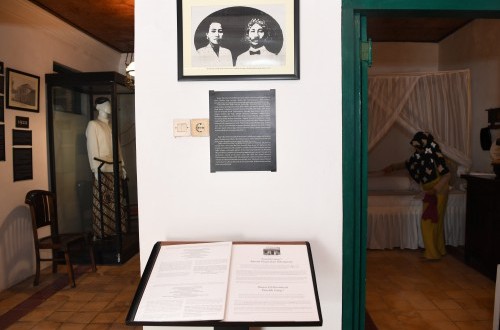
This nation once had a teacher whose home was more feared by the colonisers than an armed headquarters. Not because it stored rifles or cannons, but because from that house emerged thoughts that would later shake the colonial order and change the fate of a nation. He was H.O.S. Tjokroaminoto.
From his simple home in Peneleh, Surabaya, emerged individuals who would each tread their own path in history—Sukarno, Musso, Semaun, Alimin, and Kartosuwiryo. It is hard to find another house in Indonesian history that produced so many figures with such a broad spectrum of ideologies.
That house was not merely a residence. It was a school of politics, a kitchen for cadre training, a laboratory of ideas, and a forge where the characters of leaders were tempered before being cast into the arena of history.
Yet history often has the same weakness: it too easily glorifies those who stand on the podium, and too often forgets those who keep the home standing so that the podium can remain erect.
Behind Tjokroaminoto was a woman whose name passes almost only as a footnote: Suharsikin. Yet without her, the house in Peneleh might never have become the crucible of the nation.
She was the one who received the young men who came to board and learn. She was the one who prepared meals, managed the house that was almost never quiet, and made the family room an inseparable part of her husband’s political struggle.
But Suharsikin’s role extended even further. She was not only the guardian of the house of struggle—she was its economic pillar. Amid a life far from abundance, she managed batik work from home. From her diligent hands emerged sheet after sheet of batik cloth that helped sustain the family while keeping her husband’s struggle alive.
When Tjokro stood on the podium calling for the awakening of the people, Suharsikin ensured the kitchen remained smoking. When her husband shook the consciousness of the people outside the home, she kept the struggle from collapsing from within.
She did not stand on the congress podium. She did not lead grand meetings. Her name is not printed large in history textbooks. But like many great women scattered from the pages of history, she bore the quietest part of the struggle—and thus the least praised.
There is one scene that always lingers in my memory whenever the story of Tjokroaminoto is retold. Not his speech on the podium. Not the grand Sarekat Islam meetings. Nor his debates with his ideological students.
But a simple conversation about white kapok. Kapok that is harvested, cleaned, separated into fibres, then stuffed into pillows—a daily task that may seem trivial to history, but it is precisely there that real life unfolds.
In a body long ravaged by illness, while taking a clump of white kapok from an opened pillow, Suharsikin said to her husband:
“You once said you wanted to become white kapok—to become a pillow, a shawl, a blanket for your people. Meet those who await you. This house is also their house. Meet your people.”
Those words were simple, but precisely because of their simplicity, they feel so grand.
Because amid the grand conversations about the fate of the nation, in the home of a movement leader, there are still household tasks to be completed, kapok to be cleaned, cloth to be batiked, and love that exists not in grand words, but in its most human form: understanding, supporting, and then letting go.
Not long after that conversation, Suharsikin passed away.
And when death came for her, Tjokroaminoto was speaking on the veranda of his home—surrounded by the people of Surabaya crowding the yard because they had long missed his speeches.
At that point, history seemed to show its most honest yet cruel face: A leader was surrendering himself to the people, while at the same time his own home was losing the person who had quietly enabled that devotion all along.
It is there that we are forced to understand something too often overlooked when discussing the founders of the nation: That political struggle demands not only the courage of those who appear in public, but also the sacrifices of those who live with them.
We admire Tjokroaminoto for his speeches that ignited the masses. For his intelligence in shaping cadres. For his ability to produce great leaders. But too few ask about the personal price of all that.
About how much family time was lost. About how much household peace was sacrificed. About how many wounds had to be borne by those closest to him for ideals greater than themselves.
And perhaps it is precisely there that the true greatness of Tjokroaminoto lies—along with the reason why this republic has yet to produce a figure on his level. Because we live in an era that wants big results without the willingness to bear the high cost.
We yearn for visionary leaders, yet build political systems that only value popularity. We long for statesmen, yet nurture habits that worship image-making more than intellectual depth. We praise the sacrifices of our forebears, but too many enter the realm of power not to serve, but to live more comfortably.
Tjokro did not build a career. He built people.
He was not busy gathering loyalists. He prepared cadres—even those who would later choose different ideological paths and oppose him.
Because he understood something now almost lost from modern politics: That great leaders are measured not by how long they hold power, but by how many quality individuals are born after them.
Thus, the question for this republic is no longer merely: Where is the new Tjokro?
The more honest question is
Source: jawawa.id (https://jawawa.id/newsitem/white-kapok-in-the-home-of-the-teacher-of-the-nation-1776088253)
Originally published by Republika (https://news.republika.co.id/berita/tdfooa318/kapuk-putih-di-rumah-sang-guru-bangsa), translated from Indonesian