
Which Ministries Fall Under the Ministry of Downstreaming and Energy Transition?
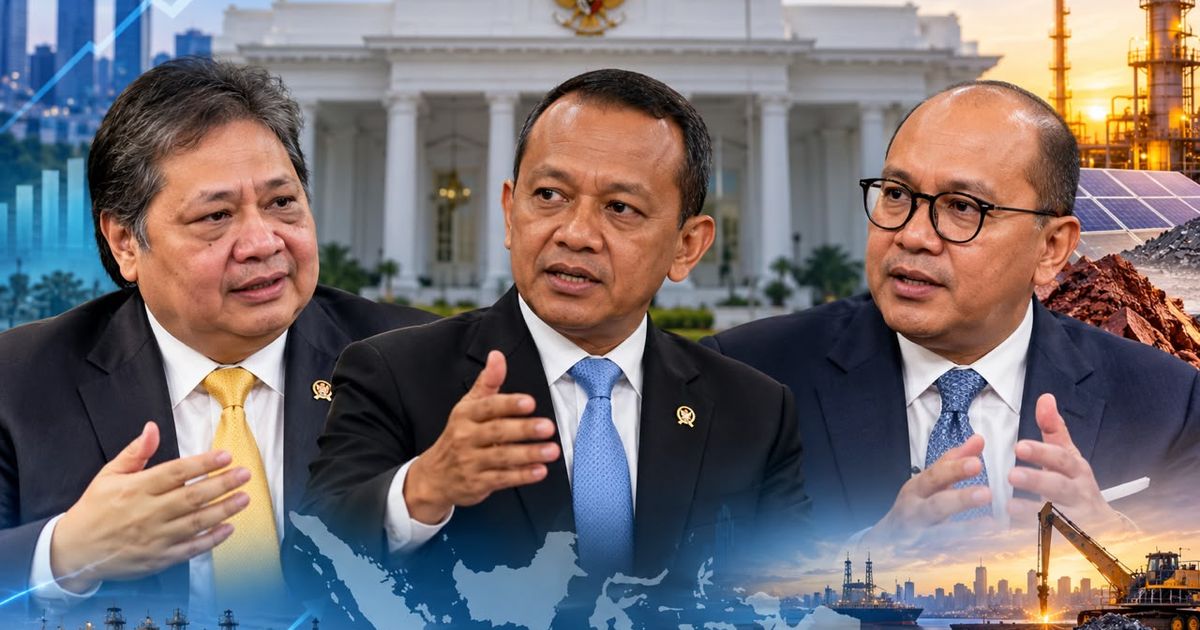
The formation of the Coordinating Ministry for Downstreaming and Energy Transition (Kemenko HTE) is altering the economic management architecture of President Prabowo Subianto’s administration. Several technical ministries that previously fell under the coordination of the Coordinating Minister for Economic Affairs, Airlangga Hartarto, are likely to shift to the new coordinating ministry led by Bahlil Lahadalia.
President Prabowo inaugurated Bahlil as the Coordinating Minister for Downstreaming and Energy Transition on Thursday, 1 October 2026. Bahlil will simultaneously continue to serve as the Minister of Energy and Mineral Resources (ESDM). According to the government, the creation of this new coordinating ministry aims to consolidate and accelerate the implementation of two major agendas of the Prabowo administration: natural resource downstreaming and energy transition.
However, as of 5 October 2026, the full list of ministries to be under the coordination of Kemenko HTE has not yet been finalised. Coordinating Minister for Economic Affairs Airlangga Hartarto stated that the division of technical ministries is still being discussed by the government and will be formalised in the new coordinating ministry’s organisational structure and working procedures (SOTK).
Bahlil has confirmed that two ministries will definitely fall under his coordination: the Ministry of Energy and Mineral Resources (ESDM) and the Ministry of Investment and Downstreaming/Investment Coordinating Board (BKPM). Bahlil explained that the Ministry of Investment and Downstreaming remains a technical ministry, while Kemenko HTE performs the coordination function. Therefore, the Ministry of Investment and Downstreaming will be under the coordination of Kemenko HTE.
The Ministry of ESDM will substantively serve as the core of the new coordinating ministry. Bahlil noted that approximately 90% of downstream investment is related to the ESDM sector. For the time being, he will continue to operate from the Ministry of ESDM while awaiting the organisational developments of Kemenko HTE.
The next ministry with a high probability of shifting is the Ministry of Industry. Minister of Industry Muhammad Sarmuji signalled on 2 October that the Ministry of Industry would fall under the coordination of the Coordinating Ministry for Downstreaming and Energy Transition. According to Sarmuji, downstreaming and industrialisation are closely linked. However, this placement still awaits a formal decision to be formalised in the government’s new organisational structure.
Thus, based on official statements and government indications to date, at least three ministries form the core architecture of Kemenko HTE: the Ministry of ESDM, the Ministry of Investment and Downstreaming/BKPM, and the Ministry of Industry. For other ministries with significant downstreaming activities—such as agriculture, plantations, forestry, and marine fisheries—it cannot be confirmed whether they will fall under Kemenko HTE until the final government structure is published.
The formation of Kemenko HFT also has the potential to reduce the scope of technical ministries currently coordinated by the Coordinating Ministry for Economic Affairs. Based on Presidential Regulation (Perpres) Number 143 of 2024 and the structure prior to the recent changes, the Coordinating Ministry for Economic Affairs manages economic coordination covering several technical ministries.
If ESDM, Investment and Downstreaming/BKPM, and Industry shift to Kemenko HTE, the government’s economic coordination structure will undergo a significant change. Ministries such as Trade, Manpower, and Tourism are likely to remain primary components under the coordination of the Coordinating Ministry for Economic Affairs. The final configuration, however, must await a new Presidential Regulation or SOTK, so it would be premature to consider the division final.
This change demonstrates the government’s effort to separate two major functions. The Coordinating Ministry for Economic Affairs can concentrate more on broad economic policy coordination, while Kemenko HTE becomes the coordination hub for industrialisation based on natural resource downstreaming and energy system transformation.
Where does Danantara stand?
The formation of Kemenko HTE also raises questions regarding the position of the Daya Anagata Nusantara Investment Management Agency, or BPI Danantara. The answer is crucial: Danantara does not automatically fall under either the Coordinating Ministry for Downstreaming and Energy Transition or the Coordinating Ministry for Economic Affairs.
Danantara has its own institutional pathway directly to the President. Government Regulation (PP) Number 10 of 2025 defines Danantara as an agency that carries out government tasks in the management of State-Owned Enterprises (SOEs), with certain presidential duties and authorities delegated to it.
This direct position is further evidenced in Presidential Regulation Number 28 of 2026 regarding the Implementation of Development Investment for the Acceleration of Economic Growth. This regulation grants Danantara a role in Strategic Investment Projects, funding structures, the formation of special purpose vehicles (SPVs), private sector involvement, and the management of development investment funds. Supervision and reporting for BPI Danantara are conducted directly to the President.
Therefore, the relationship between Danantara and either Bahlil or Airlangga is best understood as policy coordination rather than a hierarchical superior-subordinate relationship. For downstreaming and energy transition projects, Danantara will work closely with Kemenko HTE and technical ministries. In broader economic policy, Danantara will also intersect with the Coordinating Ministry for Economic Affairs and other ministries.
The simplified structure consists of two pathways. In the government pathway, there is the President, followed by the Coordinating Minister for HTE as the policy coordinator, and technical ministries such as ESDM and Investment and Downstreaming/BKPM. In the state investment pathway, there is the President, followed by BPI Danantara as the investment management agency, along with the investment instruments and the SOE ecosystem it manages.
The presence of Danantara is intended to accelerate domestic investment. By managing all SOEs and their substantial dividends, Danantara is expected to act as an investment catalyst. Although its role is approximately one to two per cent, Danantara…
Source: jawawa.id (https://jawawa.id/newsitem/which-ministries-fall-under-the-ministry-of-downstreaming-and-energy-transition-1791186705)
Originally published by investortrust.id (https://investortrust.id/indepth/118347/kementerian-mana-saja-yang-berada-di-bawah-kementerian-hilirisasi-dan-transisi-energi), translated from Indonesian