
Which is more important: Asking or answering?
Jakarta (ANTARA) - “Please, who can answer?” That phrase may well be the question heard most often in classrooms. From primary school through to university, learners are trained to answer their teachers’ questions.
Examinations, too, almost always measure the ability to answer. The more correct answers given, the higher the marks obtained. Conversely, it is very rare for a teacher to ask, “Who can pose the best question today?”
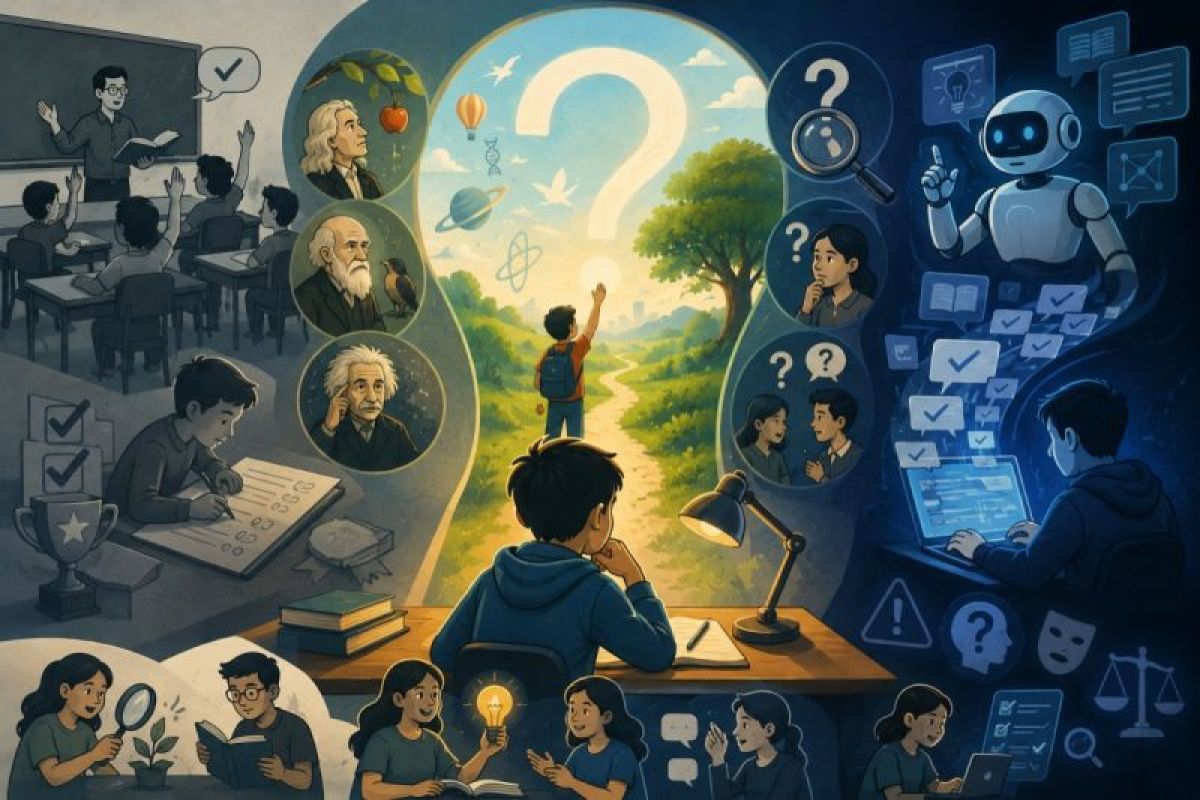
Almost every great leap in the history of science actually began with a good question, not with an answer.
Isaac Newton did not begin his theory with an answer, but with the question of why an apple falls downwards. Charles Darwin asked why living creatures display such enormous diversity. According to Albert Einstein, formulating a problem is often more important than finding its solution.
Knowledge advances because human beings ask questions, not because they stop asking them.
Ironically, our education system still rewards answers far more than questions. For centuries, that approach may have been adequate.
When books were hard to come by and teachers were the primary source of knowledge, the ability to answer was indeed an indicator of learning success. Learners needed to master as much as possible of the knowledge held by their teachers.
The internet then changed the world. Information is no longer scarce. Almost every answer can be found through a search engine. Education began to shift as a result. What matters is no longer memorisation, but knowing how to find information.
Now, artificial intelligence (AI) is changing the educational landscape once again, and more fundamentally. AI does not merely help find information; it also generates answers. Within seconds, AI can answer almost any question in language that is coherent, complete, and convincing.