
Where Are the World’s Goods Headed? China Owns the Ports
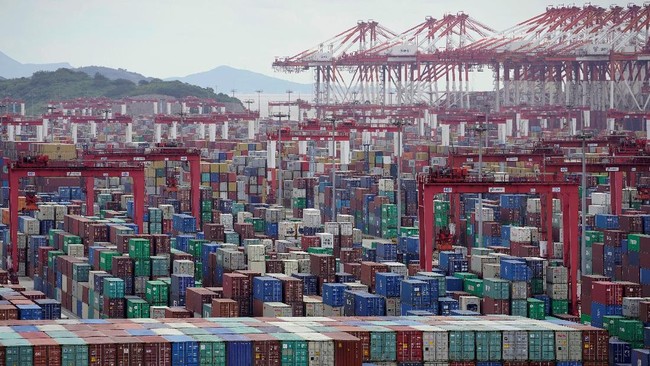
Jakarta, CNBC Indonesia — China’s dominance in global port operations underscores the country’s strong position in global supply chains. Six of the world’s eight busiest container ports are located in China, making the country not only a manufacturing hub but also a key node in the movement of international goods.
Integrated infrastructure linking ports with industrial areas and transport networks makes it easier for Chinese products to reach global markets.
As global trade becomes increasingly interconnected, ports are one of Beijing’s strategic assets in maintaining its influence over cross-border flows of goods.
According to the 2026 Lloyd’s List rankings, based on container throughput in 2025, Shanghai was the world’s busiest port, handling 55.1 million TEUs (twenty-foot equivalent units).
One TEU represents the capacity of a standard container measuring about 6.1 metres long, 2.44 metres wide and 2.59 metres high.
Shanghai has held the number-one position for 16 consecutive years. Its throughput was more than 10 million TEUs higher than Singapore’s and over five times that of Los Angeles, the busiest container port in the United States.
This dominance is not the work of a single port. Six of the world’s eight busiest ports are in China, while all eight are in East or South-east Asia. Including Hong Kong, Chinese ports handled about half of the combined volume of the 30 ports on the list.
Shanghai is also supported by transport links connecting it with industrial centres along the Yangtze River through waterways and railways. This infrastructure enables manufacturers in China’s inland regions to send goods to international markets.
As manufacturing spreads across Asian countries and China’s trade ties with South-east Asia deepen, Chinese ports remain important nodes in regional supply chains.
Singapore: A Link in Global Shipping Routes
Singapore ranked second, handling 44.66 million TEUs in 2025, but its strength differs from China’s. While Chinese ports serve a vast domestic manufacturing region, Singapore relies on its position as a link in international shipping routes.
Connected to more than 600 ports worldwide, Singapore functions like a transit airport for containers. Goods are transferred from one ship to another before continuing their journey, a process known as transshipment.
The port also relies on deep-water berths and electric-powered automated yard cranes to handle large container ships.
Its capacity will continue to expand through Tuas Port, designed to consolidate Singapore’s container operations at one site. Once completed in the 2040s, it is expected to handle 65 million TEUs a year.
The US Lags Far Behind
Los Angeles is the busiest container port in the United States, but ranked only 18th globally, handling 10.24 million TEUs in 2025. Its volume was far below Shanghai’s and Singapore’s.
Even so, this ranking does not diminish Los Angeles’s strategic role. Together with Long Beach, it forms the San Pedro Bay port complex, which handled about one-third of US international seaborne container trade in 2025.
Furniture, vehicle parts and electronics are among the main imports passing through Los Angeles. Its shipping routes are closely connected with East and South-east Asia, illustrating how goods manufactured in Asia reach American homes, shops and businesses.
Containers do not stop in California after arriving on the Pacific coast. The Alameda Corridor, a rail network about 20 miles long, connects the ports of Los Angeles and Long Beach, allowing goods to continue on to consumers in the US interior.
The global port map ultimately shows China leading in scale, Singapore in connectivity, and California’s ports serving as a key gateway linking Asian manufacturing with the US market.
Source: jawawa.id (https://jawawa.id/newsitem/where-are-the-worlds-goods-headed-china-owns-the-ports-1792482639)
Originally published by CNBC Indonesia (https://www.cnbcindonesia.com/research/20261020124214-128-777823/barang-dunia-mau-ke-mana-china-punya-pelabuhannya), translated from Indonesian