
When Will Indonesia Be Hit by Super-Boiling Heat? Here's the Prediction
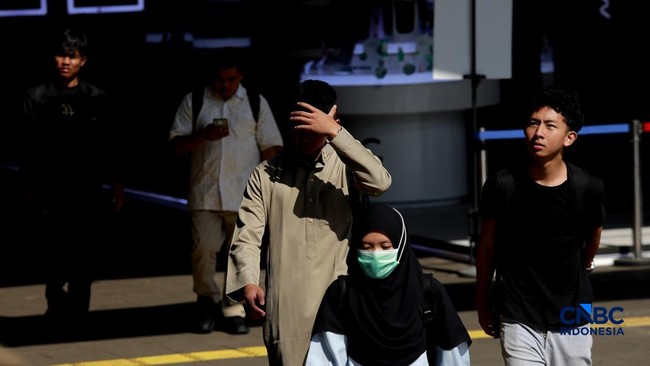
The Meteorology, Climatology, and Geophysics Agency (BMKG) predicts that the peak of the dry season in Indonesia will occur during the period from July to September 2026. This condition is expected to be drier and longer than normal, following the potential emergence of the El Niño phenomenon, which could worsen droughts in various regions.
BMKG Head Teuku Faisal Fathani stated that the peak of the dry season will begin to expand in July, before reaching its highest point in August 2026. The regions predicted to experience the peak of the dry season in July 2026 include parts of Sumatra, small parts of Kalimantan and Java, southern East Nusa Tenggara, northern West Sulawesi, western Central Sulawesi, small parts of Maluku, southern Southwest Papua, central West Papua, and eastern Papua.
BMKG noted that 83 Seasonal Zones (ZOM), or approximately 12.26% of Indonesia’s land area, will experience the peak of the dry season in July. This figure is expected to surge sharply in August to 369 ZOM, representing about 48.84% of Indonesia’s land area. In August, the peak is expected to hit central Sumatra, most of Java, Bali, West Nusa Tenggara, parts of East Nusa Tenggara, most of Kalimantan, parts of Sulawesi, parts of Maluku and North Maluku, and most of the Papua region.
Meanwhile, 169 ZOM, or about 25.41% of Indonesia, is predicted to enter the peak of the dry season in September. Affected areas include the Bangka Belitung Islands, most of South Sumatra, Lampung, small parts of Java, most of East Nusa Tenggara, southern Kalimantan, most of Sulawesi, North Maluku, Maluku, and the Papua Highlands.
BMKG Deputy for Climatology, Ardhasena Sopaheluwakan, revealed that the dry season has actually begun in several Indonesian regions. As of the end of May 2026, 200 ZOM, or approximately 11.83% of the land area, has entered the dry season. Regions experiencing the dry season earlier include parts of Sumatra, parts of Java, most of Nusa Tenggara, eastern Central Kalimantan, parts of Sulawesi, Maluku, and Papua.
According to BMKG, this year’s dry season has the potential to be more severe than usual due to the influence of El Niño, which is expected to persist until early 2027. “BMKG predicts the El Niño phenomenon will continue until the beginning of 2027, with a 98% chance of reaching moderate intensity and a 62% chance of reaching strong intensity. However, its impact on Indonesia will coincide with the dry season period until mid-October,” added Ardhasena.
The National Research and Innovation Agency (BRIN) has confirmed that the likelihood of a ‘Godzilla El Niño’—an extremely strong El Niño that can trigger extreme drought—is very low this year. Nevertheless, the public and the government must remain vigilant regarding a dry season that is expected to last longer than normal.
Head of the Centre for Climate and Atmosphere Research at BRIN, Albertus Sulaiman, stated that various analyses of global climate models show the current global climate is leaning towards a moderate El Niño category with a probability of around 2t7%. This differs from the super-strong El Niño, or ‘Godzilla El Niño’, which occurred in 1997 and 2015.
“The 2026 El Niño is not expected to reach extreme levels. However, the dry season is predicted to last longer, with rainfall falling below climatological averages,” explained Albertus.
He explained that El Niño is a phenomenon involving the warming of sea surface temperatures in the central and eastern Pacific Ocean, which disrupts the formation of rain clouds in Indonesia. Under normal conditions, Indonesia’s warm waters serve as a centre for cloud and rain formation. During El Niño, the centre of cloud formation shifts towards the Central Pacific, significantly reducing rainfall in Indonesia.
Based on BRIN’s predictions, the peak of the 2026 dry season is expected to occur in August. Several areas on Java Island, particularly West Java including Bekasi, Cirebon, Kuningan, and Bandung City, could experience very dry conditions. “Overall, the probability of a longer dry season reaches approximately 81%,” explained Albertus.
Albertus emphasised that the chance of a ‘Godzilla El Niño’ appearing this year is very low due to several scientific factors. One of these is the Indian Ocean Dipole (IOD) condition, which is currently in a neutral phase and is predicted to remain so until April 2027.
Furthermore, Indonesia and the Pacific region have recently experienced a strong El Niño during the 2023-2024 period, meaning the oceans do not yet have enough physical energy to form another super-extreme El Niño in such close proximity. However, Albertus added that BRIN has found signals of an increased risk of extreme El Niño during the period from late 2027 to mid-2028. Using stochastic analysis, the probability of a ‘Godzilla El Niño’ appearing during that period is estimated to increase to nearly 40%.
“This finding serves as an early warning for the government to begin preparing medium-term mitigation strategies,” he asserted.