
When three orangutans returned to the embrace of the Kalimantan jungle
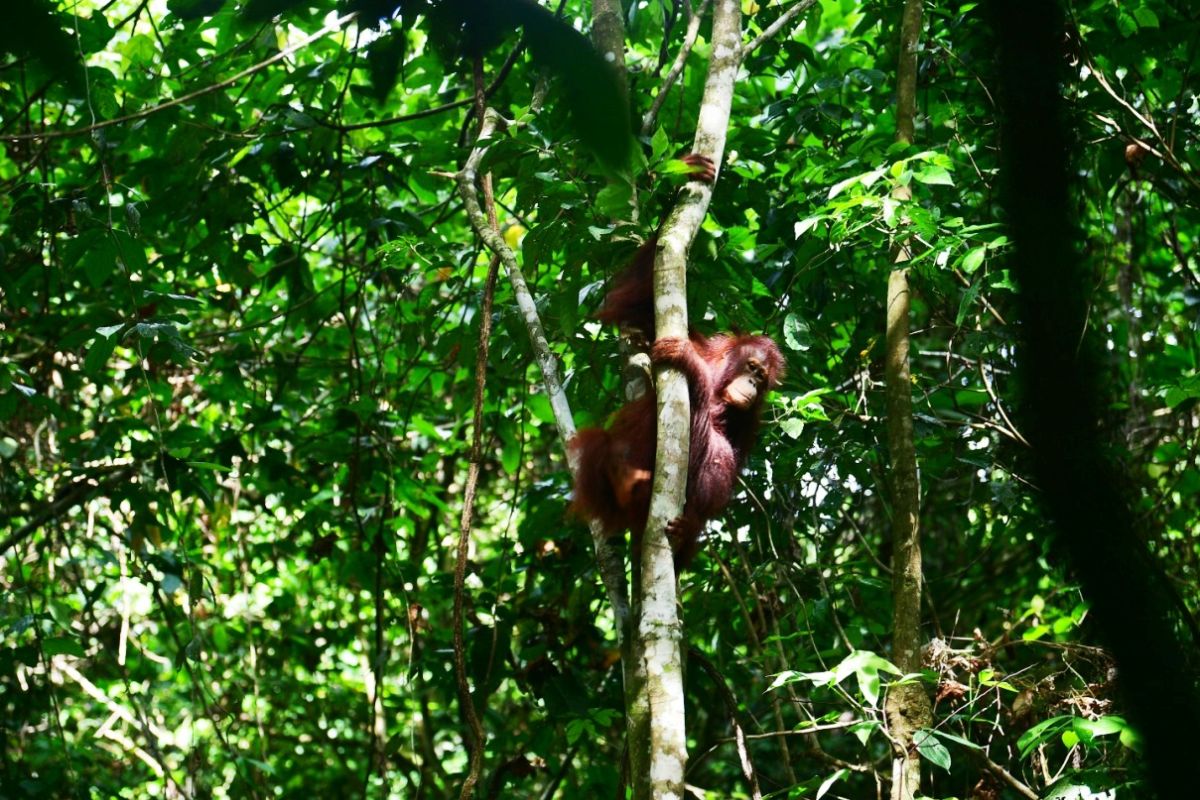
In the dense Gunung Batu Mesangat Protection Forest, Busang District, East Kutai, East Kalimantan, the morning atmosphere was silent but full of meaning. A gentle breeze rustled the leaves of giant trees, while the Hagar River, a tributary of the Menyuq, flowed calmly through a landscape that remains pristine. On Tuesday, 23 June 2026, this haven for thousands of flora and fauna species welcomed three new residents who had long yearned for freedom. After a long and arduous journey, three individuals named Bagus, Eboni, and Ruby finally stepped back into the embrace of the jungle, the wild home they should have known from birth until old age. The release was the result of cooperation between the East Kalimantan Natural Resources Conservation Agency (BKSDA Kaltim), the Kelinjau Forest Management Unit (KPHP), and the Centre for Orangutan Protection (COP). For conservationists, this moment was not merely about opening a cage door, but a major victory in the effort to restore nature’s balance and secure the future of the endangered Bornean orangutan (Pongo pygmaeus). The Gunung Batu Mesangat Protection Forest was chosen as their new home for specific reasons. The area is strictly managed by KPHP Kelinjau and possesses a complete forest structure, providing an abundance of natural food sources ranging from fruits and leaves to the shoots of various tree species, ensuring it is safe and capable of supporting the survival of the three apes. The release was also part of a series of activities leading up to National Nature Conservation Day, commemorated every 10 August, serving as a valuable gift to nature and a reminder that efforts to preserve wildlife must never cease. Releasing orangutans into the wild is not a simple matter that can be rushed. Every step must be carefully planned to minimise stress and ensure they can survive in the jungle. The joint team implemented a specific strategy for determining the timing and location of the release. The three orangutans were not released simultaneously at a single point but were spread out with carefully calculated distances and timings. The release sequence began with Eboni, followed by Bagus, and finally Ruby. The location distribution was also meticulously designed. Eboni and Ruby were released on the same land expanse, but their release points were separated by approximately one kilometre. Bagus, meanwhile, took a separate route and was released across the river, on a different land mass, about 500 metres from his companions’ release points. ‘This strategy is important so they have their own initial roaming space without having to immediately compete for territory or food,’ said Widi Nursanti, Manager of the COP Orangutan Rehabilitation Centre. All release points were centred around the Hagar River flow, which serves as the lifeblood of the forest. By spacing them out, the team gave each individual the chance to slowly and calmly get to know their new environment. Behind these familiar-sounding names lie life stories full of challenges. Bagus, Eboni, and Ruby all share a similar background; they were victims of illegal keeping by members of the public. They were successfully rescued by the East Kalimantan BKSDA and its team, after which they had to undergo a long healing process before finally being able to return to the forest. Bagus was the first to be rescued, evacuated in early September 2020 from Merabu Village, Berau Regency. At the time, he was still very young and had become accustomed to living in a domestic environment, far from his natural habits. Eboni was secured from a resident in late April 2022 in Long Beliu Village, also in the Berau region. Ruby was the last to be rescued, in early April 2024, from Sekurau Atas Preparatory Village, East Kutai Regency. Upon arrival at the treatment centre, their condition was a cause for concern. Having lived alongside humans for too long, their wild instincts had faded. They did not know how to climb trees nimbly, could not recognise which fruits were safe to eat, and lacked the basic ability to build nests for resting at night. For an orangutan, losing these instincts is tantamount to losing the ability to survive, making rehabilitation essential to restore their natural behaviours. Head of the East Kalimantan BKSDA, M. Ari Wibawanto, stated that the rehabilitation process undertaken by the team was a very long road, taking between two and six years. They had to be ‘schooled’ because they were initially accustomed to being fed, so they were slowly taught to forage for themselves. Without going through these stages, releasing them into the forest would be equivalent to leaving them to starve or face danger.