
When Three Indonesians Became Victims of the Hiroshima Atomic Bomb: Burned Skin and Near Death
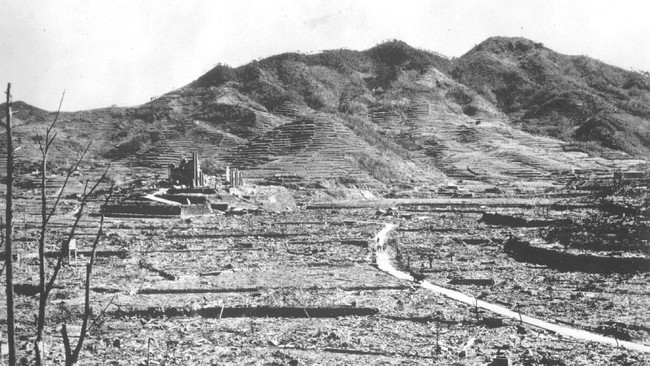
The atomic bomb explosion that devastated Hiroshima on 6 August 1945, exactly 81 years ago today, killed 120,000 people and left millions more seriously ill. Among the victims were three Indonesian students—Sjarif Adil Sagala, Arifin Bey, and Hasan Rahaya—who later became critically ill due to radiation exposure.
The three were recipients of a Japanese government scholarship, Nanpo Tokubetsu Ryogakusei (Nantoku). Historian Aiko Kurasawa, in Sisi Gelap Perang Asia (2023), revealed that the scholarship was created by the Japanese government to attract young Indonesians to study and eventually help build their homeland.
However, on 6 August 1945, everything changed. That morning, the three were going about their usual activities. Arifin Bey was attending a physics lecture when he suddenly saw a flash of light from the window.
“Suddenly, from the direction of the classroom window, a light flashed like lightning. But it brought no sound at all,” Arifin Bey recalled in his memoir Bom Atom di Atas Hiroshima: Suatu Pengalaman Nyata (1986).
A few seconds later, a heat wave struck the classroom. The walls collapsed and Arifin lost consciousness. Elsewhere, Sagala also heard the sound of an aircraft followed by a blinding light. It was later known that the aircraft was the Enola Gay B-29, which dropped the atomic bomb on Hiroshima.
“Suddenly a strange sound was heard and…. sraatt, a sparkling light, powerful and startling!” Sagala recounted in his memoir Suka Duka Pelajar Indonesia di Jepang, Sekitar Perang Pasifik 1942-1945 (1990).
When he regained consciousness, Sagala found his body scorched by the heat of the explosion, while he was still pinned under the rubble of the building. Meanwhile, Arifin saw that Hiroshima had turned into a sea of fire with victims lying everywhere.
“It was as if it were already dusk,” Arifin recalled.
Amid the chaos, Arifin met Hasan Rahaya, who had just managed to pull Sagala from the still-smouldering pile of debris. The three then tried to save themselves. During the rescue, Arifin witnessed many victims suffering horrific burns, with the skin on their hands peeling off.
“Apparently the flash of light had ‘skinned’ the parts of their hands not covered by shirt sleeves, and the skin hung down so that it looked like they were wearing gloves,” he recalled in the memoir Suka Duka Pelajar Indonesia di Jepang, Sekitar Perang Pasifik 1942-1945 (1990).
The horror of Hiroshima was also remembered by survivor Kurihara Meiko, who was rescued by Indonesian students.
“The situation was truly terrible. Near us, bodies were piled up and burning. The smell was strange—like burnt fish,” she told NHK, as quoted on Thursday (6/8/2026).
Although they survived the blast, their suffering was not over. After being evacuated to Tokyo, doctors determined that all three had been exposed to very high levels of radiation. As a result, their white blood cell counts dropped to below 4,000 per microlitre of blood, far below the normal range of 4,000–11,000. Their condition was declared critical. Sagala was even said to have a very small chance of survival.
Doctors eventually admitted they were no longer able to provide treatment. The survivors were asked to sign a statement agreeing not to sue the doctors should anything unfortunate happen.
“The statement was signed and we resigned ourselves to fate,” Arifin Bey recalled in Bom Atom di Atas Hiroshima (1989).
Fortunately, they managed to pull through the critical period after about a week. For the next five years, their health continued to be monitored before they finally returned to Indonesia.
After returning from Japan, Sagala founded Indonesia’s first instant noodle company with the Supermie brand in 1969. Hasan Rahaya became an entrepreneur, while Arifin Bey pursued a career as an academic and diplomat. Today, their names are recorded in history as hibakusha (被爆者), the term for survivors of the Hiroshima atomic bomb blast.
Source: jawawa.id (https://jawawa.id/newsitem/when-three-indonesians-became-victims-of-the-hiroshima-atomic-bomb-burned-skin-and-near-death-1785995639)
Originally published by CNBC Indonesia (https://www.cnbcindonesia.com/entrepreneur/20260806090819-25-756991/saat-3-wni-jadi-korban-bom-atom-di-jepang-kulit-terbakar-nyaris-tewas), translated from Indonesian