
When the Sun Becomes the Energy Source for Lemukutan Island Tourism
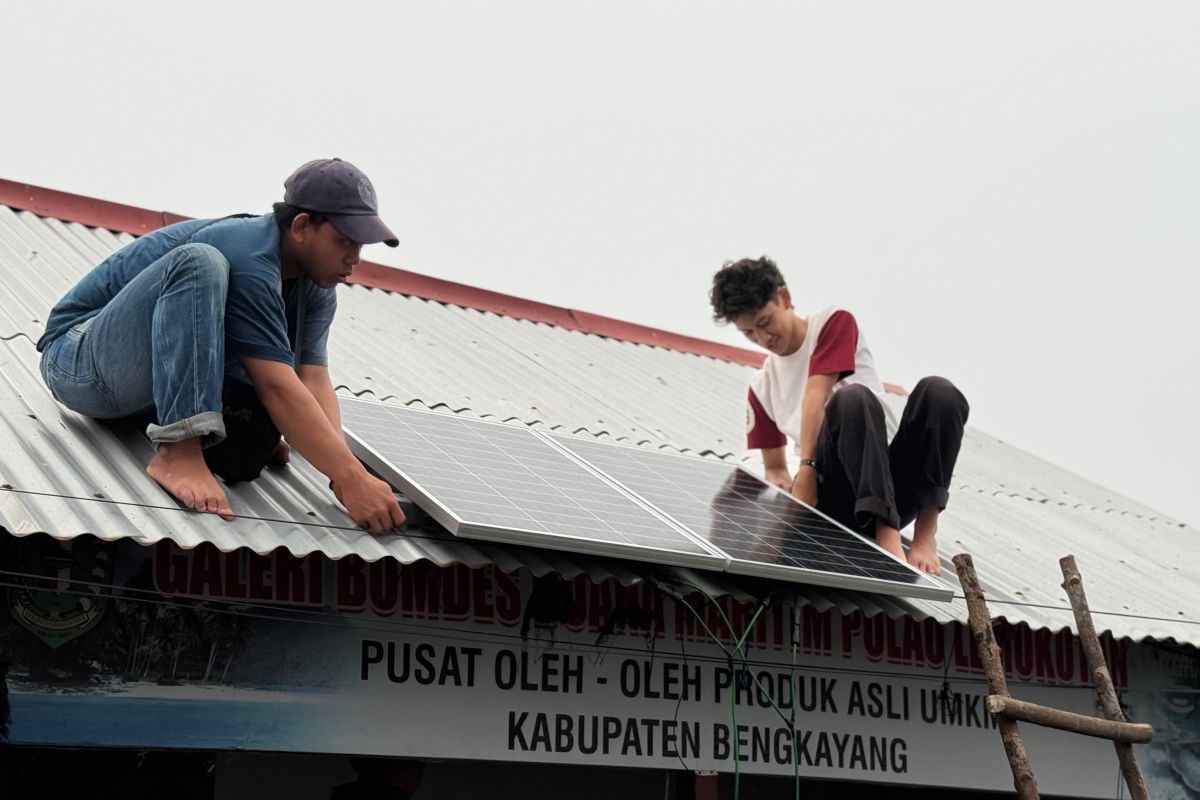
The Solar Charging Station (SCS) at Teluk Cina Pier has become a meeting point between science, solar energy potential, and community needs.
Pontianak (ANTARA) - The sun shining over the waters of Lemukutan Island, Bengkayang Regency, West Kalimantan, now offers more than just scenic views. Its energy is being utilised to provide an essential facility for tourists: a mobile phone charging station.
This solar panel-based Solar Charging Station (SCS) was installed by a Community Service (PKM) team from Sambas State Polytechnic (Poltesa) at the Teluk Cina Pier area, Pulau Lemukutan Village, on Sunday (13/09/2026).
Three lecturers and 10 Poltesa students were directly involved in this activity. They brought renewable energy technology from the campus to the island tourism area, which still experiences limited electricity supply during the day.
The team’s journey began at 04:00 WIB. After transporting the PKM equipment from the Poltes_tes Mechanical Engineering Department workshop, they travelled by road for three hours to Teluk Suak Port, Bengkayang Regency.
Arriving at the port around 07:00 WIB, the group rested briefly and had breakfast before transferring the equipment to a boat. The sea journey to Lemukutan Island continued at 08:30 WIB.
After two hours at sea, the team arrived at Teluk Cina Pier at 10:30 WIB. A warm welcome from the local community greeted their arrival before the group proceeded to their lodgings, located approximately 500 metres from the pier.
Despite the long journey, their task was not yet complete. Towards the afternoon, specifically at 16:00 WIB, the team returned to the pier area to begin the main agenda: assembling and installing the solar-based charging facility.
Solar Energy by the Seaside
Two solar panel units, each with a capacity of 100 Wp, serve as the primary energy source for the SCS. The team first assembled the panel mounts before installing them on the roof of the Teluk Cina Pier registration booth. Subsequently, the panel output cables were connected to a specially designed SCS system for charging mobile phones.
The installation work took place in a spirit of mutual cooperation. Local residents did not merely watch but worked side-by-side to assist the lecturers and students.
During the process, the PKM team provided education regarding the function of each component, the working principles of solar panels, and instructions for the use and maintenance of the facility. Technical terms were simplified to ensure they were easily understood by the community. This step was taken to ensure that residents not only have a new facility but are also capable of managing and maintaining the technology independently. The Q&A session, interspersed with laughter, helped to lighten the atmosphere.
Once all components were installed, the team re-checked every cable connection and conducted a system test. The result showed that the SCS is operating well, with 12 available power sockets ready for mobile phone charging.
The presence of this facility addresses a vital basic need for tourists. During travel, mobile phones are not just communication tools but also means to find information, access digital services, and capture travel moments.
Limited daytime electricity supply often poses a challenge for tourists when their device batteries run out. This is where solar energy provides a solution. Through this technology, the abundance of sunlight during the day is converted into electrical energy to support the power needs of visiting electronic devices.
From Technology to Self-Sufficiency
At 20:00 WIB, the activities continued with a ceremonial event and PKM training at the Long Peri Guesthouse Hall. The event was attended by the PKM team, the Head of Pulau Lemukutan Village, Ahmad Yusuf, and the Anak Remaja Teluk Cina Tourism Awareness Group (Pokdarwis) as activity partners.
Representing the PKM team, Iman Syahrizal, S.T., M.T., stated that community service is part of the ‘Tri Dharma Perguruan Tinggi’ (Three Pillars of Higher Education) that lecturers must perform alongside education and research. The activity was funded through an internal grant from Sambas State Polytechnic under the 2026 Community Science and Technology Application Program.
Iman expressed hope that the installed facility would be utilised optimally by both residents and tourists, and maintained collectively for long-term durability.
The Head of Pulau Lemukutan Village, Ahmad Yusuf, warmly welcomed the implementation of this technology. According to him, the solar-based charging facility is highly beneficial given that limited daytime electricity supply remains a constraint for both residents and tourists.
Ahmad Yusuf also hopes that the collaboration with Poltesa will continue. The partnership between higher education institutions and the community is seen as capable of helping resolve various challenges on Lemukutan Island, ranging from the plantation, food, energy, and fisheries sectors to the development of tourism based on the ‘Sapta Pesona’ (Seven Charms) principle.
Learning to Maintain, Learning to Develop
Training was a crucial part of this series of activities. The PKM team leader and speaker, Pande Putu Agus Santoso, S.Pd., M.Sc., provided technical briefing on the main components of the SCS, the function of each part, the working principles of solar panels, and the procedures for assembling a solar-based charging system.
PKM partners also gained a deep understanding of usage procedures, routine maintenance, system inspections, and initial troubleshooting steps for technical disruptions. Enthusiasm was evident among the members of the Anak Remaja Telting Cina Pokdarwis, where discussion sessions expanded to discuss the potential for developing similar technology independently.
Some Pokdarwis members expressed a desire to install Solar Charging Stations in the guesthouses they manage, provided they have sufficient capital in the future.