
When the Student Movement Becomes a 'New Class'
This article is a personal opinion and does not reflect the views of CNBC Indonesia’s editorial team.
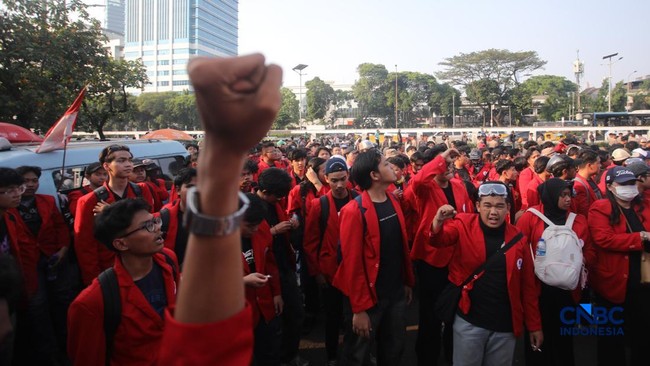
This piece arises from unease over two recent public incidents. First, the forced dispersal of a discussion at the Gadjah Mada University (UGM) Innovation and Creativity Centre on 15 June 2026, where a forum featuring three state officials ended in chaos. Second, a series of clashes between students and online motorcycle taxi drivers in Makassar, including at the Muslim University of Indonesia campus, which police say were triggered by prolonged road closures during a student protest, provoking drivers to enter the campus area and confront the students.
Though different in context, both events leave a fundamental question: whose interests does the student movement truly serve today, and to what extent do its chosen methods still connect with the interests of the ordinary people it purports to defend?
The UGM incident sparked debate about the ethics of engaging with state officials, while the Makassar clashes revealed a direct conflict of interest between student activists and informal grassroots workers—motorcycle taxi drivers who depend on the roads for their daily livelihood. It is here that the relevance of revisiting Milovan Djilas’s critique of the ‘new class’ phenomenon becomes apparent.
Whenever Indonesia enters a crucial period, the student movement has always been present as a moral force balancing power. Students are often, and rightly should be, the voice of the voiceless, representing those who cannot speak for themselves. Two student movements that profoundly impacted Indonesian statehood were those of 1966 and 1998.
Yet there is a question we rarely ask honestly: is today’s student movement still connected to its social roots—the urban poor, farmers, labourers, and other marginalised groups?
This question recalls Milovan Djilas’s framework in his book, The New Class. Djilas criticised how communist parties, which initially claimed to represent the proletariat, ultimately formed a new class: an elite group controlling access to power, resources, and privileges, while continuing to use the jargon of people’s struggle as legitimacy. This new class, according to Djilas, is defined not by capital ownership as in classical class analysis, but by control over power and political access.
Symptoms of a New Class within the Student Movement
A similar phenomenon, in a different context, is occurring within parts of Indonesia’s student movement. There is a trend where activism becomes a career ladder: from student executive body chairperson, to extra-campus organisation activist, then leaping to positions as special staffers, state-owned enterprise commissioners, or legislative seats, without ever retracing the issues they once championed on the streets.
Discourses on social justice, agrarian reform, living wages, or labour rights often remain mere rhetoric in speeches and study sessions, rarely tested through genuine, sustained engagement with the subjects of the struggle. Students speak on behalf of farmers without ever living long in villages displaced by national strategic projects. They speak on behalf of workers without ever accompanying exhausting and intimidating wage negotiation processes. They speak on behalf of the urban poor without ever truly understanding the survival logic of dense settlements under constant threat of eviction.
When this gap widens, the student movement risks morphing into a ‘new class’ in Djilas’s terminology: a group that accumulates symbolic capital and political access from grassroots issues, yet gradually detaches itself from the real interests of those very people. What remains is jargon, not a structural and emotional bond with those who grapple daily with poverty and injustice.
Honestly, I see today’s student movement as trapped in a romanticism of repeating the feats of their seniors involved in the 1998 and 1966 movements. Yet current conditions are vastly different from what was faced then.
The 1966 and 1998 Movements and Gramsci’s Organic Intellectual
To understand why grassroots connection is so vital for a healthy democracy, we turn to Antonio Gramsci’s concept of the organic intellectual. In notes written while imprisoned by Mussolini’s fascist regime, Gramsci distinguished between two types of intellectuals: traditional intellectuals, who stand outside social class structures and claim neutrality or universality, and organic intellectuals, who grow from within a particular social class and function to directly articulate that class’s interests, consciousness, and aspirations.
For Gramsci, the true strength of a social change movement is determined not by the brilliance of its ideas alone, but by how deeply the movement is rooted in and trusted by the class it represents. An organic intellectual does not merely speak on behalf of workers or farmers from a podium, but grows alongside them, understands their lived experiences, and builds what Gramsci called a counter-hegemony—a new collective consciousness born from that collective experience itself, not from theories imported wholesale from outside.
This framework explains why authentic people’s movements tend to be more capable of fostering a healthy democracy than movements driven by a handful of educated elites who speak in the name of the people without any structural bond to them. A strong democracy requires a conscious and organised social base, not merely a vocal elite.